
At a Glance
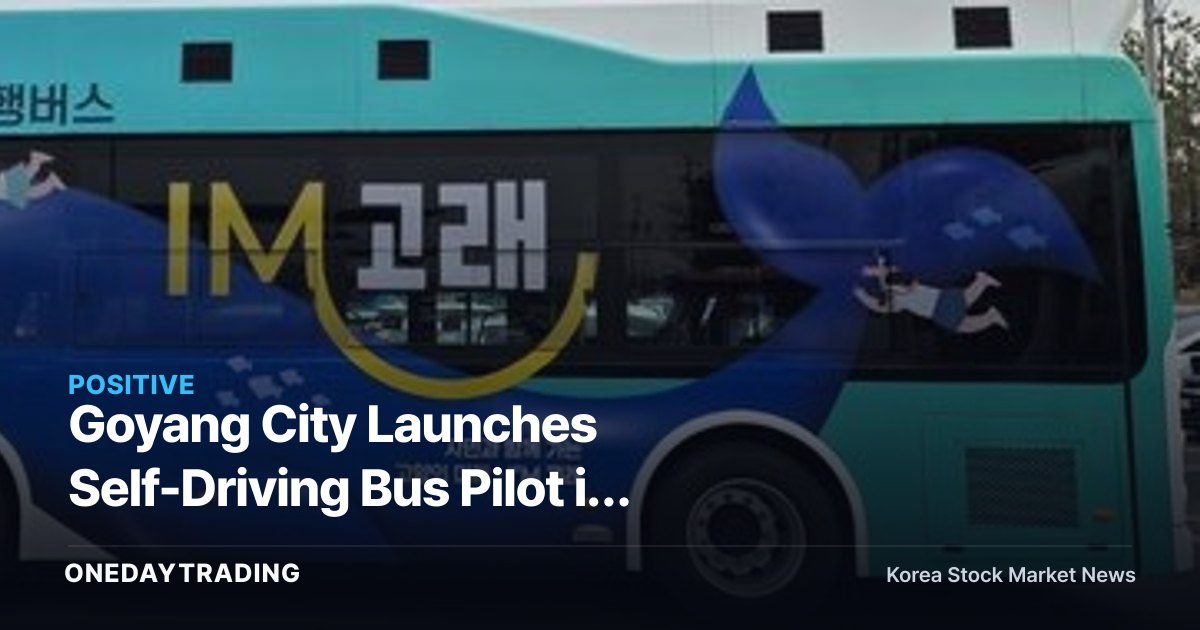
Goyang City in Gyeonggi Province has begun a pilot operation of a 19-seat self-driving bus across the Ilsanseo-gu area from June 15 through the 14th of next month. With autonomous-driving field trials led by local governments steadily spreading nationwide, this reads as a mid- to long-term demand signal for domestic listed companies in the self-driving component and software space.
Why It Matters Now
Autonomous driving is no longer a technology confined to the lab — it is entering the stage of carrying actual passengers on real roads. When field trials in which citizens ride directly are conducted in densely populated new-town areas like Goyang, the effort accumulates not only technical validation but also public acceptance and operational data. This lays the groundwork for future regular-route adoption and large-scale orders.
In particular, demand-responsive transit using small and mid-sized buses is drawing attention as a practical alternative for filling gaps in public transportation. If the government and local authorities continue to expand autonomous-driving pilot zones and allocate budgets, earnings visibility could gradually improve for companies dealing in sensors such as lidar and cameras, automotive semiconductors, and control software.
That said, this project is a short-term, one-month field trial, and no specific listed company is front and center. It is therefore more reasonable to view it as an event confirming the policy momentum across the broader autonomous-driving theme rather than a source of immediate revenue.
Frequently Asked Questions
- Will this pilot operation translate directly into earnings — As it is a short-term field-trial stage, its character leans toward accumulating references for expanding future orders rather than generating immediate large-scale revenue.
- What technologies are key — Perception sensors such as lidar and cameras, automotive semiconductors, and software that remotely controls vehicles form the core pillars.
- Why is autonomous driving being introduced on buses first — Fixed routes and low-speed operation involve fewer variables, and the strong public-service value of filling public-transport gaps makes buses favorable for field trials.
- What should retail investors watch for — Rather than one-off positive catalysts, it is important to track policy continuity such as the expansion of pilot zones and budget increases.
Related Stocks & Sector Impact
- Automakers & Mobility — As the core pillar directly supplying autonomous-driving platforms and vehicles, this group serves as the theme's sector bellwether.
- Vehicle Software & Control — Direct beneficiaries are expected from rising demand for autonomous-driving operating systems and integrated control solutions.
- Autonomous Driving Components — Companies supplying lidar and camera modules and communication parts are affected by the spread of field trials.
- Automotive Semiconductors — Demand for chips handling perception and decision-making computation could grow alongside the adoption of autonomous driving.
- Automotive Electronics & Infotainment — Additional demand may arise from the advancement of in-vehicle electronic systems.
Points to Note When Investing
- This project is a one-month short-term field trial, and overinterpreting it as a short-term share-price catalyst is risky.
- The autonomous-driving theme is sensitive to policy and expectations, making it highly volatile and prone to diverging from earnings.
- Since no specific listed company is named, separating winners from losers is necessary when trading on the theme.
- Depending on the timing of commercialization and the pace of regulatory development, profit realization could be delayed more than expected.
Overall Outlook
In an optimistic scenario, as municipal autonomous-driving field trials spread nationwide and are followed by conversion to regular routes and budget expansion, orders and earnings for companies across the sensor, semiconductor, and software value chain could improve in stages. Conversely, if the effort remains a short-term trial or commercialization is delayed by safety and regulatory issues, there is also a persistent risk that theme-driven expectations could cool quickly. In conclusion, this news is a positive signal that reaffirms the direction of the autonomous-driving industry, but at the individual-stock level it calls for a cautious approach that checks both earnings visibility and policy continuity.
This article is content automatically summarized and analyzed based on the original news. View Original (Yonhap News, Industry)