
Key Takeaways
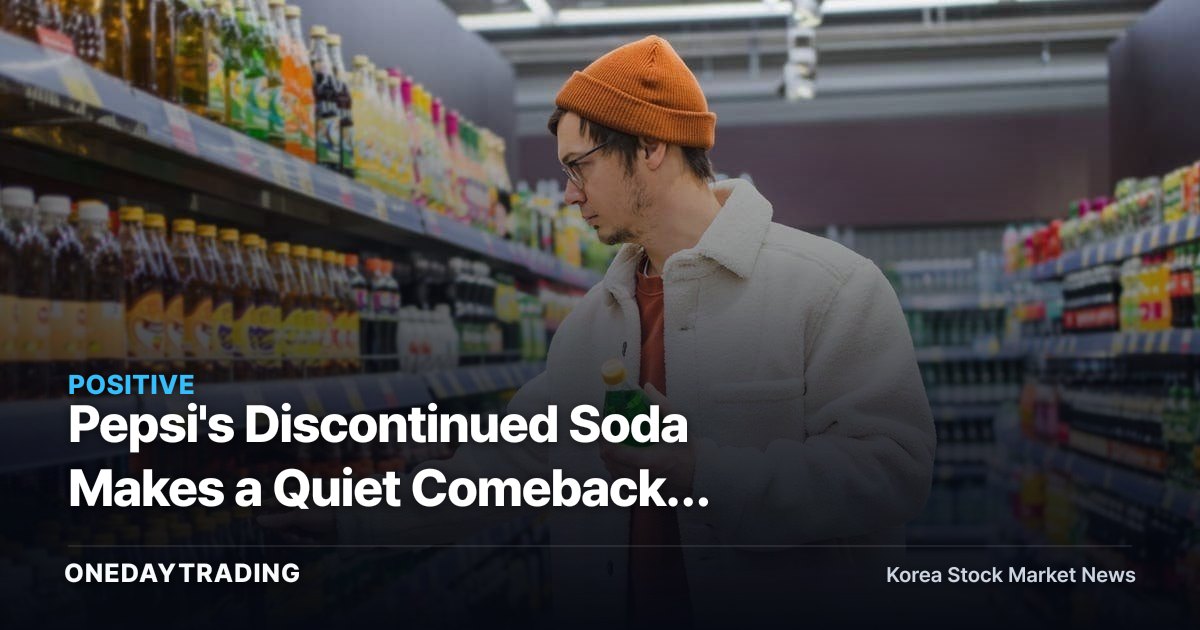
PepsiCo has quietly returned a carbonated-drink brand it once discontinued to store shelves, with little fanfare. The revival of a single product is not large enough on its own to move earnings, but it deserves to be read as a strategic signal: an attempt to use nostalgia marketing to generate buzz and secure new shelf space in a stagnant carbonated category.
From an investor's standpoint, the key issue is not any single brand but how PepsiCo responds to slowing North American beverage demand—and how that ripples through to its Korean bottler, Lotte Chilsung Beverage.
What Happened
According to reports, PepsiCo has brought a carbonated-drink brand it had once pulled from the market back into select distribution channels. Quietly placing it on shelves without a major advertising push is a classic revival tactic—first testing consumer response through a limited, trial-style rollout.
Rather than a one-off event, this move qualifies as low-cost marketing that aims to stir nostalgia among existing loyal customers while capturing both social-media word-of-mouth and additional shelf placement. Reviving a discontinued brand that already enjoys name recognition can pay back faster relative to marketing spend than building a new product from scratch.
Background and Context
In the North American carbonated-drink market, growth in traditional soda has slowed amid health trends, the shift to zero-sugar, and the rise of energy drinks. PepsiCo is a company with a large snack business—Frito-Lay and Quaker—in addition to beverages, and its beverage segment faces simultaneous exposure to shelf competition with Coca-Cola and category competition with energy drinks such as Monster and Red Bull.
In Korea, Lotte Chilsung Beverage serves as the bottler responsible for producing and distributing Pepsi products, a structure in which the global brand strategy is reflected in the domestic lineup and marketing with a time lag. As a result, whether the parent company's revival push eventually leads to a domestic launch is a separate point of interest for Korean investors.
Impact on the Market and Stocks
- PepsiCo (PEP): The direct player. That said, reviving a single brand accounts for a small share of total revenue, so it is less a catalyst capable of lifting the share price than a qualitative signal of intent to restore vitality in the beverage segment.
- Coca-Cola (KO): A direct rival. If Pepsi captures shelf space and buzz through nostalgia marketing, competition for shelf occupancy could intensify, making it a relative pressure point within the same category.
- Lotte Chilsung Beverage: The domestic Pepsi bottler. If the parent's lineup expansion translates into a domestic launch and promotion, a new-product boost could be expected; conversely, input-cost pressure from raw sugar and aluminum, along with domestic beverage competition, are variables to watch.
- Monster Beverage (MNST): A benchmark for gauging shifts in consumer interest across the carbonated category. Whether the revival of a traditional soda succeeds serves, in reverse, as an indicator of how quickly demand is migrating toward energy and functional drinks.
Investor Checkpoints
- In PepsiCo's next earnings release, check revenue and volume changes in the North American beverage segment, along with price/mix effects.
- Track—through follow-up reports and distribution trends—whether the revived brand expands beyond trial channels to nationwide shelf placement, that is, whether the response translates into actual sales.
- In quarterly earnings, examine Lotte Chilsung Beverage's beverage-segment revenue, whether new Pepsi-related products are launched, and the trend in input costs (raw sugar and aluminum cans).
- Also watch how shelf occupancy versus Coca-Cola and the trajectory of marketing spend affect beverage-segment margins.
Outlook
The positive scenario is one in which low-cost nostalgia marketing generates buzz and draws loyal customers back, adding small momentum to the beverage segment, and the same strategy spreads to the domestic bottler. A further strength is that because it reuses a proven brand asset, the cost of failure is limited.
On the other hand, it is hard to overlook that the brand was discontinued for a reason—namely, a real limit to demand. If repeat purchases fail to back up the initial buzz, it could end as a one-off event, and given PepsiCo's current valuation and the structural slowdown across the beverage category, it is a stretch to expect this revival alone to reverse the trend. Ultimately, until it is confirmed by actual sales data and the beverage-segment figures in the next earnings report, it is safer not to read this as anything more than a marketing signal.
This article is auto-summarized and analyzed content based on the original news report. View original (Yahoo Finance)