
Key Takeaways
Last month, foreign tourists spent roughly 250 billion won at domestic pharmacies and in the medical sector — an all-time high. Demand for so-called K-pharma products, centered on over-the-counter (OTC) medicines, has become a new spending category as it converges with the recovery in inbound tourism.
As familiar OTC products such as topical ointments, digestive aids, and nutritional supplements have emerged as must-buy items for tourists, market attention is turning to the potential for related pharmaceutical companies, pharmacy distribution, and the duty-free and tourism sectors to benefit together.
What Happened
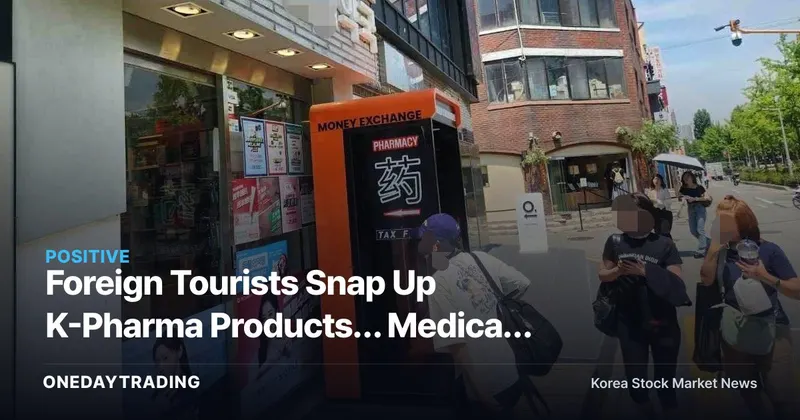
At pharmacies in areas crowded with foreign visitors, such as Hongdae Station, foreign-language signage and display stands featuring popular items have appeared. Skin ointments like Madecassol, digestive aids like Kasal Whal Myung Su, and multivitamin supplements have gone viral on social media as must-buy items for trips to Korea, becoming fast-turnover products.
Foreign medical and pharmacy spending reaching 250 billion won last month — a record high — shows that foreign shopping expenditure, once concentrated on cosmetics and fashion, is expanding into pharmaceuticals and healthcare. Even though unit prices are not high, the pattern of buying many items at once in bulk is driving up revenue scale.
The rise in OTC purchases alongside traditional Korean medicine and aesthetic medical services is interpreted as a signal that the trust in Korean products built through K-content is translating into actual spending.
Background and Context
As the number of foreign tourists has recovered rapidly since COVID-19, inbound consumption overall is reviving. On top of this, a structure of repeat purchasing has taken shape, with Korean OTC medicines perceived among Japanese, Chinese, and Southeast Asian tourists as good-value souvenirs that double as everyday necessities.
For pharmaceutical companies, OTC medicines are a high-margin area sold directly to consumers, independent of prescriptions and insurance. Added foreign demand can help offset the limits of the domestic market and serve as a springboard for expanding brand awareness overseas.
Impact on the Market and Stocks
- OTC leaders: Traditional pharmaceutical companies holding tourist-favored items such as ointments (Madecassol, Fucidin) and digestive aids and painkillers can expect an improved revenue mix.
- Health functional foods and supplements: Potential for expanded tourist demand at pharmaceutical and healthcare companies producing multivitamins and nutritional supplements.
- Pharmacy distribution and health & beauty: Higher average spending per customer at pharmacies in tourist districts and at drugstore-type distribution channels.
- Duty-free, tourism, and travel/leisure: Duty-free shops, hotels, and travel-related stocks tied to the inbound recovery benefit together.
- Cosmetics and beauty: Synergy with the beauty industry sector as pharmaceutical purchases extend into dermo-cosmetic spending.
Investor Checklist
- Check whether foreign-driven revenue is a one-off event or a structural trend that is steadily reflected in quarterly earnings.
- Note that the higher a company's OTC weighting and margins, the greater the strength of the benefit.
- The direction of variables that drive inbound spending — tourist numbers, exchange rate, and duty-free policy.
- Distinguish whether earnings releases separately disclose overseas and foreign-tourist revenue, or whether it is merely expectation-driven sentiment.
Outlook
In the optimistic scenario, trust in K-content and K-pharma combines so that foreign healthcare spending becomes structurally established, lifting the earnings and valuations of related pharmaceutical, distribution, and tourism stocks together. On the other hand, tourist spending is sensitive to the exchange rate, the economy, and geopolitical variables, making it highly volatile; and at the individual stock level, the share of foreign OTC revenue relative to total earnings may still be limited — which is a risk. Investors need to soberly assess whether share prices have already priced in the expectations.
This article is auto-summarized and analyzed content based on the original news report. View original (Yonhap News)