
At a Glance
The first downward revision since the price cap was introduced is a double-edged event: it pressures refinery and gas station margins while acting as a buffer for airlines, logistics companies, and broader consumption — sectors where fuel costs represent a significant share of expenses. The key structural point is that even under the same oil price trend, the earnings trajectory diverges between refiners subject to direct price controls and demand-side industries benefiting from cost relief.
Why It Matters Now
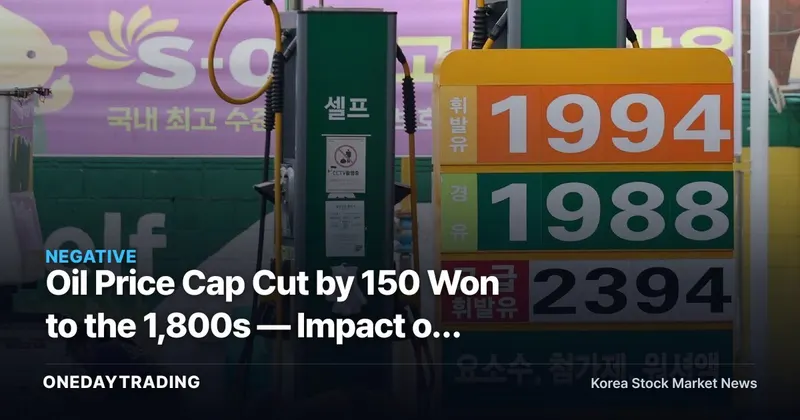
Effective from midnight on the 27th, the government has officially set the 7th oil price ceiling 150 won per liter lower — gasoline at 1,784 won and diesel at 1,773 won. As the first reduction in 106 days since the policy's introduction, this signals to the market that the price cap is not a one-way freeze but can move in both directions in response to wholesale prices and international crude trends.
The price ceiling sets an upper limit on the selling price that refiners and gas stations may charge. When the ceiling falls, unless international refining margins or procurement costs drop equally fast, the refining and distribution margins of businesses caught within the controlled price band are directly compressed. Conversely, since gasoline and diesel are key variable costs for airlines, logistics, and transportation, lower fuel prices reduce operating costs for those industry sectors and improve their earnings.
The 2–3 week lag before retail pump prices fully reflect the new ceiling is also significant. Because of inventory turnover and distribution chain timing, the moment consumers feel the effect and the moment it appears in corporate earnings diverge — leaving room for short-term stock prices to overreact to the policy announcement and then re-adjust once actual price and margin data become available.
Frequently Asked Questions
- Why is this a burden on refinery stocks? When the ceiling on selling prices falls, revenue per unit is capped lower, while crude procurement costs do not drop by the same magnitude immediately — meaning refining and distribution spreads may narrow within the price-controlled range.
- Is this a negative catalyst for every industry sector? No. Airlines, shipping, and ground transportation, which carry high fuel cost ratios, benefit from cost savings, and an improvement in household real purchasing power may be favorable for consumer-related stocks.
- When will this show up in earnings? With a 2–3 week lag before gas station prices adjust, the impact will be visible with a delay in quarterly earnings and monthly refining margin statistics.
- Will further cuts follow? As this is the first downward revision after 106 days, the direction of the next official announcement will depend on international crude prices, refining margins, and exchange rate trends — making it difficult to call at this stage.
Related Stock (Ticker) and Industry Sector Impact
- Refining (S-Oil · SK Innovation · GS) A lower ceiling on domestic selling prices may compress distribution margins in the short term. However, since export exposure and refining margins are larger variables, international market conditions could offset the impact.
- Airlines (Korean Air · Jeju Air) Fuel costs represent a large share of operating expenses, so a decline in fuel prices feeds through to improved operating profit margins.
- Ground and Maritime Transport Lower diesel prices reduce freight and logistics costs, improving profitability across the transportation industry sector.
- Consumer and Retail If relief on fuel costs preserves household disposable income, it could serve as an indirect positive catalyst for domestic consumption-related stocks.
Key Investment Considerations
- International crude prices, refining margins, and exchange rates are larger drivers of refiner earnings than the magnitude of the price cap cut — making it difficult to draw a definitive directional call from price controls alone.
- The 2–3 week gas station pricing lag may create a disconnect between stock prices immediately after the policy announcement and actual earnings results.
- For airlines and transportation, passenger and cargo demand and freight rates drive earnings alongside fuel costs — do not base a judgment on a single cost variable alone.
- The next official announcement could reverse course with an upward revision, making it risky to interpret a one-off reduction as the beginning of a sustained trend.
Overall Outlook
In the optimistic scenario, lower fuel costs reduce expenses for airlines and transportation while supporting household consumption, acting as a buffer for domestic demand broadly. Refining, by contrast, faces a headwind from compressed domestic distribution margins — though if export refining margins and exchange rates remain favorable, the impact may be limited. The indicators to watch are: the direction of the next oil price ceiling announcement, Singapore complex refining margins, the won/dollar exchange rate level, and airline fuel cost per unit in the next quarter. The alignment between the policy variable of price controls and the market variable of international conditions will determine how earnings diverge across industry sectors.
S-Oil Through the Lens of Real-Time Data
S-Oil's most recent closing price was 93,200 won (−5.09% vs. the prior day). The signal composite — incorporating foreign investor and institutional investor supply-demand (order flow) alongside news and momentum — reads 🟡 neutral · wait-and-see. Positive and negative signals are mixed, suggesting a period of observation is warranted.
- ▲ Supply-Demand (Order Flow) Continuity — Foreign investors have net-bought for 11 consecutive sessions (+16.9 billion won)
- ▼ Trend Alignment — Short- and medium-term downtrend aligned (day: −5.1% · 1 week: −11.3% · 1 month: −15.3%)
- ▲ News Flow — Positive catalysts 8 vs. negative catalysts 2 — positive catalyst lead
Recent related news shows 8 positive catalyst items and 2 negative catalyst items — a favorable tilt.
※ Price and foreign investor/institutional investor supply-demand (order flow) data are provided by Korea Investment & Securities (KIS) and reflect the time of publication.
This content was automatically summarized and analyzed based on the original news article. Read original article (Maeil Business News)