
At a Glance
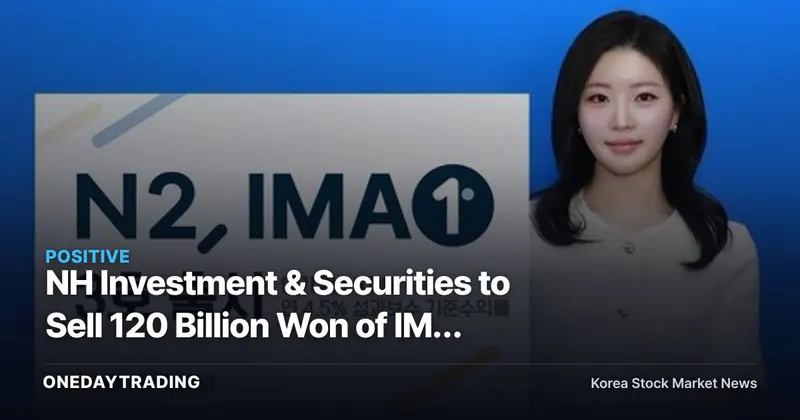
NH Investment & Securities will sell its third integrated management account (IMA) product, N2 IMA1 No. 3, from the 18th to the 24th. The benchmark return is 4.5% annually, with a subscription size of 120 billion won. Because IMA is an account-based business that only a handful of financial-authority-licensed mega investment banks can offer, this launch should be viewed not simply as a new product sale but as a phase in the expansion of brokerages' balance-sheet-based earnings model.
Why It Matters Now
Taken at face value, a 4.5% annual account looks little different from a deposit or a promissory note. But IMA is structurally distinct. An integrated management account is a licensed business available only to mega investment banks that meet capital requirements and receive regulatory approval; the brokerage invests client funds across a broad range of assets — loans, corporate finance, securities — and pays a pre-agreed benchmark return in exchange. Where promissory notes are closer to short-term funding instruments, IMA covers a wider range of investable assets and is designed with more flexible maturities, making it a business through which brokerages seek spread income akin to a deposit-loan margin.
What the market should really focus on is that this is the third such sale. If it had been a one-off, it would be event-driven marketing; but the fact that the N2 IMA1 series is being sold repeatedly signals continuing demand and shows NH Investment & Securities establishing this business as a regular channel for interest and investment income. At a time when deposit rates and MMF yields are falling, a fixed 4.5% return is well positioned to absorb funds seeking alternative investments, which could translate into balance-sheet expansion and growing investment-asset income for the brokerage.
Still, the counter-scenario deserves attention. The 4.5% benchmark return is not principal-protected under the Depositor Protection Act — it is a commitment backed by the brokerage's own credit, meaning credit risk is passed directly to investors. Also, at 120 billion won, the subscription size is not large relative to NH Investment & Securities' overall investment assets or capital base, so this single sale is unlikely to have an immediate impact on earnings. A further variable is that if the benchmark interest rate falls further, the spread between the funding-side benchmark return and actual investment performance could narrow.
Frequently Asked Questions
- What is an IMA (integrated management account)?: It is an account-based product in which a financial-authority-licensed mega investment bank invests client deposits across loans, corporate finance, securities, and other assets, paying an agreed benchmark return.
- Is the principal guaranteed?: No — it is not covered by the Depositor Protection Act, and payment capacity depends on the issuing brokerage's credit standing and investment performance.
- How does it differ from a promissory note?: Promissory notes are a relatively short-term, standardized funding tool, whereas IMA covers a broader range of investable assets and is designed with more flexible maturity structures.
- Which brokerages can offer it?: It is limited to a small number of mega investment banks that meet capital and other requirements and receive regulatory approval.
Related Stocks and Sector Impact
- NH Investment & Securities: As the issuer of N2 IMA1 No. 3, continued sales expand its interest- and investment-income-based revenue base.
- Korea Investment & Securities (Korea Investment Holdings): A mega investment bank also licensed to offer IMA, serving as a comparison point in the competitive landscape for similar products.
- Mirae Asset Securities: A competitor holding a mega investment bank license, whose pace of balance-sheet-based business expansion invites comparison.
- KB Securities (KB Financial Group): A competitor operating IMA and promissory-note-type businesses in synergy with its parent financial group.
- Samsung Securities: A candidate meeting the requirements for a mega investment bank license, drawing attention for whether it expands into this business.
Investment Considerations
- Investors should confirm that the benchmark return does not mean a guaranteed fixed payout and is not covered by depositor protection.
- The issuing brokerage's credit rating and financial soundness determine its capacity to pay.
- The impact of the success of this 120-billion-won sale on NH Investment & Securities' earnings may be limited.
- During a period of falling benchmark interest rates, the funding-investment spread could narrow, so it is worth watching how the benchmark return conditions of subsequent products change.
Overall Outlook
On the optimistic side, as the IMA business becomes more established, large brokerages stand to secure stable spread income akin to a deposit-loan margin, building the case for diversifying interest and investment income. On the other hand, the business is still at an early stage, and the spread between funding costs and investment-asset performance could swing with the interest-rate cycle, while the structure of passing credit risk on to investors remains a live risk. The indicators to watch next are whether N2 IMA1 No. 3 completes its subscription as planned, the contribution of investment income revealed in NH Investment & Securities' quarterly earnings, and the extent to which the benchmark return on subsequent IMA products is adjusted following future benchmark interest rate decisions.
NH Investment & Securities: Real-Time Data Snapshot
NH Investment & Securities's most recent closing price was 28,450 won (+0.35% versus the previous day), and the signal combining foreign/institutional supply-demand (order flow) with news and momentum reads 🟢 Buy-leaning. Positive foreign investor flows and momentum make this stock (ticker) worth watching.
- ▲ Supply-Demand (Order Flow) Continuity — Foreign investors net buying for 8 consecutive days (+1.8 billion won)
※ Price and foreign/institutional supply-demand (order flow) data are provided by Korea Investment & Securities (KIS) as of the time of publication.
This article was automatically summarized and analyzed based on the original news report. View original (Yonhap News Securities)