
Key Takeaways
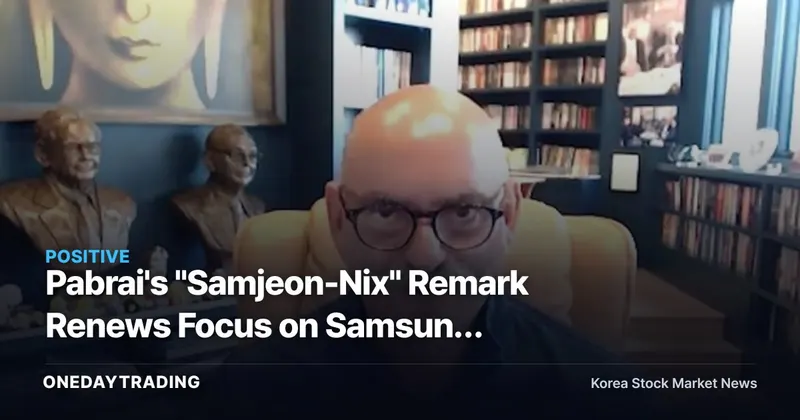
Renowned value investor Mohnish Pabrai cited Samsung Electronics and SK Hynix — the pair known together as "Samjeon-Nix" — as stocks (tickers) that should have been held for the long term, underscoring the structural strength of the memory-chip industry. This reads less as a simple stock pick than as an assessment of the entry barriers and cash-flow structure of a memory industry dominated by a handful of oligopolistic players. For investors, the key question becomes how to reflect the HBM cycle and DRAM price trend in their own portfolios.
What Happened
Pabrai, a value investor reported to manage assets of roughly 1.8 trillion won, praised the dominant competitiveness of Samsung Electronics and SK Hynix, suggesting that once an investor owned these names they should not have sold them easily. He pointed to the inherent robustness of the memory-chip industry itself as his rationale.
The implication of this remark lies in the industry structure rather than the individual stocks (tickers). The DRAM and NAND markets are effectively an oligopoly in which a small number of companies control supply, new entry is difficult, and capital-expenditure requirements are enormous. From a value-investing perspective, such an industry can be read as forming a moat that competitors cannot easily breach.
Background and Context
The recent memory cycle has been recovering, led by HBM (high-bandwidth memory), on the back of expanding AI-server demand. SK Hynix has secured a leading position in the HBM market, while Samsung Electronics is accelerating its response and maintains a broad portfolio spanning conventional DRAM and NAND. Recalling how both companies' share prices swung sharply during past downcycles when memory prices saw a sharp drop (plunge), the message can also be read as a call to separate the industry's cyclical sensitivity from its long-term competitiveness.
Impact on the Market and Stocks
- Samsung Electronics: With an integrated memory business spanning DRAM, NAND and HBM alongside its foundry operations, it offers significant earnings leverage when the memory cycle recovers. That said, the pace at which it secures HBM customers is the variable that will drive share-price momentum.
- SK Hynix: With a high share of revenue from HBM, it is structured to benefit directly from expanding AI data-center investment. Because end demand translates almost immediately into earnings, it reacts most sensitively to the AI investment cycle.
- Semiconductor materials and equipment stocks: If expanded memory capital expenditure continues, the trickle-down effect could spread to suppliers of front-end and back-end process equipment and materials.
- KOSPI index: Because the two stocks (tickers) carry an overwhelming weight in market capitalization, the direction of the memory cycle has a direct bearing on the overall index trend and foreign investors' order flow.
Investor Checkpoints
- In quarterly earnings releases, check the share of HBM revenue and the trend in DRAM average selling price (ASP).
- The AI data-center capital-expenditure guidance from North American Big Tech is a leading indicator of memory end demand.
- Track whether companies disclose HBM supply qualification and mass-production schedules by customer.
- Assess whether current share prices have already priced in much of the cyclical recovery, and check the valuation level relative to past cycles.
Outlook
If AI demand persists and memory supply remains disciplined, an optimistic case can be made that the two companies' earnings power may behave differently than in past downcycles. Conversely, it would be a mistake to forget that memory is inherently a cyclical industry. A slowdown in the pace of AI investment, swings in commodity DRAM prices, the exchange rate, and price competition from rivals entering the HBM market are all downside variables. It is more reasonable to approach the assessment of long-term competitiveness and the volatility of short-term share prices as separate matters.
Samsung Electronics by Real-Time Data
Samsung Electronics recently posted a closing price of 340,500 won (+9.84% from the previous day), and the signal light combining foreign investors' and institutional investors' order flow with news and momentum is 🟡 Neutral / Wait-and-See. With positive and negative signals mixed, this is a zone to watch.
- ▼ Order-flow continuity — Foreign investors net sellers for 4 consecutive days (−18.19 billion won)
- ▲ 52-week position — 89% toward the 52-week high — new-high territory
Recent related news skews favorable, with 22 positive catalysts and 18 negative catalysts.
※ Price and foreign/institutional order-flow data are provided by Korea Investment & Securities (KIS) and are as of the time of publication.
This article is auto-summarized and analyzed content based on the original news. View original (Maeil Business Newspaper — Corporate)