
Summary
The KOSPI's break above 9,000 is not merely a new index record — it is a signal of where capital inside the market is being funneled. The fact that idle investment cash and borrowed investment funds are rising at the same time is favorable for the brokerage industry sector, whose revenues are directly tied to trading value and margin interest income. Yet it is also a textbook symptom of a market overheating in a single direction. In other words, the risk of expanding volatility is growing inside the shell of a positive catalyst.
What Happened
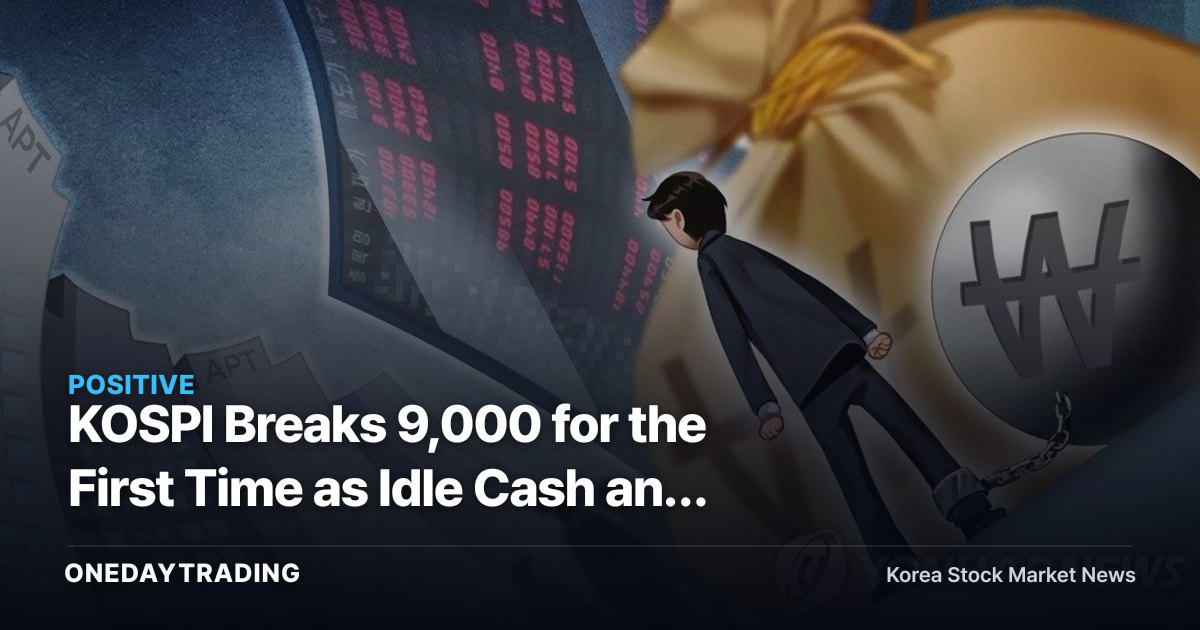
On the 18th, the KOSPI closed above 9,000 for the first time ever on a closing-price basis, ushering in what is being called the "9,000-point era." What the market focused on was not the index level itself, but the fact that, amid expectations of further gains, sidelined market cash and margin debt increased side by side.
Sidelined market cash is typically measured by investor deposits and has the character of "live ammunition" that can be mobilized for buying at any moment. The fact that this cash has grown suggests that demand to enter the market has not cooled despite the burden of the elevated index. Margin debt — that is, the rising balance of credit-financed buying — means that leveraged purchases beyond one's own capital have expanded, indicating that both the intensity of bullish bets and risk appetite have risen together.
When these two pools of money move in the same direction, the market gains strong upward momentum in the short term, but the structural vulnerability also grows whereby forced liquidations of margin positions amplify declines during a correction.
Structural Background
The simultaneous increase in idle cash and margin balances is a pattern that recurs in low-rate, ample-liquidity environments or whenever there is a strong concentration into specific market leaders. The more convinced investors become of further gains, the more they reduce their cash holdings and build up leverage — and in this process, the market's overall risk exposure accumulates faster than the index's rate of advance.
From a brokerage's standpoint, rising trading value boosts brokerage commissions while a growing margin balance increases interest income, so both are positive for earnings. However, this revenue structure only holds when trading is active and credit positions are maintained; in phases of shrinking trading or surging forced liquidations, both profitability and financial soundness can wobble at once.
Stock and Sector Impact
- Brokerage stocks (Kiwoom Securities, Mirae Asset Securities, etc.): The increase in trading value and margin loan balances lifts both brokerage commissions and interest income simultaneously, making this the most direct beneficiary sector. In particular, the larger a brokerage's retail-investor share, the greater its interest-margin benefit from expanding margin debt.
- Samsung Securities, NH Investment & Securities, Korea Investment Holdings: With both wealth-management and IB divisions, they enjoy substantial profit leverage during a trading boom, but they are also exposed to swings in trading/proprietary income when market volatility widens.
- Index-linked products and ETFs: Entry into the 9,000-point range may increase fund inflows into index-tracking products, but as the burden of elevated levels grows, new entrants face entry-price risk.
- Holding companies and financials broadly: Greater trading activity is indirectly reflected in financial holding companies' profits through the earnings of their brokerage subsidiaries within the group.
Bull vs. Bear Scenarios
In the bull scenario, the additional buying power represented by idle cash flows in as bargain buying on every dip, supporting the index's downside, while a boom in trading value lifts brokerage earnings — a virtuous cycle. In this case, 9,000 becomes the starting point for a trend-driven step-up.
Conversely, in the bear scenario, the very surge in margin debt becomes a burden. If an external shock or profit-taking supply emerges while margin balances are excessively stacked up, forced liquidations can cascade out and steepen the decline. The fact that valuation burden and the risk of widening volatility grow as the index level rises is a clear restraining factor.
Investor Action Points
- Check the trends in margin loan balances and investor deposits on a weekly basis: if both indicators keep rising together, gauge the intensity of overheating; if only deposits decline, examine the slowdown in buying power.
- If approaching brokerage stocks, treat the growth rates of brokerage commissions and interest income, along with changes in credit-related provisions, in the quarterly earnings releases as the key evidence.
- A surge in forced liquidations or a turn to declining margin balances can be a signal of short-term volatility expansion, so manage your leverage exposure in advance.
- Watch the interest-rate decision schedule together with the direction of foreign investors' supply-demand (order flow), and check ahead for inflection points where the liquidity environment shifts.
This article is content automatically summarized and analyzed based on the original news report. View Original (Yonhap News, Securities)