
Three-Line Briefing
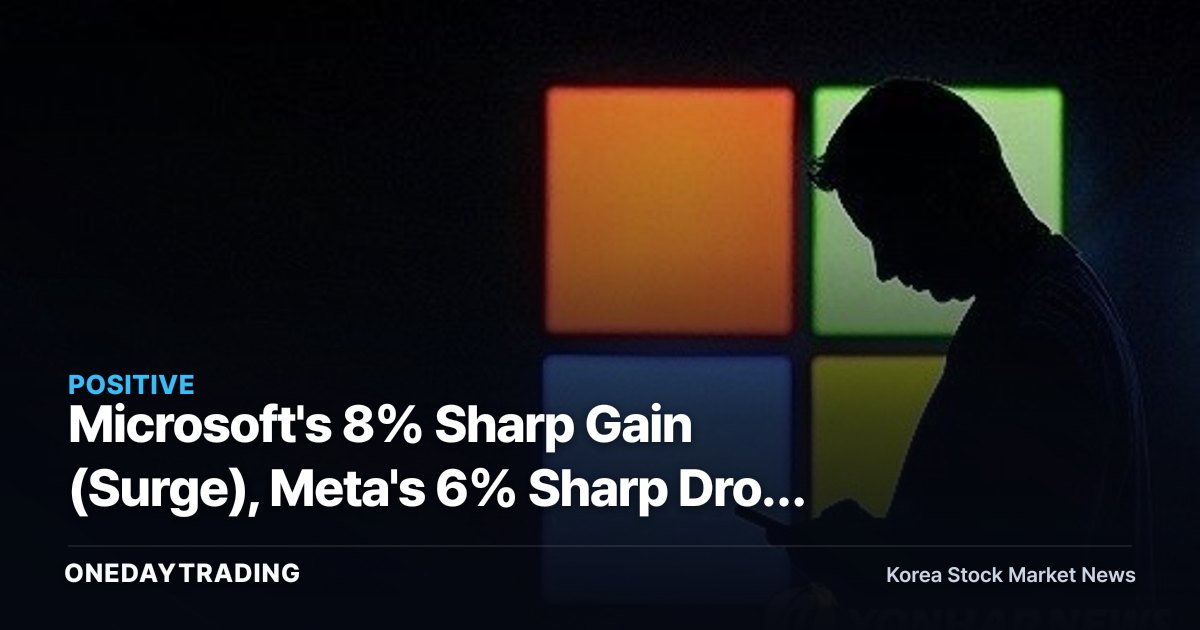
- Microsoft's stock jumped about 8% after its earnings report, while Meta fell roughly 6% on a profit miss and concerns over rising costs.
- The difference isn't the size of AI spending—it's the path to returns. Microsoft showed a clear revenue line through Azure and Copilot, while Meta lost cost credibility despite strong ad growth.
- For Samsung Electronics and SK Hynix, neither outcome is bad news. Winners and losers may diverge, but data center memory demand hasn't slowed.
What's Changing
The yardstick for judging AI investment has shifted. The market no longer just tracks how many GPUs a company buys—it now watches how quickly those GPUs convert into cloud revenue and subscription revenue. Microsoft's nearly 8% rally wasn't just an earnings surprise. Three numbers all pointed the same way: 43% Azure growth, $59.3 billion in Microsoft Cloud revenue, and 30 million paid Copilot accounts. It signals that AI server investment is starting to translate into revenue on the income statement.
Meta's roughly 6% drop is the textbook opposite case. Revenue came in at $60.8 billion, beating expectations, and ad revenue was strong too. But EPS of $6.18 missed market estimates, as legal costs, restructuring charges, and AI infrastructure spending weighed on profit. Simply explaining that AI improves ad efficiency wasn't enough—investors demanded margin protection, not just model performance.
Here's where it matters most for Korean investors: even though Microsoft and Meta's stock prices moved in opposite directions, neither company slowed its data center investment. Microsoft spent $41 billion in capex for the quarter and guided for more than $50 billion in the next. Meta likewise raised its full-year capex outlook to a range of $130 billion to $145 billion. Even if the AI narrative wavers, the volume case for HBM, high-capacity DRAM, and enterprise SSDs is still intact.
Reading the Numbers in Context
Looking further down the semiconductor supply chain makes the picture clearer. Cloud providers' capital expenditure doesn't stop at Nvidia GPUs. Installing a single GPU requires HBM, DDR5, high-speed SSDs, substrates, power components, and cooling infrastructure alongside it. HBM in particular has grown into a bigger share of AI server costs, and only makers that can mass-produce high-stack chips while holding yield steady have real pricing power. That's why Microsoft's Azure growth rate flows straight down into server memory shipment forecasts for SK Hynix and Samsung Electronics.
Even so, not every positive catalyst is of the same quality. SK Hynix's head start in HBM is already largely priced into its stock, so further upside will require continued customer orders and price discipline. Samsung Electronics carries bigger hopes for a catch-up recovery, but the actual benefit only shows up in earnings once certification clears and mass-production yields are confirmed. The broad wave of AI server demand is the same for both, but who captures a higher ASP with a lower defect rate will decide the margin.
Winners and Losers
- Microsoft: 43% Azure growth and 30 million paid Copilot accounts demonstrated a clear return path for AI spending. The company has been re-rated as an AI platform business underpinned by solid cloud revenue.
- SK Hynix: A direct beneficiary of sustained HBM demand. As long as hyperscaler capex holds up, a richer high-value DRAM mix will help defend margins.
- Samsung Electronics: Hopes are reviving for expanded server memory and HBM supply. The key variables are customer certification, yield, and the share of high-stack products.
- Nvidia: Data center investment from both Microsoft and Meta supports a floor under GPU demand. Still, if customers tighten cost controls further, there's a risk that order paces get adjusted.
- Meta: Ad revenue grew, but costs and legal burdens ate into profit. The company still needs to prove its AI investment through cash flow, not just revenue.
Risk Check
- If hyperscalers' AI spending efficiency comes under doubt again, server orders could slow within a single quarter.
- Even with high HBM prices, if yields don't keep pace, capacity expansion will raise costs before it raises revenue.
- If more cases emerge like Meta's, where AI costs eat into ad profits, the market may apply a harsher discount to the whole AI infrastructure value chain.
- The indicators to watch next: Microsoft's Azure growth rate, Meta's capex guidance, and updates on HBM shipments and customer certification at Samsung Electronics and SK Hynix.
Bottom Line
Microsoft's 8% sharp gain (surge) and Meta's 6% sharp drop (plunge) marked a clear split in who won and lost on AI investment, but both left the same signal for Samsung Electronics and SK Hynix: cloud customers still need more memory. Even so, stock prices will go further only after yield and margins are confirmed—not demand alone.
This article is automatically summarized and analyzed based on the original news report. View original article (Maeil Business Newspaper – Securities)