
Summary
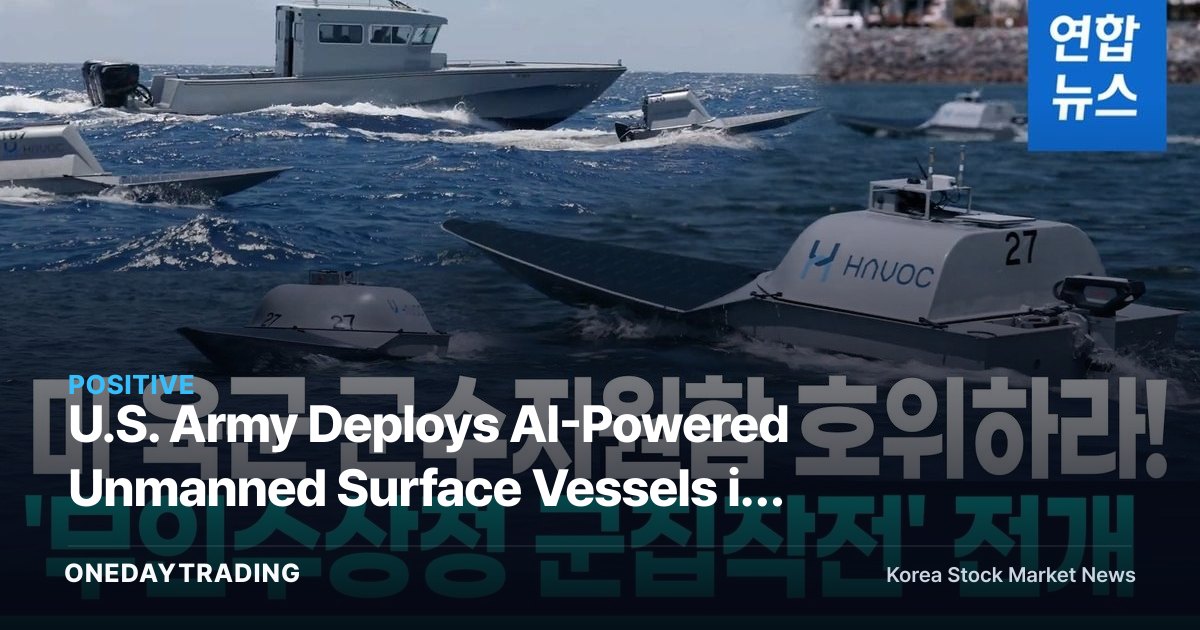
During an annual joint exercise held in the Philippines, the U.S. Army deployed artificial intelligence (AI)-based unmanned surface vessels (USVs) to conduct a maritime ship-escort operation. The fact that ground forces directly operated naval unmanned systems shows how quickly the boundaries between military operational domains are breaking down. It is a signal that once again confirms the global defense paradigm shifting from manned platforms to unmanned, autonomous systems.
What Happened
In this exercise, the U.S. Army demonstrated a mission in which multiple unmanned surface vessels operated together in a swarm to escort U.S. naval ships. Rather than simple remote control, the operation is reported to have applied AI-based autonomous navigation and swarming control technology, showing that unmanned systems are being elevated beyond a supporting role to become core assets in actual operations.
What stands out is that the operator was the Army rather than the Navy. Maritime operations have traditionally been the Navy's domain, but under the concept of Multi-Domain Operations (MDO), the U.S. military is pursuing integrated operations that cross the lines between service branches. Unmanned surface vessels can carry out reconnaissance, escort, mine countermeasure, and strike missions without risk to human life, making them highly cost-effective.
The setting of the Philippines also carries significant weight. With regional tensions rising over the South China Sea, validating unmanned systems in live operations through joint exercises with allies is directly tied to the Indo-Pacific security landscape.
Structural Background
As drones and unmanned vessels have changed the dynamics of the battlefield in the Russia-Ukraine war and Middle East conflicts, countries are accelerating the race to secure unmanned and AI capabilities. As low-cost unmanned assets emerge as asymmetric forces that threaten expensive manned platforms, the center of gravity in defense investment is shifting toward unmanned systems and AI battle-management solutions.
Korea, too, facing the challenges of a shrinking pool of military personnel and the need for defense efficiency, is actively pursuing the domestic development of autonomous weapon systems such as unmanned surface vessels, unmanned underwater vehicles, and reconnaissance drones. Expanding global demand could become a new pillar of K-defense export growth.
Stock and Sector Impact
- Hanwha Systems: With AI-based command-and-control, sensors, and integrated unmanned-system solutions, the company is expected to be a direct beneficiary of the autonomous maritime-force trend.
- LIG Nex1: Spanning unmanned surface vessels, precision-guided munitions, and surveillance-reconnaissance systems, it is a key player in the phase of advancing unmanned forces.
- Hanwha Aerospace: Through the expansion of its defense engine, platform, and autonomous-weapon portfolio, it is exposed across the entire unmanned-systems value chain.
- Hanwha Ocean: Building on its warship-construction capabilities, it has the potential to expand into maritime unmanned-force businesses such as unmanned surface vessels and unmanned underwater vehicles.
- Korea Aerospace Industries (KAI): Pursuing the development of unmanned aircraft and manned-unmanned teaming systems, it stands to benefit from the broadening reach of the autonomous-defense theme.
Bull vs. Bear Scenarios
The bull case is clear. If the adoption of unmanned systems by the U.S. and its allies gains full momentum, demand for related components, software, and integrated systems will rise structurally, and the K-defense export pipeline will expand into the unmanned domain. Continued Indo-Pacific tensions would lead to higher regional defense spending, which is favorable for defense stocks across the board.
On the other hand, bearish factors also exist. The unmanned-systems market is fiercely competitive globally, and a gap remains in core AI and autonomous-navigation technology. In addition, defense stocks are prone to posting short-term sharp gains (surges) on geopolitical news and then becoming exposed to profit-taking, and it is also a burden that it takes time for such developments to translate into actual orders and revenue. Investors should keep in mind that this exercise does not act as an immediate earnings variable.
Investor Action Points
- This news is closer to thematic momentum. Rather than chasing a short-term sharp gain (surge), a phased approach focused on the structural growth of unmanned systems and AI defense is the more reasonable strategy.
- It is necessary to check fundamental indicators — such as actual order disclosures, mass-production contracts for unmanned surface vessels and unmanned underwater vehicles, and export results — alongside quarterly earnings.
- Given the high volatility of individual stocks (tickers), it is worth considering a strategy of managing thematic exposure through diversification, such as via defense ETFs.
- Investors should monitor the situation in the South China Sea and the Indo-Pacific, as well as trends in the U.S. defense budget, to confirm whether the policy momentum is sustained.
This article is content automatically summarized and analyzed based on the original news report. View original (Yonhap News, Industry)