Key Takeaways
When a leading Fed candidate and the sitting vice president both float the idea that the central bank's 2% inflation target is negotiable, the market signal is not academic. A higher tolerated inflation rate erodes the real value of fixed coupons, argues for a steeper or higher yield curve, and reshapes the relative appeal of gold, banks and bond proxies. The debate is about the anchor of every discount rate in U.S. markets.
What Happened
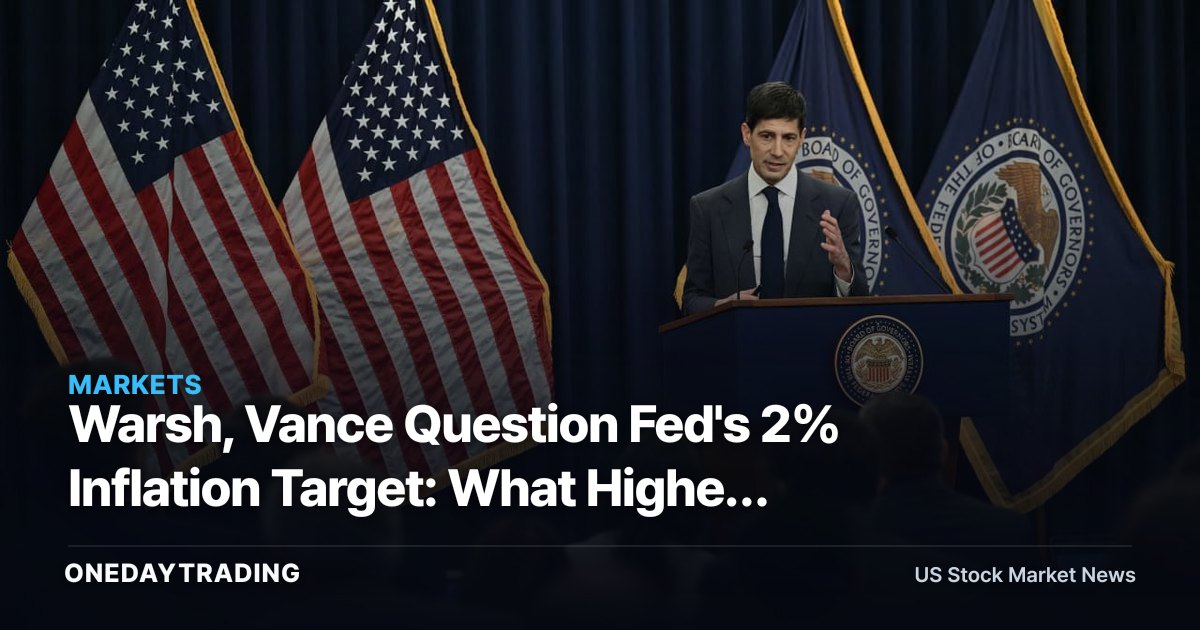
Kevin Warsh, a former Fed governor widely cited as a contender to lead the central bank, and Vice President J.D. Vance have publicly questioned the rigidity of the Fed's official 2% annual inflation objective. That number has been the explicit policy anchor since 2012, and the central bank's credibility rests on defending it.
The implication that policymakers might tolerate a structurally higher rate of price growth, or treat 2% as a flexible average rather than a ceiling, changes the calculus for anyone pricing long-duration assets. If the destination for inflation drifts toward 3% or is left deliberately vague, the market must demand more compensation to hold money over time.
Background and Context
The 2% target functions as a coordination device: it tells households, businesses and bondholders what real returns to expect. Loosening it without a formal framework review risks unmooring inflation expectations, which is precisely the dynamic the Fed spent 2022 and 2023 fighting. Politically, a more growth-tolerant stance can mean pressure for lower nominal rates even when inflation runs hot.
Market and Stock Impact
- Long-dated Treasuries and bond proxies (TLT): A higher accepted inflation rate is directly negative for fixed-coupon bonds because it shrinks real returns; investors typically respond by selling duration, pushing long yields up and prices down.
- Gold and miners (GLD, NEM): Gold has no coupon, so it gains relative appeal when the currency's purchasing power is expected to erode faster and real rates fall; a credibility question on the inflation anchor is classic support for bullion.
- Banks (JPM, BAC): A steeper curve from higher long yields can widen net interest margins, a tailwind for lenders, though the benefit fades if funding costs and credit risk climb alongside inflation.
- Rate-sensitive growth and homebuilders: Companies valued on distant cash flows and sectors dependent on cheap financing face a higher discount rate, compressing valuations if long-term yields reset upward.
Investor Checkpoints
- Watch the 10-year Treasury yield and the 5-year and 10-year breakeven inflation rates for evidence that expectations are de-anchoring.
- Track whether the Fed signals a formal framework review or restates its 2% commitment at the next FOMC meeting and in official communications.
- Monitor Warsh's standing in the leadership succession and any explicit policy comments, since personnel here is policy.
- Follow upcoming CPI and PCE prints relative to 2% to gauge how much running room the data actually allows.
Outlook
The bull case for risk assets is that a more tolerant Fed keeps nominal rates lower for longer, supporting equity multiples and easing the cost of capital. The offsetting risk is that abandoning a clear anchor lifts the inflation-risk premium baked into long yields, which would tighten financial conditions through the bond market even as the Fed talks dovish. For now this is rhetoric rather than an enacted change, so the practical danger is in expectations and positioning rather than realized policy.
📊 Analysis
Signal Neutral
Why A debate over the inflation anchor is genuinely two-sided: dovish for rates but bearish for bond real returns and inflation credibility, with no enacted policy change yet.
Tickers$TLT$GLD$JPM$BAC$NEM
This article was independently written by OneDayTrading from public reporting. Read the original (MarketWatch)