Bank of North Dakota’s Investment Read-Through
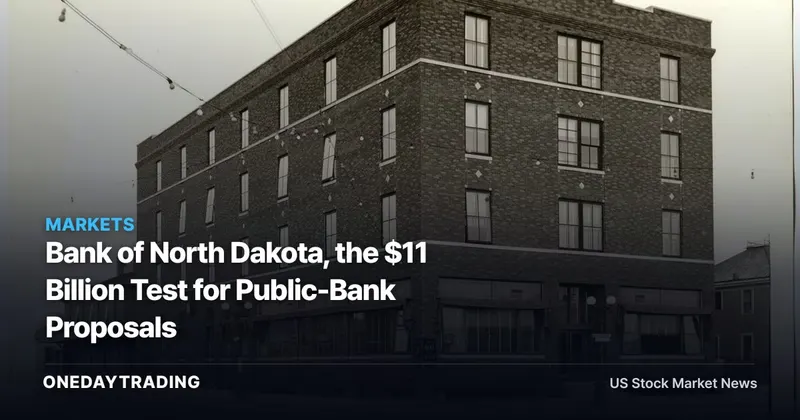
Bank of North Dakota gives bank, utility and industrial investors a live test of public capital working alongside private lenders. CNBC examined the institution on Oct. 29, 2026, finding that the nation’s only surviving state-owned and -operated bank currently manages $11 billion in assets as renewed public-banking proposals take shape elsewhere.
The central investment question is not whether public ownership is inherently positive or negative. It is whether a state bank can enlarge financing capacity without displacing private institutions, weakening underwriting discipline or turning credit allocation into an extension of politics.
North Dakota’s answer rests on structure. The bank holds state deposits, provides loans and works through local financial institutions. For investors, that makes its relevance clearest at the balance-sheet level: funding enters through public deposits, while credit reaches borrowers through participation loans, commercial real estate loans, agricultural loans and targeted programs.
How the State-Owned Bank Model Works
A public bank is a government-owned financial institution that holds public deposits and deploys them through lending and other authorized financing activities. Bank of North Dakota is the primary depository of state funds and discourages individual deposits, specifically avoiding direct competition with North Dakota community banks.
CNBC reported that Bank of North Dakota has a current average balance of $6.6 billion as its core deposit base and works through 91 financial institutions. That combination defines the operating model: the state supplies the deposit base, and participating institutions remain the channel through which much of the financing reaches projects and borrowers.
This distinction matters for private banks. A state institution that competes for retail deposits could pressure funding and customer relationships; one that participates in loans can instead share financing needs that may exceed a community bank’s capacity. Rick Clayburgh of the North Dakota Bankers Association described the bank as a tool that helps local institutions undertake larger financing assignments.
The available figures do not establish profitability. CNBC did not provide the bank’s current profit or net-income figure, so investors cannot calculate returns, margins or the fiscal contribution to the state from the supplied evidence. The balance-sheet scale is visible; its current earnings power is not.
Governance Is the Model’s First Credit Control
The Nonpartisan League swept into power in 1918, and the state legislature authorized a state-owned and -operated bank in 1919. Arthur C. Townley had organized the movement that called for public ownership of key industries. The institution has now operated for 108 years, surviving a major shift in the state’s political character.
The North Dakota Industrial Commission governs Bank of North Dakota and acts as its board of directors. The governor, attorney general and agriculture commissioner make up the commission, placing elected leadership directly over the institution while day-to-day banking still requires attention to safety, soundness and the founding framework.
That arrangement is simultaneously the model’s foundation and its core risk. Don Morgan said the tool can be powerful when used correctly and dangerous when used incorrectly. His warning directs attention to underwriting discipline and institutional boundaries rather than political labels.
Kelly Armstrong captured the unusual durability of the arrangement by saying, “I don't think we could set one up now, but I'm sure glad we have it.” Support associated with Kevin Cramer, John Hoeven and Doug Burgum shows that the bank’s present constituency extends beyond the progressive politics that created it.
Coal Creek Station Shows the Financing Channel
Coal Creek Station provides the clearest evidence of how public-bank capacity can affect physical assets. Great River Energy, the prior owner, said in 2020 that it planned to retire the plant by the 2022 deadline. Rainbow Energy Center later bought Coal Creek Station, while Nexus Line purchased the transmission line that moves its power to Minnesota.
Rainbow Energy Center and Nexus Line are affiliates of Rainbow Energy Marketing Corporation. The North Dakota Transmission Authority generated $150 million in current bond proceeds, and Bank of North Dakota purchased its bonds through a $150 million current Match Program loan.
The financing supported a transaction involving a currently operating plant that generates 1,151 megawatts of electricity per hour for 1.7 million customers and directly employs 200 people, according to CNBC. For utility and industrial investors, the mechanism is concrete: public-bank participation can help assemble financing around a large operating asset and its transmission infrastructure.
The case also illustrates concentration and policy risk. Financing selected projects may preserve capacity or unlock transactions, though political priorities can influence which industries receive support. The relevant test is whether project cash flows and credit protections remain sufficient when public-policy objectives are part of the lending decision.
Rainbow Energy is discussing a potential data center near Coal Creek Station with unidentified hyperscalers. The evidence neither identifies those companies nor confirms that construction has begun, preventing a defensible revenue, power-demand or listed-stock conclusion.
Public Banking Proposals Face a Replication Test
The North Dakota model is attracting attention beyond the state. Washington has a work group preparing a public-bank implementation plan for delivery to its legislature by mid-2027, while Massachusetts, New Mexico and California are pursuing proposals of their own.
Those proposals are not established banks. Their investable significance depends on design: the source of deposits, the relationship with private lenders, governance safeguards and the limits placed on politically directed credit. Don Morgan’s view is that another state could create a bank, provided its founding structure is designed correctly.
Support has also appeared in national and local politics. Zohran Mamdani was elected New York City mayor in 2025 after previously cosponsoring public-bank legislation as a state lawmaker. Francesca Hong included a North Dakota-style state bank in her platform before losing to David Crowley, while Alexandria Ocasio-Cortez and Rashida Tlaib led federal legislation intended to make state public banks easier to create. Bob Hasegawa serves on Washington’s work group, and Christine Desan has argued for public participation in the banking network.
The American Bankers Association takes the opposing view. Josh Britton said public banks present taxpayer risks and described them as an answer without a demonstrated problem. That objection defines the counter-scenario: public lending could duplicate services, expose public funds to credit losses or allow political preferences to distort capital allocation.
Balance-Sheet and Sector Checkpoints
- Banks: Examine whether new proposals preserve the North Dakota separation between a public-bank balance sheet and private customer relationships. Competition for individual deposits would represent a materially different model.
- Agricultural credit: Bank of North Dakota supplied $500 million in loan support during 2026. Future program disclosures would show whether targeted support remains episodic or becomes a larger part of the institution’s lending mix.
- Utilities and industrial assets: Track the credit performance and operating role of the Coal Creek Station financing package rather than treating the transaction’s completion as proof that every state-backed project is financially durable.
- Public-bank policy: Washington’s mid-2027 implementation plan is the next dated design checkpoint. Investors should compare its proposed deposit base, governance and private-bank relationship with North Dakota’s structure.
Payments Innovation Adds a Separate Test
Bank of North Dakota has launched Roughrider Coin to support near real-time bank-to-bank transfers among North Dakota community banks. The initiative extends the institution’s role from credit participation into payment infrastructure without changing its stated focus on working with local institutions.
Adoption cannot yet be assessed from the supplied evidence. CNBC did not report Roughrider Coin’s transaction volume or adoption rate, so the practical checkpoint is usage data from participating banks rather than the launch itself.
The bank also extended a current $70 million line of credit to the Theodore Roosevelt Presidential Library. That financing allowed construction to proceed while the library awaited private financing and supported an opening tied to the United States’ 250th anniversary. Robbie Lauf has characterized the institution as a partner to private enterprise, reinforcing the broader claim that the model depends on cooperation rather than replacement.
The Outlook Depends on Discipline, Not Labels
The constructive case is that a stable public deposit base can share loans with community banks, finance assets that require greater capacity and support bank-to-bank payment infrastructure. North Dakota’s current $11 billion asset base, $6.6 billion average balance and network of 91 financial institutions show an operating system rather than a theoretical proposal.
The risk case begins in the same place. Political governance can direct credit toward preferred sectors, taxpayer funds can absorb poor underwriting outcomes, and a model founded around noncompetition can break down if another state designs it differently. No evidence in the fact set establishes that the proposals outside North Dakota will become operating banks.
The next useful signal is Washington’s mid-2027 plan. Its treatment of deposits, private-bank participation, governance and credit risk will indicate whether policymakers are adapting Bank of North Dakota’s institutional constraints or borrowing only its public-bank label.
📊 Analysis
Signal Neutral
Why The model can expand financing capacity for banks and strategic projects, while political control, taxpayer exposure and uncertain replication limit a directional sector call.
This article was independently written by OneDayTrading from public reporting. Read the original (CNBC)