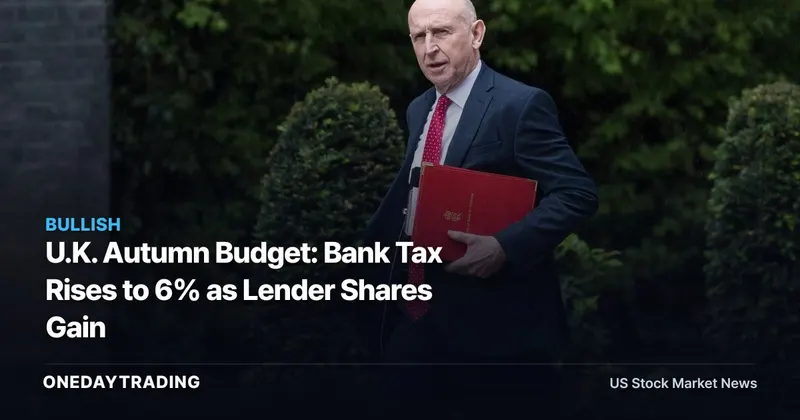
U.K. Autumn Budget Gives Banks a Defined Tax Window
The U.K. Autumn Budget announced on 2026-10-28 delivered a mixed but investable message: households receive energy-cost relief, banks face a higher temporary surcharge, and public funding moves toward defense, Ukraine and artificial intelligence. For bank investors, the sharpest signal was not the tax increase alone; it was the decision to raise the surcharge from 3% to 6% for a stated 15-month period beginning in January.
CNBC Markets reported that Barclays was last seen 3.3% higher, Lloyds Banking Group rose more than 2.6%, and NatWest Group gained 2.5% following the announcement. Those moves do not establish the budget’s future earnings impact, though they indicate that the disclosed tax terms did not prevent investors from bidding up the affected lenders.
What John Healey Put Into the Autumn Budget
The Autumn Budget is the U.K. government’s fiscal package combining tax, spending and economic measures. John Healey delivered his first fiscal budget with initiatives covering household costs, defense and artificial intelligence, while also directing £10 billion of additional economic and military support to Ukraine.
Household measures removed standing charges from gas heating bills and extended an electricity tax break through July 2027. The U.K. also included £100 ($133) checks for residents in the four lowest local housing tax bands; the government cost attached to that measure was £2.6 billion.
The package removed tariffs from over 100 grocery products, provided £15 million for children’s books and raised the U.K. minimum wage by 3.9%. These measures target several parts of household spending at once: recurring energy charges, electricity taxation, grocery costs and wage income.
For investors, the transmission channel is conditional rather than automatic. Lower household expenses can leave consumers with more room elsewhere in their budgets, while a higher minimum wage can also raise labor costs for affected businesses. The fact sheet does not quantify either effect, so neither a consumption boost nor a margin outcome can be treated as established.
Why the 6% Bank Surcharge Matters
The bank surcharge rose by 3%, taking it to 6%, with implementation in January and an end 15 months later. A temporary surcharge creates a defined period in which bank earnings may face additional tax pressure, although the exact fiscal impact on each lender is not provided.
The share response separates the tax headline from the terms investors actually received. Barclays, Lloyds Banking Group and NatWest Group all advanced following the budget, suggesting that duration and scale mattered to the initial market assessment. The gains cannot prove that future net income, credit costs or capital returns will improve.
JPMorgan Chase criticized the decision to single out banking for additional taxation and argued that the industry operates in a competitive global market. The company nonetheless said it remained “committed” to the U.K.; Jamie Dimon is its chief executive.
For JPMorgan Chase investors, the relevant checkpoint is not the London-listed lenders’ share reaction by itself. It is whether the temporary surcharge produces a disclosed effect on the company’s U.K. operations, costs or future commitments. No company-specific financial estimate is available in the supplied facts.
Energy Relief Meets a Constrained Fiscal Path
The Office for Budget Responsibility forecast £15 billion of U.K. government fiscal headroom for the 2029/30 financial year. It also projected national debt at 83.8% of GDP next year, followed by a decline to 81.7% of GDP in the 2032 financial year.
Growth projections were 1.2% for the U.K. economy this year, 1% in 2027 and 1.6% in 2028. Those forecasts frame the budget’s central tension: cost relief and strategic spending must coexist with a limited fiscal cushion and a debt path that initially rises before declining.
The bond market’s first response was measured. By 1:50 p.m. in London (9.50 a.m. ET), the benchmark 10-year gilt yield was 2 basis points lower at 5.323%, while sterling was 0.2% lower against the euro. These moves capture the immediate tape, not a verdict on whether the fiscal projections will be achieved.
Inflation provides another constraint. The U.K. rate was 3.5% in September, making the duration of household energy relief and the path of government finances important inputs for later policy assessment. The facts supplied do not provide a subsequent Bank of England decision or a future inflation outcome.
Defense, Ukraine and AI Add Strategic Spending Channels
The budget included £10 billion of additional economic and military support for Ukraine. It also linked future defense funding to the NATO commitment of 3.5% of GDP by 2035, with a U.K. target of 3% of GDP in 2030.
These are commitments and targets, not completed spending outcomes. The complete allocation across defense, Ukraine and artificial intelligence initiatives is not disclosed, and the exact amount for AI security and sovereignty is also absent. That prevents a reliable company-level revenue or order estimate.
Artificial intelligence policy included funding initiatives and support for the industry, while founders received a reduced capital gains tax rate on gains of up to £10 million. The investment case therefore depends on later allocation details: which programs receive funding, what conditions govern it and whether disclosed commitments translate into measurable activity.
Investor Checkpoints After the U.K. Budget
- Bank surcharge implementation: Check the January rollout, the stated 15-month duration and any lender disclosure that quantifies the effect of the 6% surcharge.
- Household relief: Track the electricity tax break through July 2027 and whether later reporting identifies measurable changes tied to the removal of gas-heating standing charges.
- Fiscal delivery: Compare subsequent Office for Budget Responsibility projections with the £15 billion headroom forecast for the 2029/30 financial year and the national-debt path toward 81.7% of GDP in the 2032 financial year.
- Strategic allocations: Look for the missing division of funding among defense, Ukraine and artificial intelligence, including the details supporting the 3% and 3.5% of GDP defense targets.
The Market Case and Its Limits
The constructive reading is narrow and specific. Households received several cost measures, the bank surcharge has a stated endpoint, and the initial reaction in Barclays, Lloyds Banking Group and NatWest Group was positive. The Office for Budget Responsibility also forecast fiscal headroom rather than an immediate disappearance of the government’s buffer.
The risk case sits in execution. The full fiscal cost of every measure is unavailable, future budget outcomes are unknown, and bank-specific earnings effects have not been quantified. Defense and AI ambitions also lack a complete allocation, making it premature to assign revenue benefits to individual companies.
The next investable evidence will come from implementation rather than slogans: lender disclosures on the surcharge, fiscal updates against the Office for Budget Responsibility path, and concrete funding allocations. Until those arrive, the share gains show what the tape accepted on announcement day; they do not settle the budget’s longer-term effect on bank profitability or the U.K. economy.
Market data check: JP Morgan Chase & Co.
JP Morgan Chase & Co. last traded near $338.99 (+0.95%). Our composite signal — blending price momentum and news flow — reads 🟡 neutral. Price momentum scores 58/100.
Data as of publication. Price via market feeds; for reference only, not investment advice.
📊 Analysis
Signal Bullish
Why Barclays, Lloyds Banking Group and NatWest Group shares rose after the temporary bank surcharge increase proved limited to 15 months.
This article was independently written by OneDayTrading from public reporting. Read the original (CNBC Markets)