NBA Partnerships Turn Access Into a Governance Test
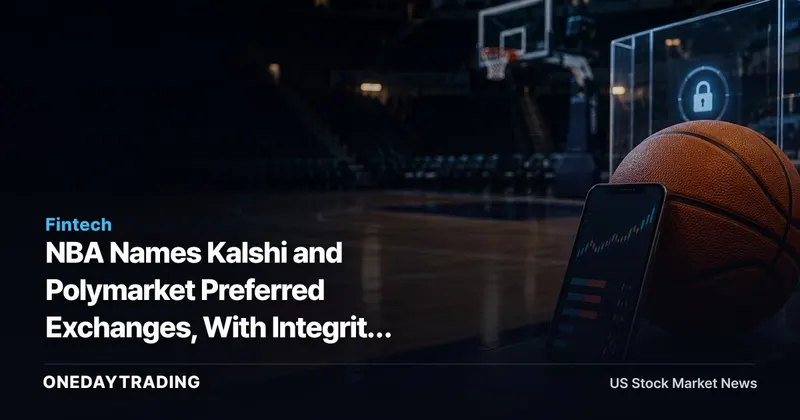
The NBA’s decision to name Kalshi and Polymarket as preferred prediction-market exchanges on 2026/10/26 is constructive for the platforms and the broader fintech category, because it pairs commercial rights with formal integrity controls. The immediate investor significance lies less in a measurable financial contribution—which the disclosed facts do not establish—than in whether league-approved access can coexist with restrictions on contracts and scrutiny of suspicious trading.
A preferred exchange, in this agreement, is a platform authorized to use NBA intellectual property and receive associated marketing and licensing rights. That designation gives both exchanges a defined relationship with the league, while the accompanying safeguards make compliance part of the commercial proposition rather than a separate issue.
What the NBA Granted Kalshi and Polymarket
According to CNBC, the agreements provide Kalshi and Polymarket with rights to use NBA intellectual property, together with marketing and licensing rights. Those permissions create a direct channel for league-linked presentation and promotion, which may strengthen user engagement if the exchanges can operate within the agreed boundaries.
The partnerships also limit which event-contract types may be featured and require information sharing concerning suspicious trades. For investors assessing prediction markets, that combination matters: the exchanges gain valuable commercial access, while the NBA retains mechanisms intended to protect how its games are represented and monitored.
Scott Kaufman-Ross stated, “Protecting the integrity of the game is our top priority.” The wording identifies the league’s central condition for the relationships. Commercial opportunity is present, though it is explicitly bounded by integrity obligations rather than offered as unrestricted access.
NBA and the Commodity Futures Trading Commission Add an Information Channel
The NBA separately signed a memorandum of understanding with the Commodity Futures Trading Commission involving exchanges of information. This creates a second layer around the preferred-exchange agreements: Kalshi and Polymarket receive league rights, while the NBA establishes a direct information framework with the federal regulator connected to prediction markets.
The available facts do not provide the memorandum’s date or detailed terms. They also do not specify the exact contract limitations or the procedures for reporting suspicious trades. Those omissions prevent a reliable assessment of compliance costs, operational burden or the speed with which information would move among the parties.
The structure nevertheless offers a concrete analytical framework. The commercial side rests on intellectual-property, marketing and licensing rights; the risk-control side rests on featured-contract limits, suspicious-trade information requirements and the NBA’s memorandum with the Commodity Futures Trading Commission. Performance should be judged across both sides rather than through partnership branding alone.
Adam Silver Frames the NBA’s Regulatory Preference
In an early October interview reported by CNBC, Adam Silver said the NBA operates across roughly 40 jurisdictions right now and argued that a consistent national policy would serve the league’s interests. The 40 jurisdictions identified by Adam Silver right now explain why regulatory consistency can matter operationally to the NBA, even though the fact sheet does not establish a final policy outcome.
Silver’s exact formulation was: “So to have a consistent policy nationally, I think would be in our best interest.” That is a statement of preference, not confirmation that one national framework has been adopted. The distinction is material because the NBA’s agreements and memorandum can establish relationships without resolving the broader division over regulatory authority.
The NFL has taken a different position, saying sports-related event contracts should be regulated by states rather than the Commodity Futures Trading Commission. That disagreement creates a counterweight to the constructive partnership signal: league acceptance is not uniform, and the NBA’s preferred structure does not settle how other sports organizations may approach the category.
NHL and MLB Relationships Broaden the Sports Context
The NBA is not the only league named in the disclosed partnership record. The NHL announced partnerships with Kalshi and Polymarket in October 2025, and the MLB announced a relationship with Polymarket in March. These agreements establish that the exchanges have relationships across multiple leagues, though the supplied facts do not provide comparable financial terms or operating results.
Ari Borod said, “The NBA is one of the most influential sports leagues in the world, and we're excited to work together to bring fans closer to the game.” Adam Barrick separately said, “It's an exciting time for both NBA fans and Kalshi users.” The statements express the platforms’ engagement thesis, while the enforceable investor questions remain the scope of licensed rights and the practical effect of integrity restrictions.
That distinction keeps the analysis disciplined. Partnership announcements can expand permitted uses of league assets, but the fact sheet provides no volume, revenue, pricing, customer-acquisition or profitability data. Cross-league relationships therefore indicate commercial reach, not a quantified financial return.
Fintech Impact: Positive Access, Unpriced Economics
- Kalshi: Preferred-exchange status, NBA intellectual-property rights, and marketing and licensing rights form a positive commercial package. Its obligations concerning featured contracts and suspicious-trade information may constrain how that package is used.
- Polymarket: The same NBA designation adds league-authorized rights alongside its NHL partnership and MLB relationship. The evidence supports broader sports relationships, not a conclusion about their revenue or durability.
- Prediction-market fintech: The NBA’s simultaneous commercial agreements and regulatory memorandum show that access and oversight are advancing together. This may support sector legitimacy, while divergent NBA and NFL positions preserve regulatory uncertainty.
No U.S.-listed company is directly identified as the subject of these agreements, so a public-equity ticker would be speculative. CNBC also disclosed that its commercial relationship with Kalshi includes customer acquisition and a minority investment; the size of that investment is not given and should be considered when evaluating the source context.
Investor Checkpoints After the NBA Agreements
- Contract scope: Look for disclosure identifying which NBA event-contract types may be featured and which are excluded.
- Integrity process: Assess any later detail on how suspicious trades are identified, shared and handled under the exchange agreements.
- Regulatory framework: Track whether the NBA’s memorandum with the Commodity Futures Trading Commission produces more specific information-sharing procedures.
- Commercial evidence: Require disclosed economics, duration or operating metrics before translating licensing access into a financial estimate.
NBA Prediction Markets Outlook
The bullish case is narrow but credible: Kalshi and Polymarket gained preferred status, NBA intellectual-property access, and marketing and licensing rights, all within a framework that directly addresses integrity. If the controls prove workable, the model could show that league engagement and market oversight can operate together.
The risk case is equally concrete. Financial terms and agreement duration remain undisclosed, detailed restrictions are unavailable, and the NFL favors state regulation over the Commodity Futures Trading Commission for sports-related event contracts. The next investable signal is therefore not another promotional statement; it is evidence that the granted rights can produce durable activity while satisfying the NBA’s contract limits and information-sharing requirements.
📊 Analysis
Signal Bullish
Why Preferred-exchange status and NBA licensing rights support the prediction-market sector, although undisclosed economics and regulatory disagreement limit the investment read-through.
This article was independently written by OneDayTrading from public reporting. Read the original (CNBC)