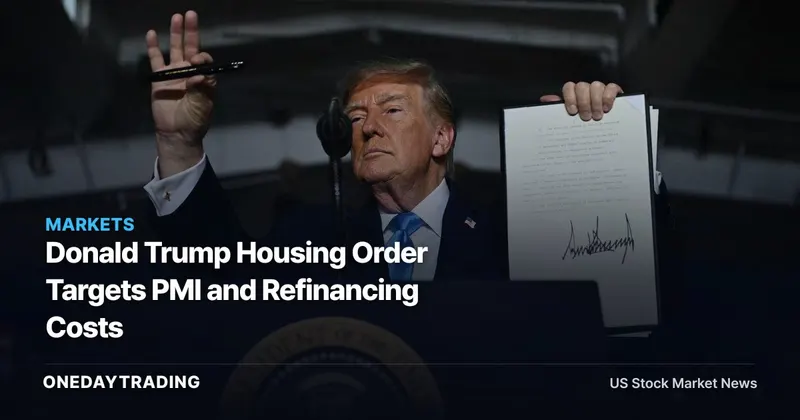
Donald Trump Housing Order: The Investor Read
Donald Trump’s housing order could lower specific mortgage expenses, yet it does not change the two variables that currently dominate borrower affordability: home prices and mortgage rates. CNBC reported on Oct. 23 that the president signed the “Decreasing Housing Costs for the American People” executive order, directing federal agencies to pursue proactive mortgage-insurance cancellation for eligible future loans and cheaper refinancing.
For investors, this is a targeted cost intervention rather than evidence of a broad housing reset. The clearest channels run through private mortgage insurance and refinance closing costs, while the financial effect remains unquantifiable until the Federal Housing Finance Agency specifies eligibility, equity thresholds, launch timing and geographic coverage.
What Donald Trump Directed Federal Agencies to Do
The executive order instructs the Federal Housing Finance Agency to create a pilot program under which mortgage insurance would be canceled proactively after an eligible borrower reaches a specified home-equity threshold. The program would cover mortgages originated after its launch, meaning the order does not establish a benefit for every existing mortgage.
Private mortgage insurance, or PMI, is coverage typically required on a conventional loan when the borrower makes a down payment below 20% of the home’s purchase price. Federal Housing Administration mortgages require mortgage insurance on all loans.
The second policy channel concerns refinancing. The order aims to make permanent an existing Federal Housing Finance Agency pilot that waives the lender’s title-insurance policy and permits lower-cost alternatives. No timetable or implementation method for making that program permanent is supplied.
Bill Pulte, director of the Federal Housing Finance Agency, said “millions of Americans will save thousands and thousands of dollars.” That claim describes the administration’s expectation, not a measured outcome. Keith Gumbinger, vice president of mortgage website HSH, said the eventual consumer effect cannot be determined without further details.
PMI Costs Show the Potential Borrower-Level Stakes
Fannie Mae says conventional borrowers can generally remove PMI after the loan balance falls below 80% of the purchase price or equity reaches 20%. A borrower may request removal when the balance reaches 80% of the property’s original value, while removal may occur automatically when the balance reaches 78% of original value.
PMI can cost between 0.2% and 2% of the loan annually, according to figures attributed to Fannie Mae in CNBC’s reporting. In Freddie Mac’s example, purchasing a $600,000 home with a 10% down payment and a 30-year fixed-rate mortgage at 7.3% could produce a monthly mortgage-insurance charge of $351.
Those figures clarify the mechanism. If an eligible future borrower reaches the required equity threshold and the pilot removes insurance without requiring a separate request, the recurring mortgage expense could end earlier than it otherwise would under a request-dependent process. The order does not provide the pilot’s threshold or eligibility rules, so the Freddie Mac example cannot be treated as an estimate of savings under the new program.
The borrower population potentially exposed to PMI is relevant because the median down payment in the second quarter of 2026 was 13.7% of the purchase price, or $27,100, according to Realtor.com. Keith Gumbinger said many mortgages carry PMI as home prices and smaller down payments shape financing choices.
Mortgage Rates Still Dominate the Affordability Equation
The policy arrives against a demanding payment backdrop. According to the Federal Reserve, the monthly payment on a 30-year fixed-rate mortgage for a median-priced home absorbed roughly 33% of median family income in 2025, compared with 26% in 2022.
Freddie Mac reported that the rate on a 30-year fixed-rate mortgage stood at 7.32% as of Oct. 23. That rate affects the principal-and-interest payment across the life of the mortgage, whereas PMI cancellation addresses one component of the borrower’s monthly cost.
This distinction sets the limit of the policy thesis. Keith Gumbinger said the initiative may not be a “game-changer” because home prices and mortgage rates currently dictate housing costs, although smaller savings can still help. Investors should therefore separate a potentially meaningful household-level saving from a claim that the order alone changes overall housing affordability.
Refinancing Relief Meets Weak Demand
Refinance demand was down 59% in mid-October from the same week of the previous year, according to CNBC. The order’s attempt to lower closing costs therefore addresses a market in which demand had already contracted sharply on that comparison.
The existing Federal Housing Finance Agency pilot was originally scheduled to run through November 2027. Sandra Thompson, a former director of the agency, described it at an April 2024 congressional hearing as limited in scope: it covered qualifying refinances with loan-to-value ratios below 80% in a handful of states.
Sandra Thompson estimated that consumers whose loans were sold under the pilot could save between $500 and $1,500 in closing costs. Those figures belong to the existing limited pilot and should not be extrapolated to every future refinance under a permanent program.
The cost channel is still concrete. Keith Gumbinger characterized the lender’s title-insurance policy as historically expensive, and a 2025 Urban Institute report found that lender fees connected to title and title insurance generally account for the largest share of mortgage closing costs. Waiving that policy or accepting cost-friendly alternatives could reduce the cash required to complete a qualifying refinance.
Implications for Mortgage Insurance and Real Estate Finance
- U.S. mortgage insurers: Proactive cancellation could shorten the period during which insurance remains attached to eligible future mortgages after borrowers cross the eventual equity threshold. The magnitude cannot be assessed because the threshold, eligibility criteria and volume of qualifying loans are absent.
- Refinancing activity: Lower closing costs could improve the economics of qualifying refinances at the margin. The counterweight is a 59% year-over-year decline in mid-October refinance demand and a 7.32% rate on 30-year fixed mortgages as of Oct. 23.
- Future homebuyers: Borrowers making down payments below the conventional 20% threshold may receive the most direct benefit if proactive removal prevents PMI from continuing after eligibility is reached. Seth Appleton, president of U.S. mortgage insurers, welcomed the focus on lowering costs for future homeowners.
- Broader real estate exposure: The order reduces selected transaction or insurance expenses rather than directly changing home prices or mortgage rates. Any market interpretation should keep that narrower transmission channel intact.
Federal Housing Finance Agency Checkpoints
- Equity rule: Compare the pilot’s specified threshold with the existing 80% balance, 20% equity and 78% automatic-removal reference points described by Fannie Mae.
- Eligible mortgages: Determine which future originations qualify and whether the final framework imposes additional borrower or loan conditions.
- Launch and geography: Check when the mortgage-insurance pilot begins and where it applies; neither detail is provided.
- Refinance expansion: Look for the mechanism and timing by which the existing pilot becomes permanent, including whether its below-80% loan-to-value condition or limited-state footprint changes.
The Policy’s Upside and Its Boundary
The constructive case is straightforward: automated PMI cancellation could stop an eligible recurring charge without depending on a borrower’s request, while title-insurance alternatives could reduce upfront refinancing costs. The existing pilot’s estimated $500 to $1,500 saving offers a bounded reference point for qualifying loans sold under that program, not a forecast for the executive order.
The risk is that investors mistake a reduction in secondary mortgage expenses for a change in the primary affordability burden. The next decisive information must come from the Federal Housing Finance Agency: the equity threshold, eligibility rules, launch date, geographic scope and permanent refinancing framework will determine whether the order becomes a broad cost channel or a narrowly targeted adjustment.
📊 Analysis
Signal Neutral
Why The order could reduce eligible borrowers’ costs, while missing eligibility, timing and geographic details prevent a reliable estimate of its sector impact.
This article was independently written by OneDayTrading from public reporting. Read the original (CNBC)