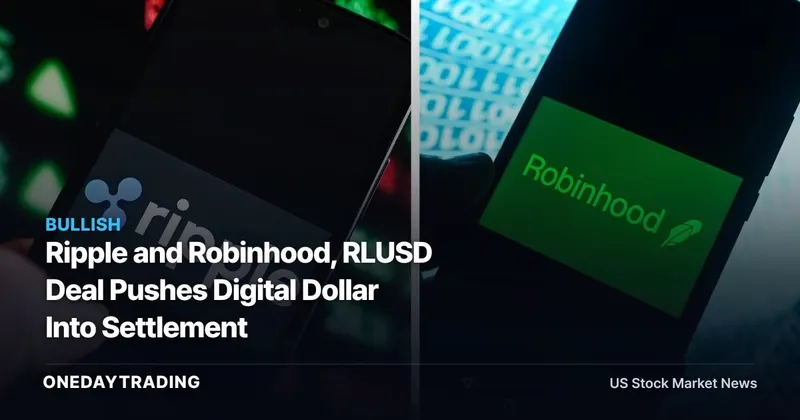
Ripple and Robinhood Put RLUSD Into the Financial Workflow
Ripple’s agreement with Robinhood moves RLUSD beyond exchange availability and into institutional settlement, treasury operations and financing. CNBC reported the deal, but its effective date and the launch dates for individual integrations were not disclosed. For investors, the important shift is functional: the partnership places the digital dollar inside both customer-facing distribution and Robinhood’s internal financial processes.
RLUSD is Ripple’s digital dollar, and the agreement calls for it to settle institutional trades and help automate Robinhood’s treasury operations. Access to digital-asset trading and financing will also expand through Ripple Prime and Bitstamp, which Robinhood acquired last year. The arrangement therefore connects a stablecoin, an institutional financing operation, an exchange and a treasury workflow rather than relying on a listing alone.
That breadth makes the deal directionally positive for the companies involved, although the evidence does not establish a financial payoff. The deal’s financial terms, expected transaction volumes and expected impact on either Ripple or Robinhood were not provided. Distribution and operational integration create potential utility; they do not by themselves prove adoption or economics.
RLUSD Gains Distribution Across Robinhood and Bitstamp
RLUSD will be listed on Robinhood’s trading platform and is already available to traders on Bitstamp and Robinhood Chain, Robinhood’s home-grown blockchain. Those placements give the asset several roles within the connected businesses: a tradable stablecoin, a settlement asset and a tool for internal treasury automation.
The distinction matters because availability measures access, while settlement and treasury use test whether the product becomes part of recurring financial activity. If institutions use RLUSD across those workflows, the partnership could deepen its practical relevance. The FACT_SHEET supplies no expected volume, so that mechanism must remain a conditional interpretation rather than a forecast.
Johann Kerbrat, general manager of Robinhood Crypto, framed the strategy succinctly in a statement shared with CNBC: “Utility is what moves stablecoins forward.” He said Bitstamp and Robinhood would gain access to RLUSD for institutional settlement, Ripple Treasury for operations and Ripple Prime for financing. His description identifies the intended operating links without quantifying their eventual use.
A $2.5 Billion RLUSD Enters a $300 Billion Market
RLUSD’s market capitalization has grown to more than $2.5 billion since its December 2024 debut, according to CNBC. That figure gives the partnership a concrete starting point, though market capitalization is not the same measure as payment volume, settlement activity or treasury adoption.
The total stablecoin market now exceeds $300 billion, with Tether’s USDT and Circle Internet Group’s USDC dominating it, CNBC reported. Against that backdrop, RLUSD’s challenge is not merely to secure another venue. It must translate broader access into identifiable usage across the institutional functions described in the deal.
This competitive setting also explains why infrastructure matters. Circle Internet Group launched the Circle Payments Network earlier this year, connecting financial institutions and payment providers through USDC and other digital assets for cross-border payments. Ripple Payments, now eight years old, supports several assets, including USDC, XRP and RLUSD.
The comparison is between operating systems as much as digital dollars. Circle Payments Network and Ripple Payments both place assets inside broader payment infrastructure, while the Robinhood agreement adds settlement, treasury and financing touchpoints for RLUSD. No transaction data in the FACT_SHEET establishes which approach is generating greater institutional activity.
Why Treasury Automation Matters More Than a Listing
A platform listing expands the set of traders who can access RLUSD. Treasury automation addresses a different function: how Robinhood manages money within its own operations. Using the same asset for institutional settlement and treasury processes may reduce the separation between trading infrastructure and internal cash management, provided the announced integrations are implemented and used.
Monica Long, Ripple’s president, told CNBC that “Stablecoins have evolved from a crypto trading tool into a critical piece of financial infrastructure.” She also said, “This is about much more than trading.” The agreement supports that framing at the level of intended use because it includes operations and financing alongside trading access.
The operating-hours thesis is equally important. CNBC described global markets as moving toward 24/7 liquidity, while Long said institutions could operate 24/7/365. The partnership is positioned around that continuous model, though the supplied evidence does not quantify liquidity, settlement speed or capital efficiency resulting from the agreement.
Robinhood’s Investor Read-Through
- Broader product access: Robinhood’s planned RLUSD listing adds the digital dollar to its trading platform, while Bitstamp and Robinhood Chain already provide access. The investment question is whether those connected venues produce sustained activity rather than simple availability.
- Institutional infrastructure: Ripple Prime and Bitstamp extend the agreement into digital-asset trading and financing. This is potentially more consequential than a retail listing because it embeds the partnership in institutional workflows, subject to adoption that has not yet been quantified.
- Internal operations: RLUSD is also intended to automate Robinhood’s treasury operations. That creates an operational use case inside Robinhood itself, although no expected cost, balance-sheet or financial effect was disclosed.
- Competitive pressure: USDT and USDC dominate a stablecoin market exceeding $300 billion. RLUSD’s more-than-$2.5-billion market capitalization establishes scale, but not leadership within that larger market.
Checkpoints for the Ripple-Robinhood Deal
- Robinhood’s next report: Robinhood reports third-quarter results for the three months ended in September after the market closes Tuesday. Investors can check whether management adds detail about the partnership, implementation or the role of Bitstamp.
- Integration launches: The next operational evidence will be specific launch information for institutional settlement, treasury automation and Ripple Prime financing, because none of those dates was supplied.
- Measurable usage: Transaction volumes would show whether access is becoming activity. No volume expectation accompanied the announcement.
- RLUSD distribution: Investors can assess whether the Robinhood platform, Bitstamp and Robinhood Chain develop into connected channels for RLUSD rather than separate points of availability.
The Bull Case and the Adoption Test
The constructive case rests on a clear sequence: Robinhood expands RLUSD distribution, institutional users gain settlement and financing access, and treasury automation gives the asset a role inside operations. That sequence would make RLUSD useful across more of the financial workflow and support Ripple’s effort to position stablecoins as infrastructure.
The risk is that integration breadth does not guarantee usage. USDT and USDC already dominate the market, and the agreement offers no financial terms, expected volumes or projected impact. The strongest evidence will come from implementation details and observable activity, not from the number of functions named in the announcement.
Robinhood’s third-quarter report after Tuesday’s market close is the nearest stated checkpoint. The decisive questions are whether management supplies launch timing, explains how the treasury and settlement functions will operate, or identifies a way to measure adoption. Until then, the deal is a credible expansion of RLUSD’s reach with an economic outcome that remains unquantified.
📊 Analysis
Signal Bullish
Why The partnership broadens RLUSD’s distribution and institutional functions, though its financial terms and expected transaction volumes remain undisclosed.
This article was independently written by OneDayTrading from public reporting. Read the original (CNBC)