Summary
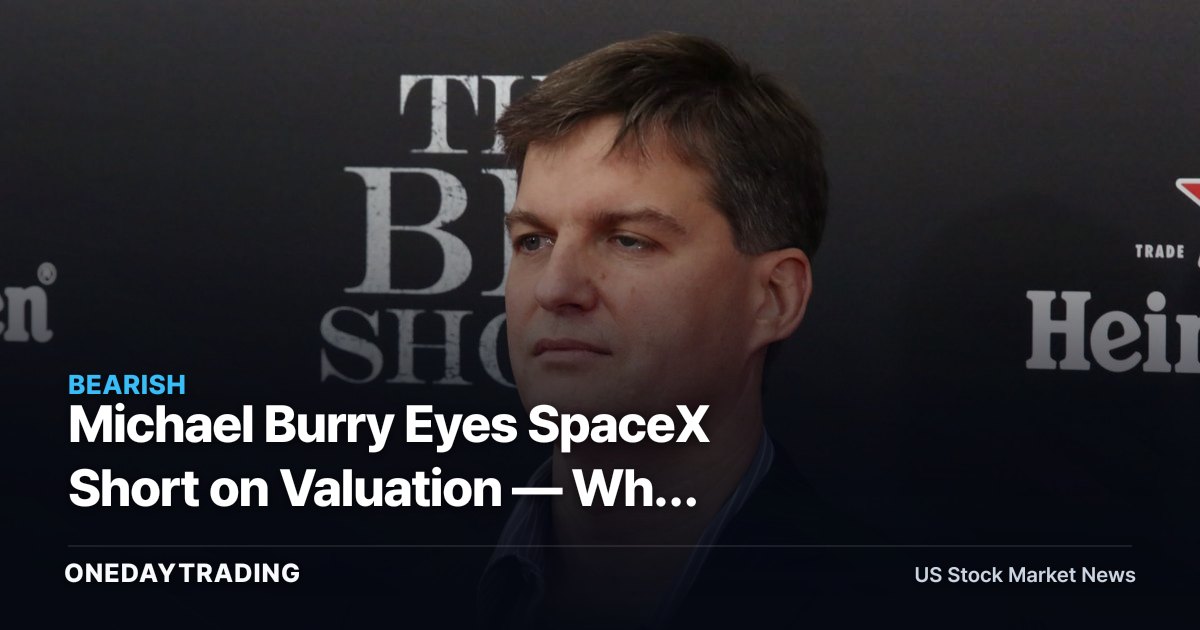
Michael Burry, the investor behind the 2008 housing short, says SpaceX has grown so large that its market capitalization dwarfs many established businesses and fortunes, tempting him to bet against it. He passed only because the cost of options to express that trade was too high. SpaceX is private, so the read-through lands on listed space names and on the broader appetite for richly valued, founder-led companies.
The Full Story
The signal here is not the trade Burry made, but the trade he wanted to make and could not justify on price. His argument is a valuation argument: SpaceX sits at a level that, in his framing, outsizes the worth of long-running public companies and individual fortunes. That is a classic Burry setup, where he questions whether an asset has detached from any anchor of underlying earnings or cash flow.
What stops him is mechanics. Because SpaceX has no listed shares, the cleanest way to short it would run through derivatives or private-market instruments, and Burry judged the options too expensive to carry. A short thesis that cannot be funded cheaply often dies in the spread, regardless of conviction. For public investors, the more useful takeaway is that a noted skeptic is publicly flagging the private space sector's valuation as stretched.
Because retail traders cannot buy SpaceX directly, sentiment tends to spill into the tradable comparables: listed launch and satellite companies, and Elon Musk's other vehicles where a valuation premium is partly tied to his brand.
Structural Background
SpaceX's value is built on two engines: a dominant launch business and Starlink's satellite-internet subscriber base. Neither has a clean public-market mirror, which is exactly why the stock cannot be shorted in the open market and why its private valuation can run without the discipline of daily price discovery. When a high-profile investor calls that valuation excessive, the friction he describes — costly, hard-to-source short exposure — is itself evidence of how one-directional private growth-equity markets have become.
Stock and Sector Ripple
- Rocket Lab (RKLB): the closest listed pure-play on launch and space systems; investor doubt about SpaceX's premium can re-rate the whole launch peer group, in either direction depending on whether SpaceX is seen as the bar or the bubble.
- AST SpaceMobile (ASTS): a listed satellite-connectivity proxy that competes with the Starlink direct-to-device thesis, so debate over Starlink's embedded value flows straight into its multiple.
- Tesla (TSLA): shares part of the Musk valuation premium; skepticism aimed at one Musk-led franchise can pressure sentiment on the others.
- Space and defense ETFs: broad space-themed funds carry concentrated narrative risk, so a credible short-seller's commentary can compress the speculative end of the sector.
Bull vs Bear Scenarios
Bear case: a recognized contrarian is naming the price as the problem, and the fact that shorting is too costly to execute can mark a crowded, one-way market — the kind of setup that historically precedes a repricing in the speculative cohort. Bull case: Burry explicitly declined to put on the trade, his past bearish calls have been early or wrong, and launch and Starlink demand are real, growing revenue streams rather than pure story. A private valuation also faces no margin call, so it can stay elevated far longer than a public short-seller can wait.
Investor Action Points
- Track the next funded SpaceX valuation print in any tender or secondary round as the reference point investors will compare against public peers.
- Watch RKLB and ASTS forward revenue and contract backlog at upcoming earnings to separate fundamentals from sentiment-driven moves.
- Monitor Starlink subscriber and ARPU disclosures, since that is the line item underpinning the disputed premium.
- Treat Burry's commentary as a sentiment marker, not a timing signal; size any space-sector exposure to the wide outcome range he is highlighting.
Market data check: RKLB
RKLB last traded near $104.75 (-4.12%). Our composite signal — blending price momentum and news flow — reads 🟡 neutral. Price momentum scores 17/100 (soft).
Data as of publication. Price via market feeds; for reference only, not investment advice.
📊 Analysis
Signal Bearish
Why A prominent short-seller publicly framing SpaceX's valuation as excessive casts a cautious shadow over listed space proxies and high-multiple, founder-premium stocks.
This article was independently written by OneDayTrading from public reporting. Read the original (CNBC)