What Changes
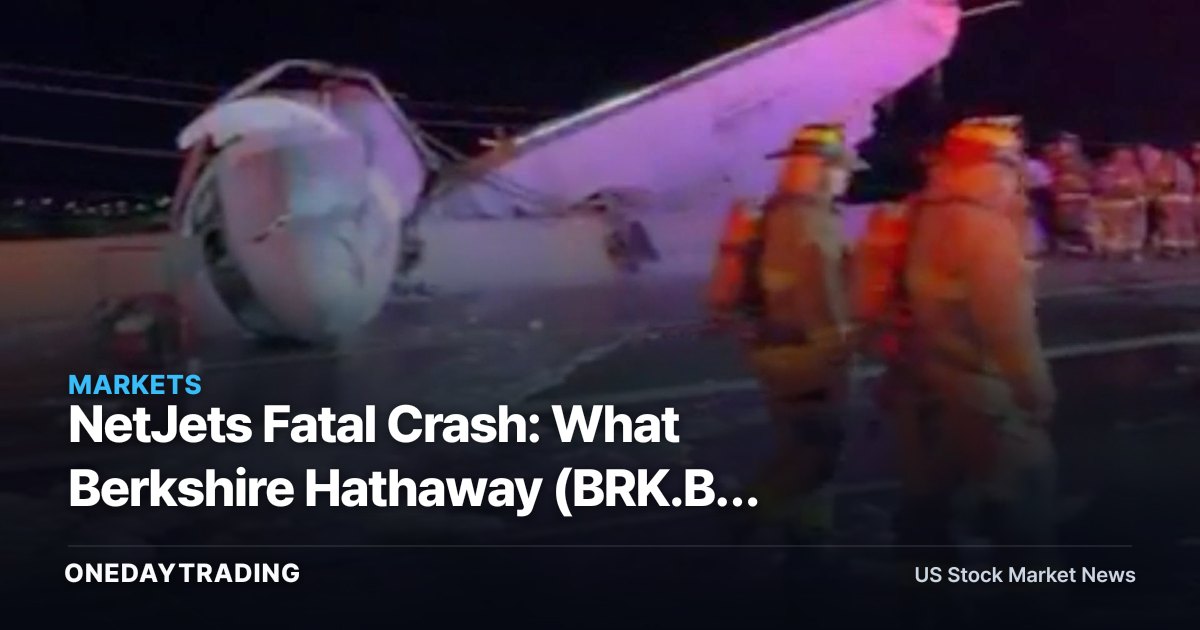
The instinct for retail investors is to ask whether a single tragic accident moves a roughly trillion-dollar conglomerate. On the numbers, no — NetJets is one subsidiary inside Berkshire Hathaway's sprawling mix of insurance, rail, energy and consumer businesses, and one airframe loss does not dent group earnings. The more durable question is reputational, because NetJets sells safety and reliability as its core product, not just travel.
Fractional ownership clients pay a premium precisely to avoid the perceived risks of charter aviation. A first-ever fatal crash, after decades of an unblemished record, attacks that premium directly. The competitive set — rivals such as Flexjet and Vista Global's brands — could use any prolonged safety scrutiny as a wedge, while NetJets leans on its long clean history as a defense. For Berkshire shareholders, the signal to track is whether this becomes a one-off NTSB investigation or a broader narrative about pilot, maintenance or operational standards.
By the Numbers
The hard facts remain thin: one aircraft, one fatality confirmed, a crash onto a public highway in Laredo, and the company's own acknowledgment that this is its first fatal accident. NetJets has stated it will not speculate on the cause pending investigation. Investors should resist filling that gap with assumptions — the cause determination, typically led by the NTSB, is what will shape any liability and insurance exposure, and that process runs in months, not days.
Winners & Losers
- Berkshire Hathaway (BRK.B): Negligible direct financial hit given scale and self-insurance capacity, but carries headline and reputational risk tied to a flagship lifestyle brand.
- NetJets brand/private-aviation demand: Most exposed channel — its entire value proposition is safety and exclusivity, so sustained scrutiny pressures pricing power and client retention.
- Competing operators (Vista, Flexjet, charter platforms): Marginal beneficiaries if safety becomes a comparison point, though the whole category absorbs reputational spillover when a high-profile crash hits the news.
- Aviation insurers and litigation exposure: A potential cost channel depending on the cause finding and any wrongful-death claims.
Risk Check
- Cause is unknown — weather, mechanical, or pilot factors each carry very different liability and brand implications.
- Reputational damage is hard to quantify and may not show in any reported metric for several quarters.
- Reading durable investment meaning into a single accident risks overreaction; Berkshire's diversification cushions almost any single-unit event.
- Regulatory or fleet-grounding actions, if the cause points to a systemic issue, would be the main escalation path to watch.
Bottom Line
For Berkshire Hathaway holders this is a human tragedy with limited near-term financial consequence, yet it touches the one asset NetJets cannot easily rebuild — an unbroken safety reputation. The checkpoint is the NTSB cause finding and any change in NetJets operational disclosures; until then, the prudent read is reputational watchfulness rather than an earnings concern.
📊 Analysis
Signal Neutral
Why A single aircraft loss is financially immaterial to a diversified trillion-dollar conglomerate, so there is no clear directional earnings impact despite the reputational angle.
This article was independently written by OneDayTrading from public reporting. Read the original (CNBC)