At a Glance
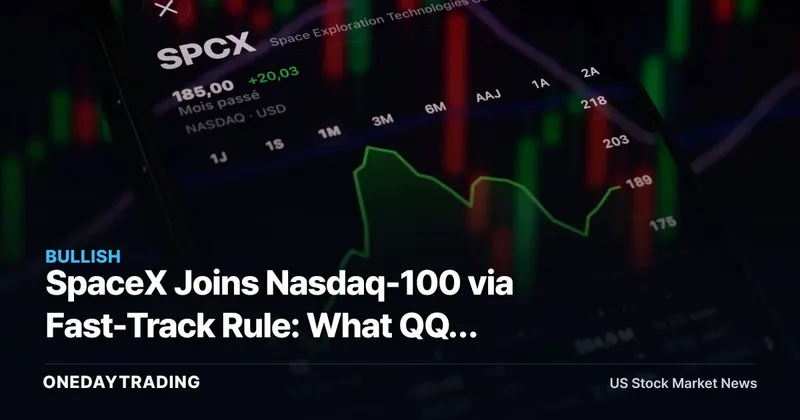
SpaceX is set to join the Nasdaq-100, becoming one of the first companies to enter the benchmark through Nasdaq's recently adopted fast-track inclusion framework. The mechanical read-through lands on every fund that mirrors the index, led by the Invesco QQQ Trust, which must rebalance to add the new constituent and trim a displaced one.
Why It Matters Now
Index inclusion is not a stock-picking decision; it is a flow event. Passive vehicles tracking the Nasdaq-100 do not get to vote on valuation. Once Elon Musk's company is named to the benchmark, those funds are obligated buyers at the reconstitution, and a current member loses weight to make room. That forced, price-insensitive demand is the entire reason inclusion matters to investors who never intend to own the name directly.
The deeper signal is the fast-track framework itself. Traditional inclusion waited on seasoning periods and scheduled annual reviews. Compressing that timeline means newly eligible large-caps can enter the index sooner, raising the cadence of rebalancing surprises for QQQ holders and tightening the link between a listing event and passive flows. SpaceX being among the first to use it sets the template for how quickly the next eligible names follow.
FAQ
- What is the fast-track framework? A recently adopted Nasdaq mechanism that shortens the path for qualifying companies to join the Nasdaq-100 outside the usual annual reconstitution schedule.
- Who is forced to buy? Funds benchmarked to the Nasdaq-100, most prominently QQQ, plus institutional index portfolios that replicate the same weights.
- Does someone get dropped? Yes. The Nasdaq-100 holds a fixed count, so adding SpaceX displaces or reduces an existing constituent.
- Is this a buy signal? No. Inclusion changes ownership mechanics and flows, not the underlying business fundamentals.
Related Stocks & Sectors
- QQQ — the largest Nasdaq-100 tracker; its holders absorb the rebalancing directly through new weighting.
- NDAQ — Nasdaq Inc. operates the index and benefits from franchise prestige as marquee names join.
- Existing Nasdaq-100 members — every constituent sees its relative weight diluted when a new large-cap is added.
- Aerospace and space exposure — heightened investor attention on the launch sector as a private giant nears benchmark status.
What to Watch
- The official inclusion date and effective reconstitution timing.
- Which constituent is removed or reweighted to make room.
- QQQ's tracking and any pre-rebalance positioning ahead of the effective date.
- Whether other eligible names queue up behind SpaceX under the same fast-track rule.
Overall Outlook
The bull read is straightforward: a high-profile addition broadens the index's growth profile and channels mechanical passive demand toward the new name. The risk is that inclusion-driven flows are one-time and front-run; once the rebalance clears, fundamentals reassert control. For QQQ holders, the practical effect is a quiet shift in composition rather than a thesis change, and the bigger story is a faster, more reactive index that can reprice its membership with less warning.
📊 Analysis
Signal Bullish
Why Nasdaq-100 inclusion via the fast-track rule creates mechanical passive-buying demand and franchise prestige, a net-positive flow catalyst for the index ecosystem.
This article was independently written by OneDayTrading from public reporting. Read the original (CNBC)