Key Takeaways
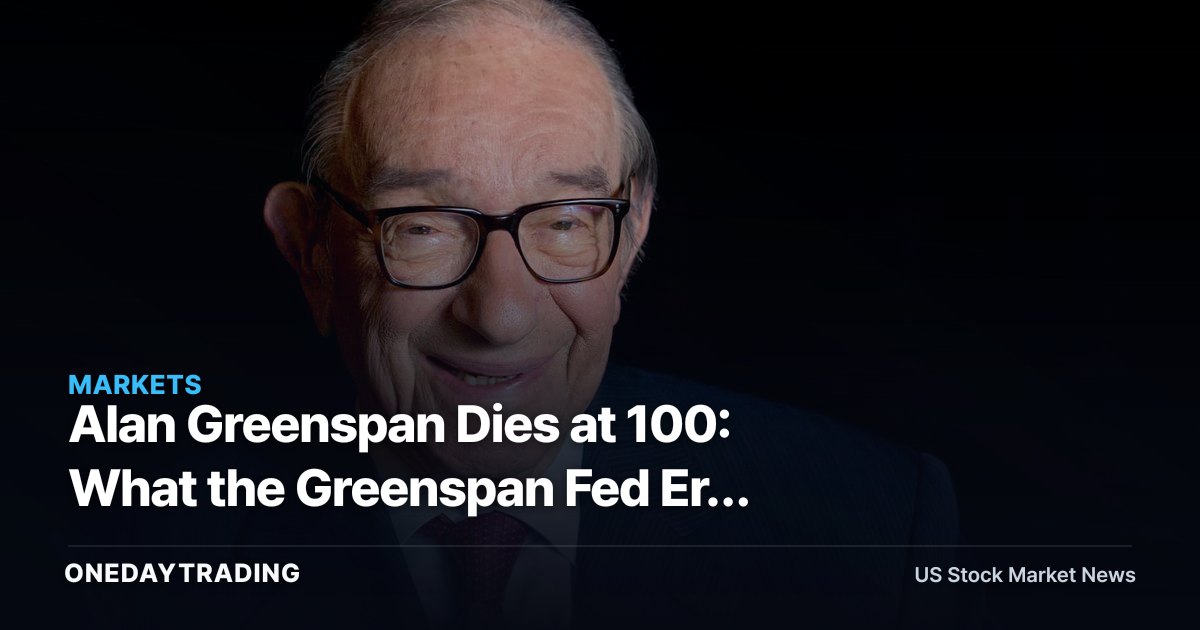
Alan Greenspan, who chaired the Federal Reserve for 19 years across four U.S. presidents, has died at age 100. The news carries no direct earnings or policy catalyst, but his tenure reshaped how markets read the Fed, popularized the idea of central-bank backstops, and framed debates over asset bubbles that still drive equity and bond positioning today.
What Happened
Greenspan led the Federal Reserve from 1987 until 2006, a span covering the administrations of Ronald Reagan, George H.W. Bush, Bill Clinton and George W. Bush. He became known for a deliberately opaque communication style nicknamed Fedspeak, in which carefully hedged language let him move markets while avoiding firm commitments.
His death at 100 closes the book on one of the most influential monetary policymakers of the modern era. His chairmanship began weeks before the October 1987 stock-market crash and ran through the late-1990s technology boom, the dot-com bust, and the early-2000s rate-cutting cycle that critics later linked to the housing bubble.
Background and Context
Greenspan coined the phrase irrational exuberance in 1996, a warning about stretched asset prices that is still quoted whenever valuations run hot. His era also gave rise to the notion of the Greenspan put, the market belief that the Fed would cut rates to cushion sharp declines, a mindset that arguably shaped risk appetite for decades.
The contrast with today matters. Modern Fed leadership has shifted toward transparency, dot plots and explicit forward guidance, the opposite of Fedspeak, partly as a reaction to the ambiguity of the Greenspan years.
Market and Stock Impact
- Rate-sensitive equities: No immediate move, but Greenspan's legacy is a reminder that the market still prices in an implicit central-bank backstop, supporting high-multiple growth and tech names when policy is expected to ease.
- Banks and financials: His deregulatory stance and the credit conditions of his late tenure remain reference points in debates over bank oversight and capital rules.
- Long-duration bonds: The Greenspan-era conundrum, when long yields stayed low despite rate hikes, still informs how investors interpret a flat or inverted yield curve.
- Broad index investors: His irrational exuberance framing endures as a valuation check for those tracking the S&P 500 and Nasdaq at elevated multiples.
Investor Checkpoints
- Watch the next FOMC statement and dot plot for how far current guidance has moved from the Fedspeak model, a gauge of policy predictability.
- Track the 10-year Treasury yield as the cleanest live read on the rate backdrop Greenspan helped define.
- Note whether commentary around any market stress invokes a Fed put, signaling that backstop expectations are back in pricing.
- Compare current equity valuations against the historical levels that prompted the irrational exuberance warning.
Outlook
For active markets the practical impact is minimal; this is a legacy event, not a trading catalyst. The bull-case reading is that decades of central-bank support have conditioned investors to buy dips, underpinning risk assets. The risk is the mirror image: the same era is often cited as the origin of moral hazard and the credit excesses that fed the 2008 crisis, a caution that backstop assumptions can fail precisely when they are most relied upon.
📊 Analysis
Signal Neutral
Why An obituary of a former Fed chair carries historical and contextual weight but no direct earnings, policy or demand catalyst that moves specific stocks.
This article was independently written by OneDayTrading from public reporting. Read the original (CNBC)