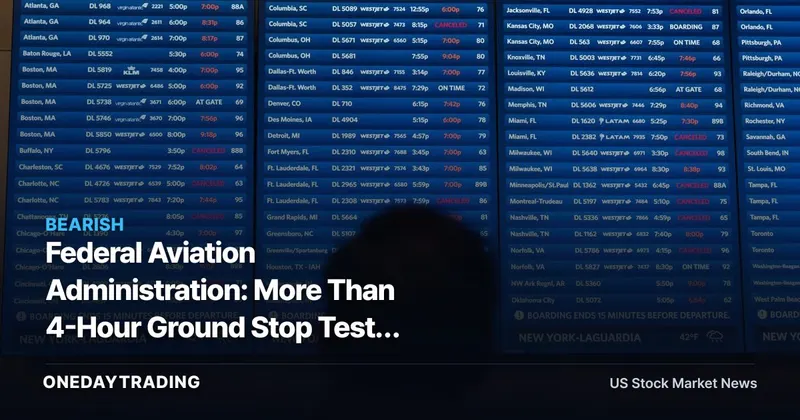
CNBC Data Frame the Airline-Sector Risk
CNBC reported that the Federal Aviation Administration grounded nationwide departures for more than 4 hours on Friday, leaving U.S. airlines to rebuild schedules through Sunday. For investors, the immediate issue is not simply the initial halt. It is the operational work required to reposition aircraft, crews and passengers after the system restarts.
- FlightAware recorded more than 1,600 U.S. flight cancellations and more than 4,000 delays as of noon ET Sunday.
- The disruption forced airlines to waive change fees and fare differences while offering pilots and flight attendants extra pay.
- The next test is whether schedules actually return close to normal on Monday; that outcome was not established in the available evidence.
Why the Federal Aviation Administration Ground Stop Matters
A nationwide ground stop is a halt to departures across the national air-travel network. The Federal Aviation Administration imposed that restriction for more than 4 hours on Friday, and the effects were still visible on Sunday. Once departures stop at that scale, reopening the system does not automatically put each aircraft, employee and passenger back where the schedule requires them.
That distinction drives the investment read-through. Airlines waived change fees and fare differences to give customers flexibility, while extra pay for pilots and flight attendants was intended to ease the disruption. Those responses may support recovery and customer handling, though they can also increase the resources required to restore service. The fact sheet does not provide airline revenue, expense or earnings estimates, so the magnitude cannot be quantified.
Delta Air Lines appeared in the passenger experience described by CNBC: Beth Martin received delay announcements before her flight was canceled, and the airline later booked her and her daughter on a different routing. That establishes direct exposure to the operating disruption, not a company-specific financial outcome. No supplied evidence supports ranking Delta Air Lines against other carriers or estimating an effect on its stock.
FlightAware Counts Show the Disruption’s Scale
FlightAware data cited by CNBC showed more than 1,600 U.S. flights canceled and more than 4,000 delayed as of noon ET Sunday. The article also reported almost 6,700 cancellations on Saturday and more than 9,200 on Sunday. These figures show that the consequences extended beyond the more than 4-hour nationwide departure halt itself.
The passenger evidence makes the operating friction tangible. Beth Martin and her daughter slept at LaGuardia Airport after their flight was canceled because an additional hotel night on Saturday cost about 700 USD. Their alternative trip required 4 hours of driving by Martin’s husband after Delta Air Lines booked them to Memphis.
Justine Fritz tried 5 different flights after Friday’s business event. Following the cancellation of her Saturday flight, she flew 4 hours out of her way to return to Minneapolis and expected to miss 1 hour of the Vikings game. These cases do not measure the average passenger experience, though they illustrate how a network interruption can convert one cancellation into repeated rebooking and longer travel.
L3Harris Technologies and the Infrastructure Question
Sean Duffy linked the issue to a router and work replacing copper wires with a fiber-optic system. L3Harris Technologies oversaw the copper-wire system being updated for the Federal Aviation Administration, while Bryan Bedford characterized the upgrades as “routine” maintenance.
L3Harris Technologies said it was supporting the investigation into the conditions surrounding the Nov. 13 nationwide air-travel ground stop. The precise technical cause and the investigation’s findings remain unknown. That boundary matters: the presence of a contractor in an infrastructure upgrade does not establish responsibility for the event.
For industrial and transportation investors, the useful distinction is between the need for modernization and the unanswered question of causation. Fiber-optic conversion may remain part of the upgrade program described by officials. The evidence does not show whether the conversion work, a router, another technical condition or some combination produced the ground stop.
Airline Exposure and Potential Beneficiaries
- Airlines: The near-term direction is negative because cancellations and delays required fee waivers, fare-difference waivers and extra crew pay. Recovery could limit the duration of that burden if Monday operations run close to normal.
- Delta Air Lines: The carrier was directly involved in the documented rebooking of Beth Martin and her daughter. The available facts do not disclose the number of Delta Air Lines passengers affected or the carrier’s financial cost.
- L3Harris Technologies: The company is connected to the copper-wire system being replaced with fiber optics and is supporting the Federal Aviation Administration’s investigation. That relationship may keep attention on its role, while no finding in the fact sheet assigns fault.
- Air traffic control infrastructure: Sean Duffy sought as much as 50 billion USD for upgrades shortly after the ground stop. Congress had already approved 12.5 billion USD for airport and air traffic control improvements over 5 years, creating a policy debate over additional funding and existing resources.
Funding Debate After the Nov. 13 Ground Stop
The policy response could shape the longer-term industrial read-through. Sean Duffy’s request for as much as 50 billion USD frames the disruption as evidence for broader air traffic control investment. Rick Larsen and Andre Carson pushed for accountability and pointed to unspent money within existing funding.
Congress had approved 12.5 billion USD over 5 years for airport and air traffic control improvements. The central question is therefore not limited to the size of a possible funding package. Investors also need evidence about how existing funds are deployed, which systems receive priority and whether the investigation changes the scope of planned work.
No additional appropriation is confirmed in the supplied facts. Treating the requested 50 billion USD as awarded spending would overstate the policy outlook, just as treating modernization demand as proof of a contract for L3Harris Technologies would exceed the evidence.
Risk Check Before Monday’s Schedule
- Operational normalization: The clearest near-term checkpoint is whether Monday flights actually run close to normal. Continued cancellations or delays would extend the recovery work; normalized operations would contain it.
- Investigation findings: The technical cause is still undetermined. Any assessment of responsibility should wait for evidence from the Federal Aviation Administration’s investigation.
- Final disruption totals: The exact number of affected passengers and the final cancellation and delay counts are unavailable, preventing a complete estimate of the event’s scale.
- Policy conversion: Sean Duffy’s proposed funding must be separated from Congress’s already approved 12.5 billion USD over 5 years. A request does not establish additional spending or an award to any company.
The Investor Bottom Line
The airline sector faces a bearish near-term operating signal because the Federal Aviation Administration’s more than 4-hour ground stop was followed by extensive cancellations, delays, passenger rebooking and extra crew compensation. The counter-scenario is a rapid Monday normalization that limits the duration of those pressures. Beyond the airlines, the investigation and the debate over 50 billion USD in requested upgrades will determine whether this remains a contained disruption or becomes a broader air traffic control investment issue.
📊 Analysis
Signal Bearish
Why Waived passenger fees, extra crew pay and persistent operational disruption create a negative near-term setup for the airline sector, while the final financial impact remains unknown.
This article was independently written by OneDayTrading from public reporting. Read the original (CNBC)