Nvidia’s CEO Crisis at a Glance
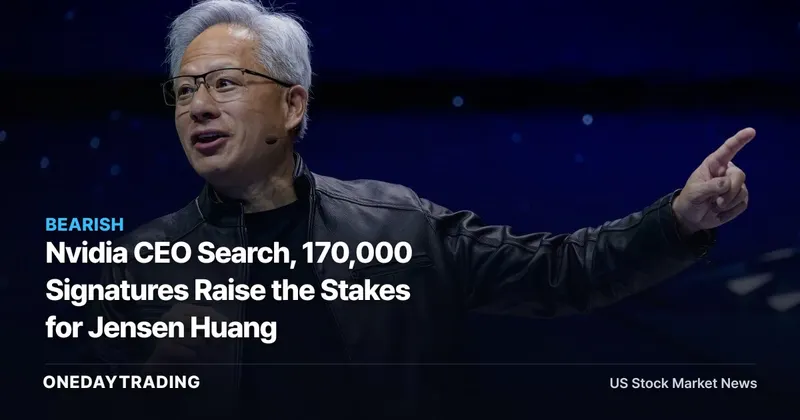
On 2026-11-16, Nvidia faced growing calls to restore Jensen Huang as CEO after his resignation, even as its board searched for a successor and continued an independent investigation. For NVDA investors, the central issue is not whether a petition can produce a comeback; it is whether the board can resolve leadership, governance and operating authority without allowing those questions to overshadow the semiconductor company’s fiscal third-quarter earnings.
CNBC reported that the Stand with Jensen campaign had collected more than 170,000 signatures. That is a substantial public show of support, but it is not a board decision, and the petition website says signatories’ stated affiliations are self-reported and unverified.
This leadership transition is the process of replacing Huang as Nvidia’s permanent chief executive after he resigned as president, CEO and board member. Longtime finance chief Colette Kress is serving as interim CEO while the company selects a search firm and considers its next step.
Why Jensen Huang’s Potential Return Matters to Nvidia
Huang’s importance to the debate begins with institutional continuity: Jensen Huang co-founded Nvidia in 1993. Reinstating a co-founder could preserve a familiar center of authority, while appointing a new permanent CEO would require the company to establish leadership under a different executive.
The support campaign extends beyond online signatures. Elon Musk said, “A petition is underway to reinstate Jensen and I'm signing it too.” Garry Tan, CEO of Y Combinator, argued that Huang deserved due process, while Tim Sweeney, CEO of Epic Games, posted “save Jensen!” Tobias Lütke and Travis Kalanick also confirmed their signatures on X, and Hugging Face CEO Julien Chaumond was listed as a signatory.
Employee-linked support adds another dimension, although the affiliations cannot be treated as verified. Darrell Dai identified himself as an Nvidia robotics engineer, while Vartika Singh said she had worked at Nvidia for nearly eight years and wrote, “I have never worked for anyone quite like Jensen Huang, and I doubt I ever will.” These statements show the depth of personal support around Huang; they do not establish how the wider workforce views the succession.
Shareholder pressure is also visible. Altimeter Capital CEO Brad Gerstner and Gavin Baker of Atreides Management urged the board to examine all available options, including Huang’s possible return. Their position raises the cost of making a permanent appointment without first addressing demands for a measured process, although the board’s investigation remains a separate constraint.
The Nvidia Board Faces Two Different Decisions
Nvidia must choose a permanent CEO while independently determining the outcome of the investigation into the conduct that led to Huang’s departure. Combining those questions into a single referendum on Huang would obscure the distinction between executive capability and the board’s governance responsibilities.
The formal search remains at an early stage based on the company’s own account. An Nvidia spokesperson said the company was choosing a search firm and added, “We have not formally engaged any potential candidates.” That statement limits how much investors can infer from reported names or public lobbying.
The Financial Times reported that the board approached Arm CEO Rene Haas as a potential successor. That establishes Haas as a reported option, not a formally engaged candidate, and the fact sheet does not indicate whether Nvidia will advance discussions with him or anyone else.
The investigation creates an asymmetric decision problem. A return before its outcome could leave the board exposed to unresolved findings; excluding Huang before the process concludes could intensify pressure from supporters who want him considered. The board’s next communication therefore needs to clarify process and authority, even if it does not immediately identify the permanent CEO.
Supporters and Skeptics Disagree on the Operating Risk
- The continuity case: Neil Shah, vice president of research at Counterpoint Research, said a Huang return could be good for the stock. Shah tied Huang’s leadership rhythm to an AI ecosystem associated with trillion-dollar capex every year, while questioning whether new guardrails would restrict Huang’s effectiveness.
- The governance case: Anthony Scaramucci, founder of SkyBridge, rejected the comeback campaign with the statement, “The tech bros want Jensen back. Not happening.” His view emphasizes that public support cannot itself settle an investigation or determine the board’s decision.
- The precedent debate: Scaramucci also rejected comparisons with Sam Altman, CEO of OpenAI, who returned after his 2023 ouster. The existence of that separate episode does not establish a likely outcome for Nvidia because Huang’s return and the investigation’s result remain unknown.
- The conditional comeback case: Jay Goldberg, senior analyst at Seaport Research Partners, saw a possible path back for Huang if he could overcome the challenges around him. Dan Ives, partner and senior managing director at Yorkville Ives & Co., took the opposite view: “We see no chance Jensen comes back to Nvidia as CEO.”
NVDA Is the Direct Market Exposure
- Nvidia: NVDA is the directly affected U.S.-listed stock because the unresolved questions concern its permanent CEO, board investigation and interim leadership. The investment tension is between continuity under Huang and stability under a successor; neither outcome is confirmed.
- Semiconductors and AI infrastructure: The leadership decision matters to the sector narrative because Nvidia sits inside the AI ecosystem discussed by Neil Shah. The fact sheet supplies no shipment, order, utilization or financial guidance figures, so it does not support a quantified sector read-through.
- Arm: Arm enters the story through the Financial Times report that Nvidia’s board approached Rene Haas. No evidence establishes that Nvidia formally engaged Haas or that the report produced a measurable effect on Arm, so NVDA remains the only ticker with a direct supported market impact.
- Huawei: Huawei is described as Nvidia’s biggest competitor in China. The supplied evidence does not quantify any competitive change resulting from Nvidia’s leadership transition, which prevents a stronger company-specific conclusion.
Investigations Set the Boundary for Any Comeback
Nvidia’s independent investigation is the main unresolved condition around Huang’s possible reinstatement. Its outcome is unknown, and the available evidence does not establish whether the board will complete that work before appointing a permanent chief executive.
A separate process concerns Megaspeed. The company said it retained external legal counsel for an internal investigation and that Alice Huang left Megaspeed effective Aug. 30, 2025, with no continuing role there. The result of Megaspeed’s investigation is also unknown, so it cannot be used to infer the outcome of Nvidia’s review.
Scott Bessent said Nvidia should look outside the company for its next executive. That position adds to the public debate over succession, though it does not change the company’s statement that no potential candidate had been formally engaged.
What NVDA Investors Should Check Next
- Fiscal third-quarter earnings: Nvidia was scheduled to report fiscal third-quarter results Tuesday. The immediate test is whether Colette Kress and the leadership team can address the company’s performance while explaining decision-making authority during the transition.
- The CEO search process: Confirmation that Nvidia has selected a search firm would move the succession beyond its stated preparatory stage. Formal engagement with Rene Haas or another candidate would be a separate and more consequential signal.
- The independent investigation: Its findings could determine whether Huang remains a viable option. Until the outcome is disclosed, both reinstatement and permanent exclusion remain unconfirmed.
- Board communication: Investors should distinguish evidence about the formal search from endorsements, petition totals and reported approaches. Each speaks to pressure around the decision, but only the board can appoint the next permanent CEO.
Nvidia’s Outlook Hinges on Process, Not Petition Momentum
The constructive scenario is a disciplined resolution: Nvidia completes the investigation, defines the interim team’s authority and chooses between Huang and a successor through a credible process. Support from technology executives, employees identifying themselves as Nvidia staff and investors including Brad Gerstner and Gavin Baker shows why the board cannot treat the leadership question as routine.
The risk scenario is prolonged overlap between the investigation, the search and the campaign for reinstatement. More than 170,000 signatures give the Stand with Jensen campaign visibility, but they do not verify employee sentiment or determine the investigation’s findings. Public disagreement may keep attention on governance when the company is also presenting fiscal third-quarter earnings.
That balance supports a bearish near-term assessment of the leadership event without implying a forecast for Nvidia’s business results. The next investable evidence will come from the fiscal third-quarter report, the board’s search milestones and the investigation’s outcome—not from the volume of endorsements alone.
📊 Analysis
Signal Bearish
Why Nvidia’s unresolved CEO search and independent investigation create governance uncertainty ahead of its fiscal third-quarter earnings report.
This article was independently written by OneDayTrading from public reporting. Read the original (CNBC)