Nvidia Investors Put Process Ahead of an Immediate Reinstatement
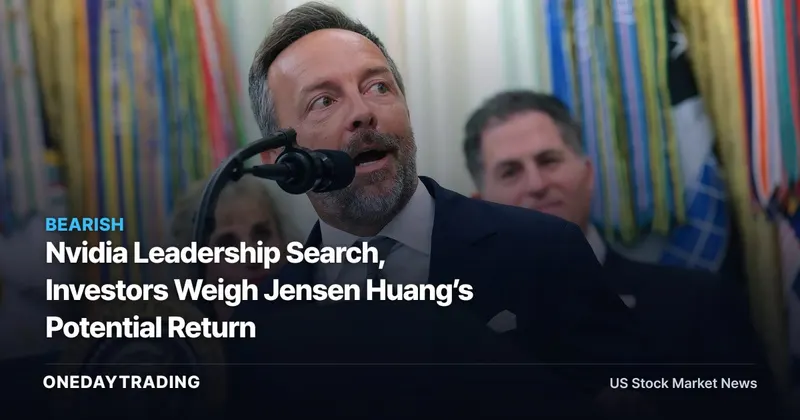
Nvidia shareholders with $2.13 billion of stock as of June 30 are pressing the board to preserve leadership options after Jensen Huang resigned on Thursday. For investors, the central issue is not simply whether the founder returns; it is whether the board can maintain operating continuity while addressing an unsettled leadership process and a separate investigation involving customer Megaspeed.
CNBC reported that Altimeter Capital CEO Brad Gerstner posted the shareholder letter on Friday, with Gavin Baker of Atreides Management also signing it. The document asked Nvidia to conduct a slow, measured and deliberate search, including consideration of Huang’s potential return, without demanding his immediate reinstatement.
What the Nvidia Leadership Search Means
A leadership search is the board’s process for evaluating permanent management options while an interim executive keeps the company operating. The investors’ message separates those functions: Colette Kress can provide continuity now, while the board avoids committing to a permanent outcome before the relevant facts are established.
The disclosed stakes give the intervention financial weight. Altimeter Capital held 9.4 million Nvidia shares worth nearly $1.9 billion as of June 30, according to CNBC, and Nvidia was its largest disclosed equity holding in its most recent SEC filing. Atreides Management held 1.2 million shares worth nearly $250 million at the end of June.
Those holdings do not determine the board’s decision. They do show that the request comes from shareholders with substantial exposure to the consequences of a rushed appointment, a prolonged vacuum or a disputed return. Their preferred route is procedural patience rather than a predetermined winner.
Colette Kress Provides Nvidia With an Operating Bridge
Nvidia’s board announced on Thursday that Colette Kress would lead the company in Huang’s absence. She had served as chief financial officer for 13 years before that announcement, and the investor letter said she would lead Nvidia capably.
That history matters because an interim leader’s immediate task is continuity, not resolution of every governance question. Kress gives the board room to assess permanent leadership without leaving the company leaderless. The countercondition is equally important: the fact sheet does not establish who will become permanent CEO or whether Huang will return.
For the stock, this creates two distinct variables. Operational continuity can reduce the disruption associated with an abrupt resignation, while uncertainty over permanent authority can remain a risk until the board communicates a decision. Investors should keep those variables separate rather than treating an interim appointment as evidence that the succession issue is settled.
Jensen Huang’s Exit Meets a Wider Policy Investigation
Huang resigned on Thursday amid multiple affair allegations. The available facts do not establish whether those allegations are true, and the board letter argues against replacing him before all relevant facts are known. That position supports due process without resolving the underlying claims.
The policy dimension centers on Megaspeed, an Nvidia customer being investigated by the Justice Department for possibly redirecting restricted Nvidia artificial intelligence chips to China. Alice Huang worked with Megaspeed. Whether the company redirected restricted chips, and how the investigation will end, remain unknown.
The Commerce Department began the Megaspeed investigation before it moved to the Justice Department in 2025, according to reporting attributed to The New York Times. A letter sent Friday asked Howard Lutnick to testify about Megaspeed before the House Intelligence Committee. Lutnick agreed to testify before the Senate Banking Committee on Dec. 10 about the Commerce Department’s broader role in preventing China from acquiring advanced AI chips, and Jensen Huang was also asked to testify.
This channel matters to Nvidia because leadership scrutiny and controls on advanced AI chips are now part of the same investor risk frame, even though the facts do not establish the outcome of either process. The board must evaluate management while government bodies examine conduct involving a customer and restricted products.
Nvidia Stock and AI-Chip Risk Channels
- Nvidia: The direct pressure comes from uncertainty over permanent leadership, the unresolved allegations surrounding its founder and the Justice Department investigation involving customer Megaspeed. Continuity under Colette Kress is the principal offset identified by the shareholder letter.
- Advanced AI chips: Howard Lutnick’s Dec. 10 testimony before the Senate Banking Committee creates a defined policy checkpoint concerning the Commerce Department’s role in preventing China from obtaining restricted technology.
- SpaceX connection: SpaceX CEO Elon Musk said on Friday that he signed a petition seeking Huang’s reinstatement. On Saturday, Musk said “critical deals will be lost” without Huang, though the fact sheet provides no deal values, counterparties or confirmed losses.
The “Stand with Jensen” petition claims more than 100,000 signatures, including more than 5,000 current Nvidia employees. CNBC identified those as claimed counts, and the fact sheet says they were not independently verified. The petition may signal organized support, but it does not establish the board’s decision or the commercial effect of Huang’s absence.
Bull and Bear Cases for Nvidia’s Board
Bull case: Kress’s long tenure as CFO may help preserve continuity while the board runs a deliberate process. The two shareholders are not demanding an immediate reversal; their letter leaves room for the board to examine Huang’s potential return, retain Kress or select another permanent leader after reviewing the facts.
Bear case: The company faces unresolved questions about its permanent CEO at the same time that the Justice Department is investigating whether a customer redirected restricted Nvidia AI chips to China. Public pressure from shareholders, employees and Elon Musk could also complicate the board’s process without resolving the allegations or the policy inquiry.
The outcome cannot be inferred from either the size of the investors’ holdings or the petition. A credible process could contain governance risk, while an extended or contested search could keep attention fixed on leadership instead of execution. Neither scenario supplies evidence about future revenue, shipments, orders or margins, so those operating effects should not be assumed.
Concrete Checkpoints for Nvidia Investors
- Board process: Watch whether Nvidia describes the scope and timing of its permanent leadership search, and whether Jensen Huang is formally considered for a return.
- Interim authority: Monitor company communications for evidence that Colette Kress retains the board’s support while the search proceeds.
- Policy testimony: Howard Lutnick’s Dec. 10 appearance before the Senate Banking Committee is the clearest dated checkpoint for scrutiny of advanced AI-chip controls. Jensen Huang’s requested testimony is another potential source of relevant facts, though no date is supplied.
- Justice Department inquiry: Track whether the Megaspeed investigation establishes that restricted Nvidia chips were redirected to China. That conduct and the investigation’s outcome are currently unconfirmed.
Donald Trump is scheduled to visit China on Thursday and meet Xi Jinping, while Elon Musk is expected to join the trip to Shenzhen for the Asia-Pacific Economic Cooperation summit on Nov. 18 and 19. U.S. officials said Trump did not plan to raise Nvidia and the suspected spy affair during the meeting. The live stock question therefore remains with Nvidia’s board: whether continuity under Kress gives it enough time to establish the facts before choosing a permanent leader.
Market data check: NVIDIA Corporation
NVIDIA Corporation last traded near $162.85 (-2.01%). Our composite signal — blending price momentum and news flow — reads 🟡 neutral. Price momentum scores 34/100 (soft).
Data as of publication. Price via market feeds; for reference only, not investment advice.
📊 Analysis
Signal Bearish
Why Leadership uncertainty and a Justice Department investigation involving an Nvidia customer create unresolved governance and policy risks despite support for an orderly process.
This article was independently written by OneDayTrading from public reporting. Read the original (CNBC)