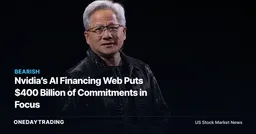
Nvidia Investors Face a Compliance Test, Not Just a Leadership Story
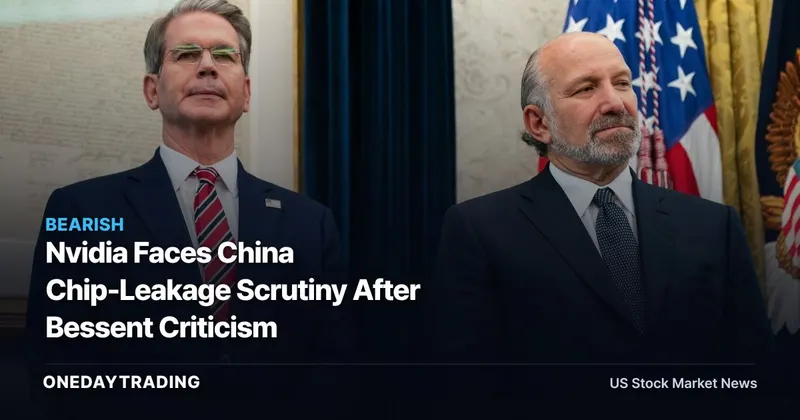
Nvidia investors now face a sharper policy and compliance risk after Scott Bessent criticized alleged chip leakage to China and described support inside the U.S. government for restrictions on Megaspeed. CNBC reported the dispute as Jensen Huang resigned as Nvidia CEO on Thursday, placing leadership turnover and questions about control of advanced processors in the same investment frame.
The event is a dispute over whether Nvidia processors were diverted to China and whether Megaspeed should face U.S. restrictions. Neither diversion nor Nvidia’s knowledge of it has been established in the supplied facts, so the defensible bearish reading concerns uncertainty, oversight and possible policy constraints rather than a proven violation.
Scott Bessent Draws the Policy Line at Nvidia’s H100s
Scott Bessent told CNBC that Donald Trump had made clear China should not receive Nvidia chips above H100s. Bessent called any leakage frustrating and said Treasury, Defense, State and the Office of the U.S. Trade Representative had favored putting Megaspeed on the entity list for months.
That distinction matters for semiconductor investors because the policy issue turns on where advanced chips ultimately go, not merely on the identity of the first buyer. If authorities conclude that existing controls cannot reliably prevent diversion, the policy response could focus on tighter customer screening or restrictions on an intermediary. The fact sheet does not establish which response, if any, will follow.
Bessent also said there was substantial leakage in the system and that officials were continually working to close it. His remarks raise a concrete diligence question for Nvidia: whether its procedures could identify customers acting as pass-throughs. They do not answer whether the company knew processors were being diverted or whether Megaspeed performed that role.
Megaspeed Restrictions Expose an Administration Dispute
Bessent’s account indicates broad departmental support for restrictions on Megaspeed, while leaving unexplained why those controls had not been implemented. The Commerce Department’s role is central to the disagreement described in the source, although the supplied record provides no decision, timetable or stated reason for the delay.
Commerce Department spokeswoman Kristen Eichamer said Scott Bessent and Howard Lutnick had no such conversation in the Situation Room. Asked about the reported exchange, Bessent replied, “We don't repeat conversations in the Situation Room.” The competing accounts mean investors should separate the confirmed policy support Bessent described from the disputed claim about a specific conversation.
The Commerce Department did not immediately respond to CNBC’s request for comment on Bessent’s remarks. Until Commerce states its position or takes an observable action, departmental support does not equal an implemented restriction. That gap between preference and execution is the core policy uncertainty around Megaspeed.
H200 Conditions Complicate Nvidia’s China Exposure
In December, Donald Trump said Nvidia could sell H200 chips to approved Chinese customers under stated conditions, according to CNBC. The permitted H200 channel and Bessent’s concern about chips above H100s make customer approval and end-user verification the operational pressure points, though the fact sheet does not detail Nvidia’s procedures.
The U.S. was also to receive a percentage of Nvidia’s H200 sales under the stated conditions. No percentage is supplied, preventing any calculation of the financial effect or the value of eligible shipments. Investors therefore cannot derive a revenue, margin or cash-flow estimate from this record.
The downside mechanism is conditional: stronger restrictions or more demanding verification could narrow the set of eligible transactions or add compliance friction. The countercase is equally specific. If approved H200 sales proceed under the stated conditions and no evidence links Nvidia to knowing diversion, the present facts would not establish direct commercial damage.
Jensen Huang’s Exit Adds Governance Pressure
Jensen Huang resigned as Nvidia CEO on Thursday after admitting to an affair. Alice Huang was identified as a Megaspeed executive, creating an established personal and corporate connection, while the assertion that U.S. intelligence deemed her a Chinese spy remains reported rather than confirmed by the fact sheet.
For shareholders, the analytical issue is whether leadership transition and policy scrutiny weaken accountability at the moment authorities are examining customer controls. No succession details, operating changes or financial effects are provided. Treating the resignation itself as proof of export-control misconduct would exceed the evidence.
Tim Scott said Jensen Huang and Howard Lutnick had been asked to testify before the Senate Banking Committee next month. Jensen Huang was separately asked to attend a closed-door briefing involving multiple House committees on Dec. 1, giving investors a defined checkpoint for potential clarification even though a closed session may not produce public detail.
Nvidia Stock and Semiconductor-Sector Read-Through
- Nvidia: The direct risk is an unresolved combination of customer-screening scrutiny, possible restrictions involving Megaspeed and CEO turnover. The facts contain no stock move, sales figure or guidance change, so the bearish assessment reflects a wider risk range rather than a measurable earnings reduction.
- Advanced AI chips: The policy boundary described by Bessent centers on Nvidia processors above H100s, while the separately stated sales framework concerns H200 chips for approved Chinese customers. The investment question is whether enforcement preserves that approved channel or makes access more restrictive.
- Semiconductor compliance: The case highlights how the identity of an intermediary and the final destination of processors can become material policy questions. No other chip company is identified in the fact sheet, so extending the analysis to named peers would be unsupported.
Bull and Bear Conditions for NVDA
Bear case: Authorities could determine that current safeguards are inadequate, restrict Megaspeed and intensify scrutiny of Nvidia’s customer controls. Combined with Jensen Huang’s resignation, that outcome could keep governance and policy uncertainty elevated even before any financial consequence can be quantified.
Bull case: The inquiries could fail to establish that Nvidia knew of diversion or that Megaspeed served as a pass-through. Approved H200 sales could remain available under the conditions Donald Trump described in December, leaving the supplied record without evidence of a revenue or guidance impact.
The decisive split is evidentiary. A confirmed enforcement action, a finding about Nvidia’s knowledge, or a clear Commerce Department position would change the analysis. Political criticism alone does not settle those questions.
Checkpoints After Bessent’s Nvidia Allegations
- Commerce action: Check whether Megaspeed is placed on the entity list and whether the department explains why restrictions had not been implemented.
- Company controls: Look for Nvidia disclosures addressing customer diligence, approved buyers and prevention of pass-through transactions, without assuming deficiencies before evidence appears.
- Congressional scrutiny: Monitor the requested Senate Banking Committee testimony next month and the Dec. 1 closed-door briefing involving Jensen Huang and multiple House committees.
- H200 framework: Watch for clarification of the conditions governing approved Chinese customers and the unspecified U.S. percentage from Nvidia’s H200 sales.
Market data check: NVIDIA Corporation
NVIDIA Corporation last traded near $160.01 (-3.72%). Our composite signal — blending price momentum and news flow — reads 🟡 neutral. Price momentum scores 20/100 (soft).
Data as of publication. Price via market feeds; for reference only, not investment advice.
📊 Analysis
Signal Bearish
Why Unresolved diversion questions, potential Megaspeed restrictions and leadership turnover create compliance and governance risk for Nvidia.
This article was independently written by OneDayTrading from public reporting. Read the original (CNBC)