Nvidia Investors Now Have to Price Leadership Risk
Nvidia enters a leadership transition at the center of the AI infrastructure market after CNBC reported in an article dated 2026-11-12 that Jensen Huang resigned. Chief Financial Officer Colette Kress became interim CEO, while Harvey Jones was appointed chairman. For investors, the immediate issue is whether a company shaped by one decision-maker can preserve execution across chips, financing and customer relationships while its board searches for permanent leadership.
The timing raises the stakes. Nvidia was on pace for a 6-consecutive-week losing streak, including a 9% decline last week, according to CNBC. Its quarterly report scheduled for Tuesday now becomes the first measurable checkpoint for separating operating performance from the uncertainty created by Huang’s departure.
Jensen Huang’s Exit Changes Nvidia’s Decision Structure
Jensen Huang co-founded Nvidia and led it for 33 years. An interim CEO is a temporary executive appointed to run a company while its board determines longer-term leadership. The source does not identify a permanent successor, so Kress’s authority, the board’s succession process and the eventual allocation of responsibilities remain central unknowns.
CNBC said Nvidia’s board launched an investigation into Huang’s behavior and potential national-security implications. The outcome was not provided, Nvidia had not responded to the outlet’s multiple requests for comment, and the supplied evidence does not establish the truth of the reported extramarital-affair or espionage allegations. Those limits matter because governance analysis must distinguish a confirmed resignation and investigation from unproven claims.
Former Cisco CEO John Chambers framed the corporate test directly: “How companies handle a crisis determines their future,” he told CNBC. His second point was more relevant to Nvidia’s valuation question: the company must demonstrate that its leadership team can operate beyond one person.
A $5 Trillion Nvidia Must Prove the System Can Outlast Its Founder
Nvidia had reached a $5 trillion market capitalization, placing exceptional weight on continuity. Huang was not only the public face of the company; CNBC’s account described a decision structure in which he controlled major choices involving GPU allocation, startup investment and project finance. That concentration can accelerate decisions under a founder, then create bottlenecks when authority changes abruptly.
The customer network spans Amazon, Google, Meta and Microsoft, which were described as major buyers using Nvidia GPUs for AI services and cloud customers. OpenAI also acquired GPUs for models and consumer applications. The investor question is no longer limited to product demand: it includes whether relationships and allocation decisions can move through a repeatable institutional process under Kress and the broader leadership team.
Huang’s influence also extended into financing. Nvidia said in August that it would provide up to $105 billion in financing for an OpenAI data center in Ohio. The amount is a ceiling rather than a completed outcome, and the source does not supply final terms or completion status. Leadership continuity matters here because financing decisions connect chip demand with capital availability and project execution.
Tuesday’s Nvidia Revenue Test Carries More Than Earnings Risk
Analysts cited by LSEG projected Nvidia’s Tuesday quarterly revenue to reach $109.2 billion, representing 92% year-over-year growth. CNBC said that revenue level would be 18-fold the comparable quarter in 2022. The actual quarterly results were not included in the source, leaving the projection as an expectation rather than a reported result.
Those figures create a demanding baseline. If Nvidia delivers near the projection, investors will still need evidence that order execution, capital commitments and customer support are functioning through the transition. A shortfall would be harder to interpret because operating performance and leadership disruption could become entangled without additional disclosure.
The company’s proposed ecosystem ambitions are similarly large. CNBC connected Huang to a proposed $500 billion artificial-intelligence buildout plan. The final terms and completion status are unknown, so the proposal cannot be treated as delivered capacity or secured revenue; it instead illustrates the scale of initiatives whose oversight must now be redistributed.
The AI Infrastructure Exposure Extends Beyond Nvidia
- CoreWeave and Nebius: Nvidia placed equity into these neoclouds, businesses described as renting GPU capacity. Their established relationship makes continuity in Nvidia’s capacity and investment decisions relevant, although the source provides no quantified financial impact from the resignation.
- Oracle: The company is identified as a buyer of Nvidia GPUs. A leadership transition could matter if allocation, financing or related commercial decisions require new approval channels, but no changed order or contract outcome is established.
- xAI, SpaceX, Anthropic and Google: xAI is described as part of SpaceX and as renting excess capacity to Anthropic and Google. This chain shows how Nvidia-powered infrastructure can serve multiple AI companies, making stable GPU deployment consequential beyond the initial buyer.
- OpenAI: Nvidia’s announced financing of up to $105 billion for an Ohio data center makes this the clearest disclosed capital commitment to monitor. Investors need confirmation of terms and progress before assigning an outcome to the announcement.
- Alembic and Fireworks AI: These relationships show the founder’s personal role in portfolio support. Tomás Puig said Nvidia, Alembic’s biggest customer after the 2023 collapse of Silicon Valley Bank, prepaid 2 years of invoices after he contacted Huang. Nvidia first backed Fireworks AI in 2024.
Colette Kress Faces an Allocation and Accountability Test
Kress brings continuity as Nvidia’s Chief Financial Officer and was named among Huang’s deal-making lieutenants alongside corporate-development head Vishal Bhagwati. Nico Caprez, Nvidia’s vice president of global AI infrastructure growth, was identified with financial-backstop work. These roles provide an existing operating framework, though the source also portrays major decisions as concentrated with Huang.
The distinction investors need is between capable executives and delegated authority. CNBC described pitch meetings involving as many as 30 Nvidia employees in which only Huang asked questions. That account suggests the transition must establish who can approve investments, financing and allocation decisions, not merely who attends the meetings.
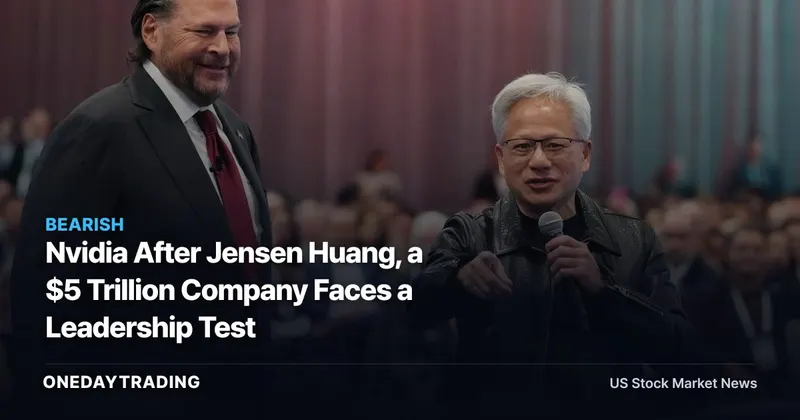
The countercase is that Nvidia’s commercial position rests on a broad network rather than one executive alone. Michael Dell called Huang a “visionary of the AI age,” while Salesforce’s Marc Benioff publicly emphasized following his lead. Such comments demonstrate Huang’s reach; they do not prove that Nvidia’s technology, customers or leadership bench disappear with his resignation.
Concrete Checkpoints for NVDA Investors
- Tuesday’s report: Compare actual revenue with the LSEG projection of $109.2 billion and 92% year-over-year growth. The source supplies no actual result, so this remains the nearest operating test.
- Succession disclosure: Look for a permanent CEO, a defined leadership structure and clarity on which executives control GPU allocation, investments and project financing.
- Board investigation: Monitor the outcome and any Nvidia response. Neither is contained in the current evidence.
- Capital commitments: Seek updated terms or execution evidence for the OpenAI financing announced at up to $105 billion and for the proposed $500 billion AI buildout plan.
Nvidia’s Next Quarter Is About Process as Well as Silicon
The bearish risk is institutional: founder-centered decisions may slow while customers, portfolio companies and financing partners seek clarity. That risk arrives as Nvidia faces elevated revenue expectations and an existing losing streak, increasing the market’s sensitivity to weak execution or incomplete disclosure.
The more constructive scenario requires evidence, not reassurance. Strong quarterly results, explicit delegation and continued execution across Amazon, Google, Meta, Microsoft, OpenAI, CoreWeave, Nebius and Oracle could show that Nvidia’s operating system is deeper than its founder. Until those checkpoints arrive, Tuesday’s revenue, the board investigation and the permanent succession decision are the facts capable of changing the investment case.
Market data check: NVIDIA Corporation
NVIDIA Corporation last traded near $165 (-5.03%). Our composite signal — blending price momentum and news flow — reads 🟡 neutral. Price momentum scores 10/100 (soft).
Data as of publication. Price via market feeds; for reference only, not investment advice.
📊 Analysis
Signal Bearish
Why Jensen Huang’s exit adds leadership, governance and execution risk as Nvidia approaches a high-expectation quarterly report.
This article was independently written by OneDayTrading from public reporting. Read the original (CNBC)