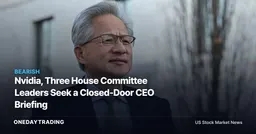
Nvidia’s 6.3% Drop Turns Leadership Into the Immediate Investment Risk
Nvidia shares fell 6.3% in Thursday premarket trading as of 4:34 a.m. ET after its board met on Wednesday to discuss whether to remove co-founder and CEO Jensen Huang. CNBC confirmed the meeting, while the board’s decision, any successor and the effect of a leadership change on the stock remain unknown.
The sharp read-through is that investors are no longer evaluating only Nvidia’s semiconductor position. They must also price an unresolved question about who would direct the company if Huang left, with no exact succession plan established in the available facts. Leadership risk here means uncertainty over who holds decision-making authority and how the market values that continuity; it does not establish that Nvidia’s operations or competitive position have already changed.
The pressure extends beyond one premarket session. CNBC reported that Nvidia was already down more than 20% over the last month, and Bernstein reduced its Nvidia price target from $400 to $200 on Thursday. Those figures show a material reassessment of the shares, though they do not isolate how much of the decline reflects the board discussion or predict where the stock trades next.
What Nvidia’s Board Discussed—and What It Has Not Decided
Huang admitted on Sunday to having an affair, according to the article. The New York Times also reported another extramarital relationship with Kimberly Powell, Nvidia’s vice president of health care, who reports to Huang. That reporting places the controversy inside the company’s reporting structure and raises a board-level leadership question rather than a matter confined to Huang’s private reputation.
Alice Huang is an executive at Megaspeed. The Financial Times and The New York Times are among the named publications connected with reports surrounding the controversy, while CNBC independently confirmed only that Nvidia’s board met on Wednesday to discuss whether to oust Huang. U.S. lawmakers have called for his resignation, adding an external source of pressure without determining what the board will do.
The distinction between discussion and decision is essential. The available facts do not confirm that the board removed Huang, decided to retain him or selected a successor. They also do not supply exact calendar dates for the referenced Sunday, Wednesday and Thursday, so those relative time descriptions should remain intact.
Why Jensen Huang’s Role Carries Unusual Weight for Nvidia
Huang co-founded Nvidia in 1993 and remains its CEO. That history makes the board’s deliberation a potential continuity issue: the company would not merely be replacing an executive with a short institutional tenure, but considering the future of a leader associated with Nvidia since its founding.
Bernstein analyst Stacy Rasgon described it as “much tougher for the board to leave him in position.” He also said, “Jensen is Nvidia, right? He is the visionary.” Rasgon framed the succession problem around decisions Huang made 10 years ago and the question of who could make the right decisions for Nvidia over the next 10 years.
For investors, that framing separates two risks. Retaining Huang could leave the controversy and calls for resignation attached to the company. Removing him could create uncertainty over strategic authority because the available record does not identify a successor. Neither path has been chosen in the confirmed facts, and neither outcome’s effect on the share price can be quantified from the evidence provided.
Richard Reyle, chief investment officer at Questar Capital Partners, called Nvidia “uninvestable” because of the absence of an exact succession plan in the available account. That is Reyle’s assessment, not a confirmed market outcome. It nevertheless captures why the next board communication matters: investors need clarity about both leadership status and continuity, not simply another reaction to the allegations.
AMD, Broadcom and the Split Semiconductor Tape
- Nvidia: The stock was down 6.3% in Thursday premarket trading as of 4:34 a.m. ET. The move coincided with uncertainty over Huang’s position, while Nvidia had fallen more than 20% over the last month.
- AMD: Shares rose 3.9% in Thursday premarket trading. AMD is identified as an Nvidia rival, making the divergence relevant as a market signal, though the facts do not prove that Nvidia’s leadership issue caused AMD’s gain.
- Broadcom: Shares advanced 3% in Thursday premarket trading. Broadcom is also described as an Nvidia rival, but the evidence does not establish a direct transfer of revenue, demand or market position.
- Intel, Marvell, Arm and Qualcomm: All traded lower. Their declines show that the semiconductor response was not a uniform move away from Nvidia into every other chip stock.
The mixed tape limits the strongest sector-wide conclusions. AMD and Broadcom moved higher while Intel, Marvell, Arm and Qualcomm moved lower, so the confirmed price action supports a company-specific leadership overhang more clearly than a single directional verdict on semiconductors. It does not reveal whether those moves will persist beyond the cited premarket period.
The Bull and Bear Cases Around Nvidia’s Board Decision
Bear case: The 6.3% premarket decline, the fall of more than 20% over the last month and Bernstein’s reduction of its price target from $400 to $200 indicate that the shares were already under substantial pressure. If the board removes Huang without identifying a credible successor, investors could continue to question who will make the long-horizon decisions Rasgon associated with Nvidia’s leadership.
The alternative route also carries risk. If Huang remains CEO, the board would still face the controversy, the reported relationship involving a direct report and calls from U.S. lawmakers for his resignation. The facts do not establish the duration or market cost of that pressure, so any claim that retention automatically resolves the overhang would run ahead of the evidence.
Bull case: No removal has been confirmed, and no future stock effect is known. A clear board decision accompanied by an exact leadership or succession framework could narrow the uncertainty now surrounding authority at Nvidia. That is a conditional mechanism, not a forecast: the evidence supplies neither the board’s choice nor the details required to judge a successor.
The higher premarket prices for AMD and Broadcom may suggest that some investors distinguished between Nvidia-specific uncertainty and its named rivals. The lower trading in Intel, Marvell, Arm and Qualcomm cautions against treating the episode as a confirmed broad competitive redistribution.
What Nvidia Investors Need From the Next Update
- A definitive board decision: Confirmation of whether Jensen Huang remains CEO or is removed would resolve the first unanswered question, though it would not by itself determine the stock’s future path.
- A named successor or explicit succession plan: If leadership changes, investors need to know who assumes authority. No successor or exact plan is confirmed in the supplied facts.
- Clear reporting relationships: The New York Times reported that Kimberly Powell reports to Huang. Any company response addressing that structure would be directly relevant to the board-level issue.
- Evidence in the semiconductor tape: Investors can compare Nvidia with AMD and Broadcom, which rose in the cited premarket period, and with Intel, Marvell, Arm and Qualcomm, which fell. Continued divergence would require fresh evidence rather than extrapolation from one premarket snapshot.
The next meaningful checkpoint is Nvidia’s own disclosure of the board’s decision and, if necessary, its succession arrangements. Until that arrives, the confirmed record supports a bearish leadership overhang—not a settled verdict on Huang’s tenure, Nvidia’s future direction or the competitive outcome for the semiconductor sector.
Market data check: NVIDIA Corporation
NVIDIA Corporation last traded near $162.38 (-6.53%). Our composite signal — blending price momentum and news flow — reads 🟡 neutral. Price momentum scores 5/100 (soft).
Data as of publication. Price via market feeds; for reference only, not investment advice.
📊 Analysis
Signal Bearish
Why The share decline, reduced price target and unresolved leadership question create a negative overhang for Nvidia despite no confirmed board decision.
Tickers$NVDA$AMD$AVGO$INTC$MRVL$ARM
This article was independently written by OneDayTrading from public reporting. Read the original (CNBC)