Nvidia Faces a Security-Scrutiny Test
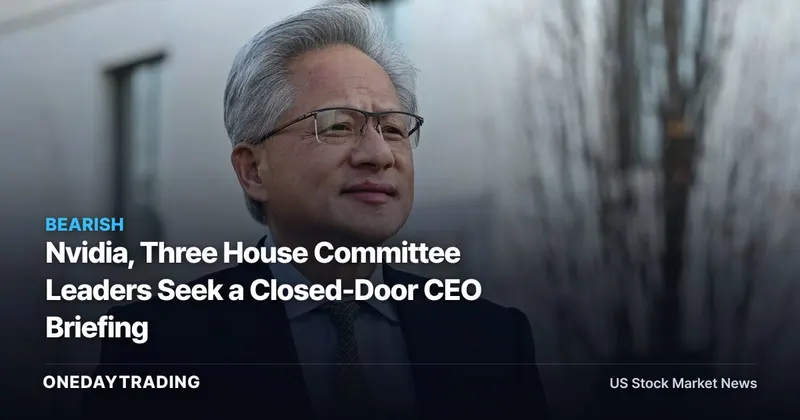
Nvidia investors now face a governance and security question alongside the company’s operating results: Three House Republican committee leaders asked CEO Jensen Huang to attend a closed-door briefing on Nov. 18. CNBC reported that the request concerns Huang’s interactions with Megaspeed executive Alice Huang and Nvidia’s protocols against espionage by foreign adversaries.
The immediate issue is not a disclosed breach or a confirmed transfer of sensitive information. It is whether Nvidia can give lawmakers enough detail about executive contacts and internal safeguards to contain uncertainty around a politically sensitive relationship. That distinction matters because the available facts establish congressional scrutiny, not misconduct by Nvidia or Jensen Huang.
A closed-door briefing, in this case, is the proposed private meeting in which the three committee leaders are seeking information directly from Nvidia’s chief executive. The company did not directly confirm to CNBC whether Huang would accept the invitation.
Why the Nov. 18 Request Matters for Nvidia
The timing compresses two separate investor checkpoints. Nvidia was scheduled to report third-quarter earnings on Nov. 17, followed by the proposed in-person joint briefing on Nov. 18. The earnings report addresses the company’s operating performance, while the congressional request directs attention to security controls, executive oversight and exposure to foreign-adversary espionage.
Those subjects can affect how investors assess risk even when the fact sheet provides no measurable commercial outcome. If Nvidia supplies a clear account of the relationship and its safeguards, the issue could remain confined to oversight. If the briefing produces unresolved questions, scrutiny could persist beyond the initial invitation. Neither path is confirmed.
The letter was unveiled Thursday and dated Wednesday. Its authors wrote that reports had raised national-security concerns about the People’s Republic of China gaining access to sensitive U.S. technology and information. The letter itself did not identify the reports on which that concern was based, leaving an important evidentiary gap at the center of the request.
The Report Behind the Congressional Questions
CNBC identified a report published last week by The New York Times as relevant context. The newspaper reported that U.S. intelligence had identified Alice Huang, a Chinese citizen and Megaspeed executive, as funneling information to Beijing and said she had developed a close relationship with Jensen Huang. These are attributed intelligence-related claims from The New York Times, not findings established by the lawmakers’ letter.
The New York Times also reported that Donald Trump had been briefed on the intelligence findings about a year ago. The available facts do not provide further detail about Jensen Huang’s interactions with Alice Huang, and the committee leaders did not specify which reporting prompted their letter.
That separation between confirmed procedure and attributed allegation is essential for investors. The confirmed development is a request for information from congressional committee leaders. The underlying characterization of Alice Huang and her relationship with Nvidia’s CEO comes from The New York Times report.
What Nvidia Says About Jensen Huang’s Customer Meetings
Nvidia framed the interactions as ordinary customer engagement rather than access to protected material. A company spokesperson told CNBC that regional cloud customers receive routine business information, not sensitive Nvidia trade secrets or information relevant to national security.
The spokesperson also said Jensen Huang meets thousands of customer executives every year as part of his work as CEO. That response offers a scale-based explanation: contact with an executive client does not, by itself, establish unusual access.
Nvidia further said it expected the U.S. government to notify the company if officials believed a person threatened American industry. The statement addresses how Nvidia views its customer communications and government notification, while the lawmakers are asking a different operational question: what internal security protocols the company uses against foreign-adversary espionage.
The gap between those positions defines the live debate. Nvidia argues that customers received ordinary business information. The committee leaders want to determine whether U.S. national security was placed at risk. The fact sheet does not establish which assessment will prevail.
Three Committee Chairs Bring Distinct Oversight Roles
- Brian Mast: The chairman of the House Foreign Affairs Committee signed the letter seeking the briefing.
- John Moolenaar: The chairman of the Select Committee on China joined the request, linking the inquiry directly to congressional scrutiny of the People’s Republic of China.
- Rick Crawford: The chairman of the House Permanent Select Committee on Intelligence also signed, placing intelligence oversight within the proposed joint discussion.
Three House Republican committee leaders therefore attached their names and committees to the request, giving it broader institutional weight than an inquiry from a single lawmaker. The letter remains an invitation to a briefing; the supplied facts do not say that Jensen Huang has accepted it.
Core Questions for Nvidia Investors
- Scope of contact: Lawmakers are seeking further information about Jensen Huang’s interactions with Alice Huang, while the available record supplies no additional detail about those exchanges.
- Information boundaries: Nvidia says regional cloud customers did not receive sensitive trade secrets or national-security information. The proposed briefing may test how the company supports that assertion.
- Security architecture: The committees specifically requested information about Nvidia’s protocols against espionage by foreign adversaries. No description of those protocols appears in the fact sheet.
- Source clarity: The letter refers to reports without naming them. That omission limits the ability to compare each congressional concern with its underlying evidence.
NVDA and the Semiconductor Read-Through
- NVDA: Nvidia is the directly affected U.S.-listed company because the request targets its CEO, his interactions and the company’s security procedures. The near-term relevance is added governance and national-security scrutiny, not a disclosed change in revenue, demand or costs.
- Semiconductors and AI: The committee leaders framed access to sensitive U.S. technology as central to their work. The supplied evidence supports attention to Nvidia’s controls, but it does not establish an impact on other companies or the wider sector.
The stock-specific interpretation is therefore cautious and mildly negative. A congressional request can increase uncertainty around oversight and controls. There is no supported basis here to quantify an earnings effect, infer a change in customer demand or extend the impact to unnamed peers.
Two Immediate Nvidia Checkpoints
- Nov. 17: Nvidia’s scheduled third-quarter earnings report is the next stated operating checkpoint. Investors can separate any disclosed business performance from the security issue because the fact sheet provides no causal link between them.
- Nov. 18: The proposed in-person joint briefing is the next stated oversight checkpoint. The first question is whether Jensen Huang attends.
- Nvidia’s supporting detail: Any further explanation of how the company limits customer access to sensitive information would address the committees’ central concern more directly than its current general statement.
- Committee follow-up: The next signal is whether the three chairmen consider Nvidia’s response sufficient or seek more information after the proposed meeting.
Balanced Outlook Ahead of the Proposed Briefing
The risk case is straightforward: national-security scrutiny now reaches Nvidia’s CEO, his customer interactions and the company’s defenses against foreign espionage. Uncertainty remains elevated because attendance is unconfirmed, the letter does not name its source reports and the underlying interactions are not described in detail.
The counter-case rests on Nvidia’s denial that regional cloud customers received sensitive trade secrets or national-security information. If the company substantiates that position and explains its controls to the committee leaders, the inquiry may produce no demonstrated commercial consequence.
For investors, the cleanest discipline is to keep the Nov. 17 earnings event separate from the Nov. 18 proposed briefing. The former is the stated checkpoint for third-quarter performance; the latter is the test of whether Nvidia can narrow a security and governance uncertainty that the current public record does not resolve.
Market data check: NVIDIA Corporation
NVIDIA Corporation last traded near $181.89 (-9.11%). Our composite signal — blending price momentum and news flow — reads 🟡 neutral. Price momentum scores 5/100 (soft).
Data as of publication. Price via market feeds; for reference only, not investment advice.
📊 Analysis
Signal Bearish
Why The congressional request adds security and governance scrutiny while Nvidia has not confirmed whether Jensen Huang will attend.
This article was independently written by OneDayTrading from public reporting. Read the original (CNBC)