Democrats Put Nvidia and TSMC at the Center of the Policy Debate
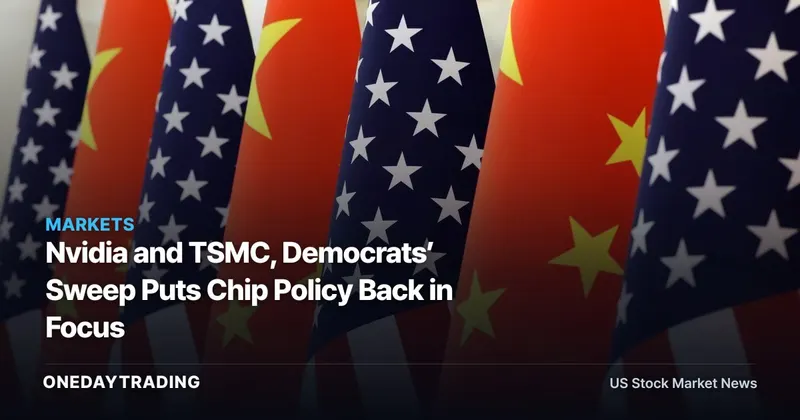
Nvidia and TSMC now sit inside a wider U.S.-China policy risk after Democrats swept the midterm elections. On 2026-11-05, CNBC reported that Democrats had taken majorities in the House and Senate, with most new winners due to begin their terms in January. For semiconductor investors, the immediate issue is not a confirmed policy change; it is the possibility that Taiwan and technology competition receive greater congressional attention.
The election also shifted governors’ offices in Texas, Nevada and Iowa from Republicans to Democrats. The investment relevance rests primarily with Congress, where the content of any hearings or legislation on China and Taiwan is still unknown.
Why the Democratic Sweep Matters for the Chip Chain
Technology competition is the transmission channel from politics to semiconductor exposure. The U.S. government has tightened restrictions on Chinese companies buying advanced chips from Nvidia. TSMC manufactures many of Nvidia’s chips, connecting the chip designer’s policy exposure with a manufacturer based in Taiwan.
Advanced-chip restrictions determine which Chinese customers can buy Nvidia technology. The fact sheet does not establish whether Congress will tighten, loosen or preserve those restrictions, so investors cannot convert the election result into a specific revenue outcome. The defensible conclusion is narrower: Nvidia remains directly exposed to decisions governing Chinese access to its advanced chips.
TSMC’s relevance comes from both its manufacturing relationship with Nvidia and Taiwan’s place in U.S.-China relations. The U.S. maintains unofficial relations with Taiwan under a “One China” policy. George Chen of The Asia Group described the stakes directly: “Taiwan remains the most dangerous issue in U.S.-China relations.”
This creates a linked risk map rather than a forecast. Congressional attention to Taiwan could raise uncertainty around the location where many Nvidia chips are manufactured, while technology measures could affect access to those chips. Neither channel establishes what legislation will emerge or how either company’s market value will respond.
The January Gap Separates Election Results From Governing Power
Most new election winners do not begin their terms until January. CNBC reported that Donald Trump and Xi Jinping could hold 2 meetings before January, with an expected Shenzhen meeting this month and an expected Miami, Florida meeting next month. Whether either anticipated meeting occurs is unconfirmed.
That timing creates two distinct policy windows. Before January, attention falls on whether Donald Trump and Xi Jinping meet and whether their engagement changes the tone around trade, Taiwan or technology. After the new Congress begins, the observable questions become whether Democrats initiate China-related hearings or introduce legislation.
The executive and legislative paths need not produce the same signal. Congressional majorities can shape hearings and legislation, while the fact sheet does not specify what those steps will contain. Investors should therefore avoid treating a Democratic sweep as proof of either immediate escalation or an assured easing of trade pressure.
Taiwan Is the Sharpest Political Fault Line
Congressional interest in Taiwan has visible precedents in the supplied record. Nancy Pelosi visited Taiwan in 2022, and Hakeem Jeffries met Tsai Ing-wen in 2023. Those events show that Taiwan has drawn attention from senior Democratic figures, without establishing what the incoming Congress will do.
The risk is especially relevant to the semiconductor chain because TSMC manufactures many Nvidia chips. A political development involving Taiwan can therefore matter to investors even when it does not immediately alter chip orders, shipments or restrictions. No such commercial change is confirmed in the fact sheet.
Donald Trump also traveled to Beijing in May. That meeting belongs to the diplomatic track, while January marks the start of terms for most new election winners. The next useful evidence will be observable action from either track, not assumptions about how the two will interact.
Tariffs and Technology Restrictions Point in Different Directions
CNBC learned that removing Donald Trump’s tariffs ranks high on the Democrats’ agenda as part of a broader focus on domestic inflation. Tariff removal has not occurred, and the fact sheet does not identify which goods would be covered. It cannot therefore support a company-specific earnings estimate or a conclusion that trade friction will broadly decline.
Technology policy presents a separate question. Existing U.S. restrictions already limit Chinese companies’ ability to buy advanced Nvidia chips. A Congress interested in tariff removal could still pursue hearings or legislation concerning economic security, Taiwan or technology competition; the actual agenda remains unknown.
Chinese dominance in rare earths adds another constraint because it has given Beijing leverage in trade talks with the U.S. and the EU. That leverage makes a simple one-direction policy thesis unreliable. Tariffs, advanced-chip access, Taiwan and rare earths are distinct negotiating issues, even when they appear in the same bilateral relationship.
What the Market Moves Do and Do Not Confirm
U.S. stocks surged Wednesday after Donald Trump accepted the Democrats’ election wins. Apple also surged, while Nvidia declined. Those moves establish the tape reaction reported in the fact sheet; they do not identify whether investors were pricing congressional control, company-specific factors or another interpretation.
Chinese technology stocks climbed Thursday. WisdomTree’s Liqian Ren framed the unresolved variable: “There’s a lot of uncertainty on how much AI can deliver for U.S., or for China.” That uncertainty limits any attempt to infer the long-term direction of technology competition from a short market move.
Apple belongs in the market snapshot because its Wednesday move is confirmed. The supplied evidence does not establish a manufacturing, revenue or policy relationship linking Apple to the election outcome, so a deeper company-specific thesis would exceed the available facts.
Investor Checkpoints From Diplomacy to Semiconductor Policy
- This month: Check whether the expected Donald Trump and Xi Jinping meeting in Shenzhen occurs and whether Taiwan, tariffs or technology restrictions enter the observable agenda.
- Next month: Watch whether the expected Miami, Florida meeting occurs. Together, the anticipated events amount to 2 meetings before January, according to CNBC.
- January: Track the start of terms for most new election winners, followed by concrete Democratic hearings or legislation concerning China, Taiwan or economic security.
- Policy action: Separate any tariff proposal from changes to restrictions on Chinese purchases of advanced Nvidia chips. Neither tariff removal nor a new technology rule is confirmed.
Balanced Outlook for Nvidia, TSMC and Technology Investors
The constructive case is that diplomacy remains active before January and Democrats pursue tariff removal as part of their domestic inflation agenda. That scenario could coexist with continued restrictions on advanced-chip sales, since the evidence does not show that tariff and technology policies will move together.
The risk case centers on Taiwan and a harder technology contest. TSMC’s role manufacturing many Nvidia chips makes the island relevant to the semiconductor supply chain, while existing restrictions already place Nvidia inside the policy dispute. Chinese leverage in rare earths further complicates negotiations.
A neutral stance best matches the evidence. The election changed control of Congress, not the underlying rules identified in the fact sheet. The signal becomes investable only when anticipated meetings occur, new members take office in January, or Congress produces specific hearings or legislation that can be evaluated against Nvidia’s chip restrictions and TSMC’s manufacturing role.
Market data check: NVIDIA Corporation
NVIDIA Corporation last traded near $198.75 (-0.69%). Our composite signal — blending price momentum and news flow — reads 🟡 neutral. Price momentum scores 44/100.
Data as of publication. Price via market feeds; for reference only, not investment advice.
📊 Analysis
Signal Neutral
Why Taiwan and advanced-chip restrictions create policy risk, while the scope and market effect of any congressional action remain unknown.
This article was independently written by OneDayTrading from public reporting. Read the original (CNBC)