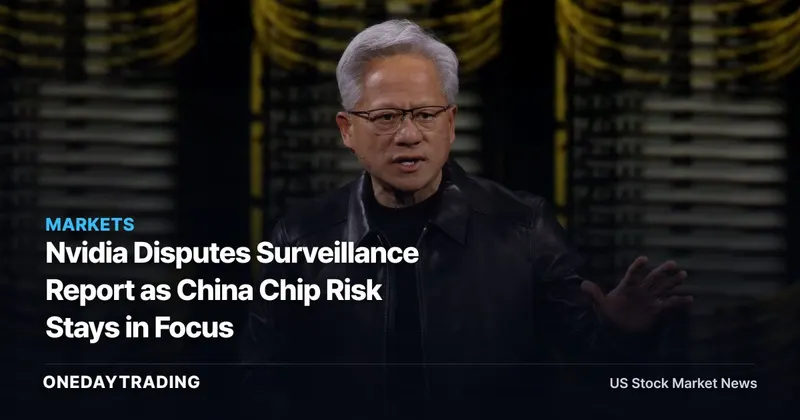
Nvidia’s Dispute Leaves Investors With a Policy Question, Not a Proven Threat
Nvidia investors face a governance and export-control question rather than evidence of a new financial loss. On 2026-10-29, CNBC published Nvidia’s response disputing a New York Times report about U.S. intelligence agencies surveilling a person close to CEO Jensen Huang over concerns that she could be a Chinese intelligence asset.
The distinction is critical. The surveillance concern came from the New York Times report, while Nvidia’s rebuttal came in a statement to CNBC. Whether Alice Huang was a Chinese intelligence asset, whether the U.S. government briefed Nvidia about her, and which intelligence agencies were involved remain unknown.
For semiconductor investors, the sharper issue is the policy channel surrounding Nvidia’s access to China. The company wrote off about $4.5 billion in Chinese-tuned AI chips last year, according to CNBC, giving the dispute a concrete financial backdrop even though the fact sheet does not connect that charge to the reported surveillance.
Why the New York Times Report Matters to Nvidia
Nvidia said Singapore-based Megaspeed is one of its regional cloud customers, and Alice Huang is linked to Megaspeed. That relationship places the report at the intersection of customer oversight, chip distribution and export-control scrutiny, three areas that can affect how investors assess the durability of international demand.
A regional cloud customer is part of the commercial path through which computing infrastructure reaches users outside Nvidia’s direct operations. In this case, the available facts establish only that Megaspeed is a customer and that Alice Huang is linked to it; they do not establish diversion, intelligence activity or access to sensitive information.
Nvidia also said Megaspeed had already been investigated for evading export controls. A spokesperson told CNBC, “The diversion allegations against this regional cloud were thoroughly investigated and debunked last year.” The exact period covered by that investigation is not supplied, so the statement cannot resolve whether every issue described in the New York Times report fell within its scope.
The $4.5 Billion Signal in Nvidia’s China Exposure
CNBC reported that Nvidia wrote off about $4.5 billion in Chinese-tuned AI chips last year. That figure shows how restrictions or blocked market access can transmit into the financial statements: inventory designed for a constrained destination may lose economic value when the intended route to customers closes.
The $4.5 billion Nvidia write-off does not quantify the effect of the surveillance report, Megaspeed or Alice Huang. It instead establishes that China-specific product exposure has already carried a measurable balance-sheet consequence, making any new export-control controversy relevant even before a separate financial effect can be demonstrated.
This is the central investor tension. Nvidia’s rebuttal challenges the reported concerns around a customer-linked individual, while the write-off shows that the broader China policy environment is not an abstract risk. Treating those two points as identical would overstate the evidence; ignoring their proximity would understate why the dispute warrants scrutiny.
H200 Access Shows the Two-Sided Policy Constraint
H200s are Nvidia’s Hopper generation chips. The U.S. government cleared the H200 for shipment to China earlier this year, but Chinese regulators prevented its import.
That sequence separates permission to export from permission to sell into the destination market. U.S. clearance alone did not produce access because Chinese regulatory action remained a second gate. For investors, the mechanism is straightforward: a chip can clear one government’s rules and still fail to reach its intended market.
The facts do not provide H200 shipment volumes, orders, revenue, margins or a date for any next policy decision. No supported estimate can therefore convert the clearance and import block into an incremental earnings impact. The relevant analysis is directional: continued restrictions can constrain the addressable route for China-bound products, while a change in either government’s position could alter that route.
Where Nvidia and the Report Diverge
- Status of Alice Huang: The New York Times report described intelligence concerns, but the fact sheet does not establish whether Alice Huang was a Chinese intelligence asset.
- Government communication: Nvidia’s spokesperson said, “We're confident that if the U.S. government believes that any person is a threat to American industry, it would let us know.” Whether the government actually briefed Nvidia remains unknown.
- Megaspeed scrutiny: Nvidia said the regional cloud customer had already been investigated for export-control evasion and that diversion allegations were debunked. The supplied evidence does not identify the investigation’s exact coverage.
- Financial linkage: Nvidia’s approximately $4.5 billion write-off last year concerned Chinese-tuned AI chips. The facts do not attribute that write-off to Megaspeed, Alice Huang or the reported surveillance.
Related Stock and Semiconductor Exposure
- Nvidia: NVDA is the directly affected U.S.-listed stock because the report concerns its CEO, a regional cloud customer and oversight of its AI-chip distribution relationships. The investment relevance runs through regulatory access, customer controls and the potential value of destination-specific inventory.
- Semiconductors: The sector read-through is limited to the mechanism demonstrated by Nvidia’s experience: export authorization does not ensure import access, and market-specific chips can create write-off risk when regulatory barriers prevent their intended sale. The fact sheet names no other chip company, so no peer-specific conclusion is supported.
- AI infrastructure: H200 is a Hopper generation chip, placing the policy dispute within the hardware layer of AI infrastructure. The evidence supplies no utilization, capacity, order or shipment data, preventing a broader demand conclusion.
What Investors Should Check Next
- Government confirmation: Any disclosure clarifying whether U.S. authorities briefed Nvidia about Alice Huang would test the gap between the reported surveillance concern and the company’s response.
- Investigation scope: Documentation identifying what the Megaspeed investigation examined, and the period it covered, would show how fully Nvidia’s rebuttal addresses the reported diversion concern.
- H200 market access: The next observable policy signal is whether Chinese regulators continue preventing H200 imports after the earlier U.S. clearance.
- Company disclosures: Nvidia’s next reporting event should be checked for additional China-related write-offs, shipment commentary or customer-control disclosures. The fact sheet provides no forecast for any of those measures.
Nvidia’s Balanced Risk Case
The constructive case rests on Nvidia’s explicit denial and its statement that Megaspeed’s alleged diversion had already been investigated and debunked. If subsequent disclosures support that account, the report may remain a governance controversy without a demonstrated new financial consequence.
The risk case is that unanswered questions about government communication or the scope of the Megaspeed review produce further scrutiny around international customer relationships. China exposure already has a measurable reference point: CNBC said Nvidia wrote off about $4.5 billion in Chinese-tuned AI chips last year.
The investable conclusion is neutral because the evidence does not establish intelligence wrongdoing, a new restriction or an incremental loss. The next signal must come from documented government communication, fuller investigation details, a change in H200 import treatment or Nvidia’s own disclosures—not from treating a disputed allegation as a settled fact.
Market data check: NVIDIA Corporation
NVIDIA Corporation last traded near $212.6 (-1.29%). Our composite signal — blending price momentum and news flow — reads 🟡 neutral. Price momentum scores 40/100 (soft).
Data as of publication. Price via market feeds; for reference only, not investment advice.
📊 Analysis
Signal Neutral
Why Nvidia rejected the report’s allegations, while unresolved surveillance questions and continuing China-related chip restrictions leave the financial direction unclear.
This article was independently written by OneDayTrading from public reporting. Read the original (CNBC)