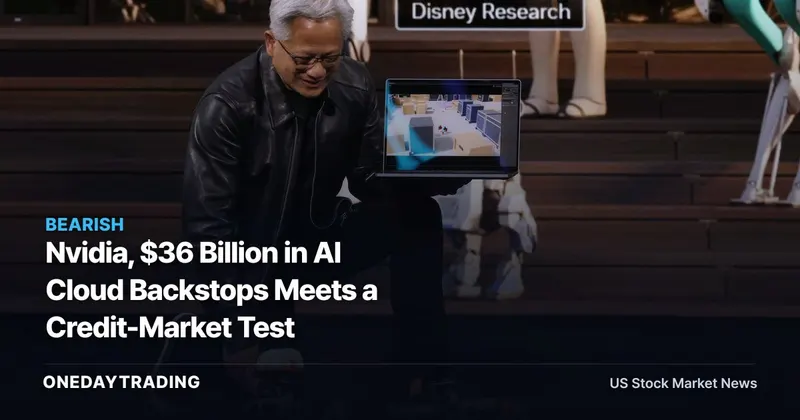
Nvidia’s Financing Edge Faces a Credit Test
Nvidia shares declined 7.6% in October as tighter credit markets and falling neocloud shares tested the chipmaker’s expanding role as financier to AI infrastructure partners. CNBC reported that Nvidia disclosed $36 billion in off-balance-sheet AI cloud agreements in its last quarterly financial filing in July, alongside a guarantee of up to $105 billion connected to OpenAI’s proposed 10 gigawatt data center in Ohio.
The investor issue is no longer confined to GPU demand. Nvidia is using investments, loan assistance and guarantees to help customers fund the infrastructure that buys its systems, linking hardware sales more closely to the financing capacity and credit quality of its ecosystem.
How Nvidia’s AI Backstops Transmit Risk
An off-balance-sheet guarantee is a contingent obligation: it may require payment only if specified contractual conditions occur. Nvidia also signed as tenant for $20 billion in future data-center leases intended for later assignment to third parties, expanding the set of commitments whose ultimate economic effect depends on other participants.
The largest disclosed guarantee connects Nvidia to OpenAI’s proposed Ohio facility and requires use of Nvidia hardware for at least 20 years. The guarantee can end if OpenAI provides collateral or obtains a sufficient credit rating, although whether either condition will occur is unknown.
The CoreWeave relationship shows a different structure. Nvidia owns equity in the company and has a conditional commitment to purchase up to $6.3 billion of its compute. Nvidia also has revenue-sharing agreements with Sharon AI and other neoclouds, so its exposure can span ownership, customer support and contractual economics rather than a conventional chip sale alone.
Neocloud Prices and Credit Now Matter to Nvidia
CoreWeave, Nebius and IREN shares have each declined at least 30% this month, while CoreWeave’s credit-default-swap spread moved past 11%, according to CNBC. Those signals do not establish a default, but they show that markets are charging more to absorb credit risk around a major Nvidia-backed operator.
CoreWeave carries roughly $51.6 billion in total debt, including about $35 billion in notes, bonds and loans. Yields topped 15% on its bonds maturing in 2031 and 2032. For Nvidia investors, the relevant transmission channel is straightforward: weaker access to capital can constrain the infrastructure partners that purchase, host or distribute GPU compute, while contractual backstops may shift some downside toward Nvidia if agreed conditions are triggered.
Firmus, Nscale and SoftBank-backed SB Energy are also Nvidia investments. Whether those companies will revive or advance public-listing plans is unknown, making funding access and project progress more useful checkpoints than promotional demand language.
Cash Strength Supports the Strategy, Not Its Economics
Nvidia generated $70 billion in free cash flow in the first half of this year, compared with just over $4 billion for AMD. That liquidity gives Nvidia greater capacity to support customers, seed infrastructure funds and bridge a capital shortage without proving that every financed project will earn an adequate return.
The company’s latest fiscal-year revenue reached $216 billion, roughly eightfold the level associated with the period since OpenAI launched ChatGPT in late 2022. Nvidia’s investment portfolio was valued at $99 billion in the second quarter, and its market capitalization stood at $5 trillion. These figures explain why Nvidia can operate as both equipment supplier and financial sponsor; they do not reveal the eventual loss rate on its commitments.
The hardware economics raise the stakes. Vera Rubin is a seven-foot rack containing 72 GPUs and carries a Morgan Stanley estimated cost of more than $7 million. Financing can widen access to systems of that scale, while any decline in future GPU values could weaken the collateral or residual-value assumptions supporting those transactions.
The Commitments Extend Beyond Individual Neoclouds
Nvidia outlined over $500 billion in off-balance-sheet commitments over the coming years, with a majority maturing through fiscal 2029. Nvidia and six large asset managers also launched a $500 billion financing push that included up to $125 billion in residual-value guarantees on GPU financings.
The company committed $2 billion to Brookfield’s inaugural AI Infrastructure Partners Fund, which targets $10 billion in total capital. Nvidia has also taken unconfirmed limited-partner stakes in KKR’s $11 billion Helix Digital Infrastructure vehicle and Valor Equity Partners’ $5.4 billion dedicated compute fund.
These arrangements attempt to establish compute infrastructure as a financeable asset class. Their durability depends partly on demand for compute, partner credit performance and the future market value of GPUs—all variables whose eventual outcomes remain unknown.
Stock and AI-Infrastructure Read-Through
- Nvidia: Financing support may help customers deploy more Nvidia hardware, reinforcing demand across software, services and integrated systems. The offset is contingent exposure if partners default or guaranteed asset values prove insufficient.
- CoreWeave: Its share decline, credit-default-swap spread and bond yields place funding conditions at the center of the Nvidia financing test. Stability of customer demand and whether Nvidia’s conditional compute commitment is activated are the critical company-specific checks.
- Nebius and IREN: Their share declines of at least 30% this month indicate that pressure is not isolated to a single neocloud. The supplied facts do not establish defaults or quantify any resulting Nvidia liability.
- Advanced Micro Devices and Google: AMD offers its Helios AI rack, while Google rents tensor processing units through its cloud offering. Nvidia’s much larger free cash flow provides a financing advantage, although that advantage carries risks those cash figures alone cannot measure.
Bull and Bear Conditions for Nvidia
Bull case: Strong customer demand and robust sales pipelines could allow partners to use new infrastructure productively, support payment obligations and expand purchases of Nvidia systems. Additional private capital, successful assignment of leases and insurance coverage for GPU-value risk could reduce the amount Nvidia ultimately bears.
Bear case: If compute demand falls short of expectations, financed capacity could struggle to attract users while weaker GPU values reduce recoveries. David Trainer of New Constructs told CNBC, “If the demand for compute doesn't meet these really super lofty expectations, we're going to have a problem.”
New Constructs estimated the net present value of Nvidia’s off-balance-sheet liabilities at over $153 billion in fiscal 2026, an increase of over $100 billion from last year. Moody’s monitors guarantees without counting them as debt when rating corporate buyers, which makes the contractual details and trigger conditions more informative than the accounting label alone.
What Nvidia Investors Should Check Next
- Filings: Track changes in Nvidia’s off-balance-sheet AI cloud agreements, lease commitments and guarantee terms, including the commitments maturing through fiscal 2029.
- Partner credit: Monitor CoreWeave’s credit-default-swap spread, bond yields and total debt alongside the share performance of CoreWeave, Nebius and IREN.
- Guarantee triggers: Look for evidence of participant defaults, Nvidia payments, lease assignments or activation of the CoreWeave compute-purchase commitment.
- Risk transfer: Assess whether insurers assume exposure to potential GPU-value declines. Howden’s Tom Hoad said insurers are not a complete solution, indicating that coverage may help only in suitable transactions.
The next decisive evidence will come from contractual outcomes, not demand slogans: whether partners keep funding projects, whether guarantees expire without payment and whether GPU values support the residual assumptions embedded in Nvidia’s financing structures.
Market data check: NVIDIA Corporation
NVIDIA Corporation last traded near $210.96 (-0.59%). Our composite signal — blending price momentum and news flow — reads 🟡 neutral. Price momentum scores 45/100.
Data as of publication. Price via market feeds; for reference only, not investment advice.
📊 Analysis
Signal Bearish
Why Tighter partner credit conditions could turn Nvidia’s financing advantage into contingent exposure, although no default or guarantee payment has been confirmed.
Tickers$NVDA$CRWV$NBIS$IREN$AMD$GOOGL
This article was independently written by OneDayTrading from public reporting. Read the original (CNBC)