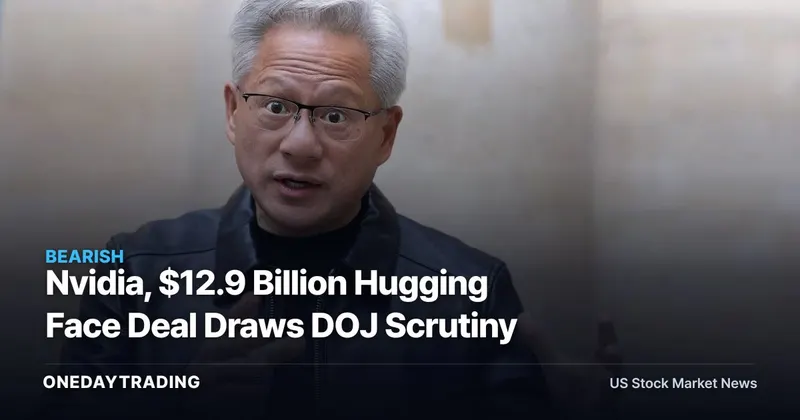
Nvidia’s Hugging Face Deal Meets Regulatory Friction
Nvidia’s $12.9 billion acquisition of Hugging Face is under scrutiny from the U.S. Department of Justice, creating a new regulatory risk around the chipmaker’s expansion across AI infrastructure. CNBC confirmed the inquiry through a source familiar with it after Reuters first reported it on Wednesday. For investors, the immediate issue is not a disclosed legal outcome; it is the uncertainty surrounding a transaction that connects Nvidia with a widely used platform for models, datasets and development tools.
The acquisition matters because Hugging Face sits at a collaboration layer used by AI developers, institutions and companies, while Nvidia occupies the hardware side of the AI stack. Hugging Face is a platform for sharing and testing AI models that also sells infrastructure and collaboration tools to organizations working with closed, proprietary AI, including chip companies. Bringing those functions under Nvidia could make the platform strategically important beyond the purchase price, which explains why questions about possible effects on competitors deserve close attention.
That mechanism is conditional, not a finding of competitive harm. The fact sheet does not disclose the U.S. Department of Justice’s specific questions, the inquiry’s procedural status or whether the acquisition has affected competitors. Investors therefore cannot infer a remedy, timetable or outcome from the existence of scrutiny alone.
Hugging Face’s Scale Raises the Stakes
Nvidia said that, at the time of the deal, Hugging Face was reportedly used by more than 18 million people and more than 200,000 companies. Those figures indicate that the transaction reaches an established community rather than an undeveloped software asset. For a semiconductor company, ownership of a platform with that breadth could create a closer link between computing infrastructure and the workflows through which organizations build and share AI.
Nvidia also said Hugging Face users shared at least 3 million models and 500,000 datasets at the time of the deal. Models and datasets are distinct from chips, yet they occupy adjacent parts of the development process. The investor question is whether ownership changes how platform access, infrastructure tools or collaboration are offered to organizations, especially chip companies; the supplied evidence does not establish that any such change has occurred.
Nvidia announced the nearly $13 billion Hugging Face acquisition in September. Jensen Huang said the deal would help “expand access to AI for developers and institutions worldwide.” That stated objective presents the transaction as an expansion of access, while the inquiry focuses attention on its possible impact on competitors. Neither proposition establishes the eventual commercial or regulatory result.
The combination’s strategic logic is easier to see than its financial contribution. Hugging Face provides tools and a large user network around AI development, and Nvidia provides AI hardware. If the platform’s reach strengthens Nvidia’s position across that workflow, the acquisition could carry value beyond an isolated software product. Any conclusion about revenue, costs or demand would exceed the available evidence because the fact sheet supplies no financial performance metrics for Hugging Face.
Nvidia’s Second-Biggest Purchase Faces a Familiar Question
CNBC identified the Hugging Face acquisition as Nvidia’s second-biggest purchase, behind the company’s purchase of Groq assets. Nvidia paid $20 billion for Groq assets at the end of last year, and that deal has also attracted U.S. Department of Justice scrutiny. The recurring regulatory attention makes transaction oversight a live variable in Nvidia’s broader AI expansion, even though the inquiries may not share the same scope or outcome.
Microsoft’s acquisition of GitHub supplies a limited transaction reference. Microsoft acquired GitHub in 2018 for $7.5 billion, and GitHub was the closest comparable business identified for Hugging Face. The comparison helps frame Hugging Face as a software repository and collaboration platform rather than a semiconductor asset, but it does not establish matching economics, competitive conditions or regulatory treatment.
For Nvidia shareholders, the risk channel runs through uncertainty around control of a platform used by developers, institutions and companies. Regulatory questions could matter if they lead to constraints affecting how Nvidia integrates or operates Hugging Face. No such constraint is confirmed, so treating the inquiry as evidence of a specific financial loss would outrun the facts.
Microsoft remains relevant only through its established relationship with GitHub. The supplied evidence does not show that the Nvidia transaction changes Microsoft’s business or creates a measurable benefit or cost for it. Nvidia is therefore the primary listed stock tied directly to the event; Microsoft is contextual rather than a demonstrated winner or loser.
What Nvidia Investors Can Verify Next
- Scope: Watch for disclosure of the specific questions raised by the U.S. Department of Justice. That would clarify which elements of Nvidia’s ownership or Hugging Face’s operations are receiving attention.
- Procedure: Look for confirmation of the inquiry’s status. The current evidence does not identify a formal stage, timetable or possible outcome.
- Platform conduct: Check whether Nvidia describes changes to access, infrastructure or collaboration tools for the more than 18 million people and more than 200,000 companies reportedly using Hugging Face at the time of the deal.
- Competitive evidence: Separate documented effects on competitors from hypothetical mechanisms. The inquiry concerns possible impact, while the fact sheet does not confirm that competitors have been affected.
The balanced reading is straightforward. Hugging Face gives Nvidia ownership of an AI platform with at least 3 million models, 500,000 datasets and broad organizational use at the time of the deal, which may deepen its reach across the AI development stack. The counterweight is regulatory uncertainty around a $12.9 billion acquisition and separate scrutiny of the Groq assets purchase. The next meaningful signal will come from concrete disclosure about the Justice Department’s questions, the inquiry’s status or any confirmed change in how Hugging Face serves its users.
Market data check: NVIDIA Corporation
NVIDIA Corporation last traded near $213.87 (-1.87%). Our composite signal — blending price momentum and news flow — reads 🟡 neutral. Price momentum scores 35/100 (soft).
Data as of publication. Price via market feeds; for reference only, not investment advice.
📊 Analysis
Signal Bearish
Why The inquiry adds regulatory uncertainty around Nvidia’s second-biggest purchase, although its status, scope and outcome remain unknown.
This article was independently written by OneDayTrading from public reporting. Read the original (CNBC)