Nvidia’s Rebound Does Not Resolve the Earnings Risk
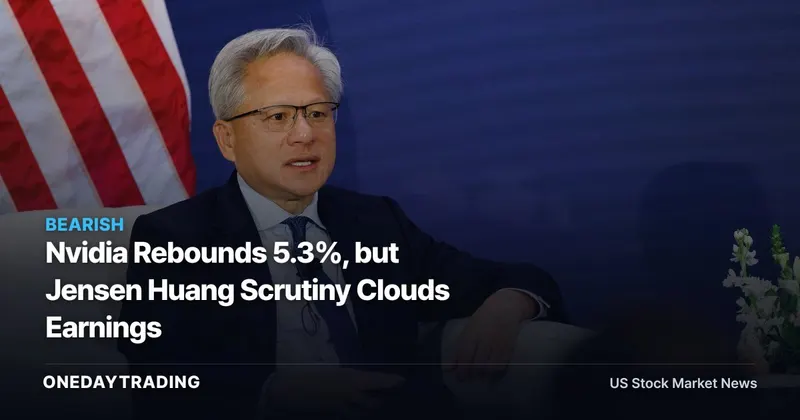
Nvidia shares rose 5.3% in premarket trading as of 5:47 a.m. ET Wednesday, according to CNBC, as investors assessed scrutiny involving CEO Jensen Huang ahead of the company’s Nov. 17 quarterly earnings. The move matters because it followed two sharp declines without answering the questions now hanging over leadership continuity, possible restrictions and the reliability of the earnings outlook.
The central issue is no longer simply whether Nvidia can recover from a selloff. It is whether the investigation produces information that changes the assumptions investors use to assess the company before earnings. A premarket rebound shows that some pressure eased at that point in trading; it does not establish that the underlying uncertainty has cleared.
Two Down Sessions Set the Stage for Wednesday’s Move
CNBC reported that Nvidia closed 5.47% lower on Tuesday after falling 4.3% on Monday. Those declines provide the necessary baseline for interpreting Wednesday’s 5.3% premarket rise: the stock was retracing part of a two-session fall, not reacting to a disclosed resolution of the investigation.
Nvidia announced Tuesday that it had hired Wachtell, Lipton, Rosen & Katz to examine whether company secrets or national security were compromised. An investigation is a formal process for establishing facts; its existence confirms that the questions are being examined, not that either form of compromise occurred.
Jensen Huang was in the office Monday and Tuesday. His description of conditions as “business as usual” signals an effort to maintain operating continuity, though the FACT_SHEET does not establish whether the matter will affect Nvidia’s business or disrupt its leadership.
Why the Nov. 17 Earnings Date Has Become More Important
Nvidia’s quarterly earnings were scheduled for Nov. 17. That event gives investors a defined checkpoint at which management can address the business outlook while the market weighs a separate set of governance and policy uncertainties.
The transmission mechanism is conditional. If the investigation finds no compromise and leadership remains stable, investors may treat the episode as contained. If findings raise concerns about company secrets, national security, leadership continuity or tighter restrictions, investors may reassess the confidence attached to earnings expectations.
This distinction matters because an earnings reassessment requires more than an adverse headline. Investors would need information that changes the expected business path, the operating assumptions behind it or confidence in management’s ability to execute. None of those outcomes is confirmed in the supplied evidence.
Bank of America Frames Three Paths for Nvidia
Bank of America described three scenarios with different investment implications. One keeps the impact contained with leadership continuity; another allows prolonged uncertainty to pressure valuation before earnings; the escalated case involves what analyst Vivek Arya called “adverse findings, leadership disruption or tighter restrictions requiring earnings reassessment.”
That framework separates an uncertainty discount from a fundamental revision. Prolonged uncertainty could affect how investors value Nvidia even before there is evidence of a business impact. The escalated scenario would demand a deeper review because it links potential findings or restrictions to the earnings case itself.
For investors, the ordering of evidence is critical. First comes the investigation and any disclosed findings. Next comes the question of leadership continuity or restrictions. Only then can the market judge whether the Nov. 17 earnings assessment requires a material change.
Morgan Stanley Removes Nvidia as a Top Pick
Morgan Stanley removed Nvidia as a top pick Wednesday after the shares had fallen more than 25% since Oct. 2, when the firm had named the company a top pick. The removal does not, by itself, establish a change in Nvidia’s reported business performance; it does show that the investment framing changed after a substantial share-price decline.
The firm described Jensen Huang’s leadership as “crucial” to Nvidia’s strategic direction. That assessment explains why leadership continuity has become a market variable: when investors view a chief executive as central to strategy, uncertainty around that role can influence the confidence they attach to future execution.
Zacks Chief Equity Strategist John Blank identified two concerns behind the selloff: the possibility of further U.S. restrictions and the risk that additional problems emerge. He asked, “What else has Jensen done?” and told CNBC, “It’s not good for Nvidia. It’s not good for Jensen Huang. It’s certainly not good for the AI trade.” These comments express an analyst’s risk assessment, not confirmed findings.
What the Price Action Does and Does Not Signal
- Nvidia: The 5.3% premarket advance as of 5:47 a.m. ET Wednesday indicates a rebound after the 5.47% Tuesday decline and 4.3% Monday fall. It does not disclose whether company secrets or national security were compromised.
- Valuation: Bank of America’s middle scenario identifies prolonged uncertainty as a possible source of valuation pressure before earnings, even without a confirmed operating effect.
- Earnings expectations: A reassessment becomes relevant in Vivek Arya’s escalated scenario if adverse findings, leadership disruption or tighter restrictions emerge. Those conditions remain hypothetical.
- AI exposure: John Blank extended his concern to the AI trade, though the FACT_SHEET supplies no separate price moves or company-specific effects beyond Nvidia.
Investor Checkpoints Before and After Nov. 17
- Investigation findings: Check whether Wachtell, Lipton, Rosen & Katz identifies any compromise of company secrets or national security. The supplied facts confirm the inquiry, not its outcome.
- Leadership continuity: Watch for evidence that Jensen Huang continues in his role without disruption. His presence in the office Monday and Tuesday is confirmed, while the future leadership outcome is unknown.
- Restriction risk: Look for an actual change in U.S. restrictions rather than treating the possibility as established policy.
- Nov. 17 earnings: Assess whether Nvidia’s quarterly report or related commentary changes the business outlook and whether any investigation-related development requires earnings assumptions to be reconsidered.
The Live Debate for Nvidia Investors
The constructive case is straightforward: the investigation could remain contained, leadership continuity could hold and the Nov. 17 earnings event could proceed without a business reassessment. Wednesday’s premarket rebound is consistent with investors assigning some probability to that path, though price action alone cannot verify it.
The adverse case has several stages rather than one automatic outcome. Prolonged uncertainty could weigh on valuation; adverse findings could intensify scrutiny; leadership disruption or tighter restrictions could then force investors to revisit the earnings framework. Bank of America’s scenarios are useful precisely because they keep those conditions separate.
The next decisive evidence will come from disclosed investigation findings, any confirmed restriction or leadership change, and Nvidia’s Nov. 17 earnings. Until one of those checkpoints supplies new facts, the 5.3% premarket rebound is best read as a market move within unresolved uncertainty, not a verdict on the company’s business.
Market data check: NVIDIA Corporation
NVIDIA Corporation last traded near $177.37 (+5.02%). Our composite signal — blending price momentum and news flow — reads 🟡 neutral. Price momentum scores 90/100 (firm).
Data as of publication. Price via market feeds; for reference only, not investment advice.
📊 Analysis
Signal Bearish
Why The premarket rebound does not remove investigation, leadership, restriction and earnings-reassessment risks surrounding Nvidia.
This article was independently written by OneDayTrading from public reporting. Read the original (CNBC)