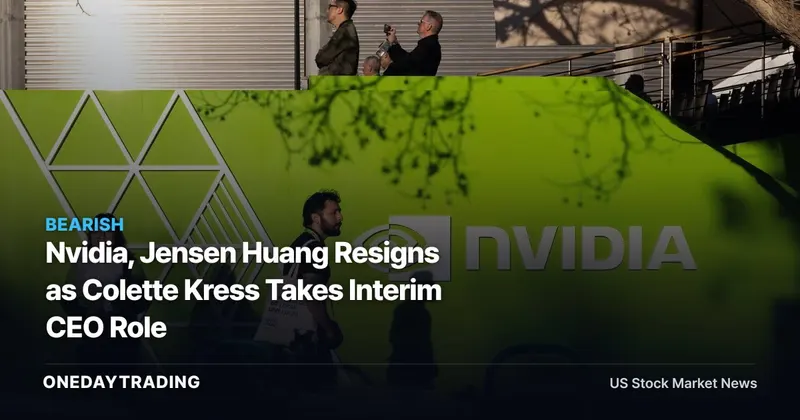
Nvidia Succession Risk Moves to the Center of the Investment Case
Nvidia now faces a leadership transition after Jensen Huang resigned as CEO and board member, making succession the immediate issue for investors in the company’s stock. Chief Financial Officer Colette Kress is serving as interim CEO, while Nvidia’s next scheduled communication is a company meeting on November 18 at 9 am PT, according to CNBC.
The central tension is clear: Nvidia has installed an internal executive with deep company experience, but the board has not selected a permanent successor. That combination may preserve near-term organizational continuity while leaving authority, strategic direction and the duration of the transition unresolved.
A CEO succession is the process through which a board transfers executive leadership to an interim or permanent replacement. In Nvidia’s case, the process also includes a governance change because Harvey Jones said he would become the first-ever chair of the board.
Jensen Huang’s Exit and Colette Kress’s Interim Appointment
CNBC reported that Jensen Huang resigned from both the CEO position and Nvidia’s board. The outlet obtained copies of employee emails from a source familiar with the matter, providing the attributed record of the leadership changes and the board’s response.
The board asked Colette Kress to serve as interim CEO while it conducts a permanent search. It is considering internal and external candidates, which keeps both continuity and a broader leadership reset available without establishing which path the directors prefer.
Harvey Jones told employees, “Jensen has resigned as CEO and Board Member.” He also wrote, “The Board has full confidence in Colette to deliver on our commitments,” framing the interim appointment around continuity of existing obligations rather than announcing a different corporate agenda.
The available facts do not establish why Jensen Huang resigned. They also do not identify the permanent successor or provide a timetable for completing the search, so those questions should remain separate from confirmed reporting.
Why Colette Kress Provides Continuity Without Settling Succession
Colette Kress has served as Nvidia’s CFO for over 13 years, according to CNBC. That tenure gives the interim CEO longstanding exposure to the company’s finances and commitments, an important continuity mechanism when leadership changes without a permanent replacement ready to assume control.
Continuity and permanence are not equivalent. Kress can lead during the search, while the board’s willingness to examine internal and external candidates means her interim appointment does not by itself determine the final outcome.
Her finance background may help maintain discipline around existing commitments during the transition. The evidence supplied does not support assumptions about a change in strategy, operating priorities or financial targets, so investors should treat such claims as speculation unless leadership provides them directly.
Kress acknowledged the strain surrounding the transition, writing, “The Board, Estaff and I recognize that this has been an extraordinarily difficult period.” That statement establishes the internal tone of the moment; it does not explain the cause of Huang’s resignation or quantify any business effect.
Harvey Jones Adds a New Governance Layer at NVIDIA
Harvey Jones said he would serve as the first-ever chair of NVIDIA’s board. The change matters because oversight of the permanent CEO search now sits alongside an interim executive structure, placing the board’s candidate selection and communication under closer investor scrutiny.
The board’s stated confidence in Kress is a stabilizing signal, especially because she is already part of Nvidia’s senior leadership. The counterweight is that an open search can preserve uncertainty until directors identify a permanent CEO and clarify whether the appointment favors internal continuity or an external candidate.
Investors should distinguish board support from evidence of a completed transition. Jones endorsed Kress’s ability to meet commitments, while the board simultaneously kept the permanent role open; both facts can be true without resolving the company’s longer-term leadership structure.
What the Leadership Change Means for NVDA Investors
- Leadership risk: Jensen Huang’s resignation removes the company’s CEO and a board member at the same time. Until a permanent successor is named, investors must assess Nvidia through an interim leadership arrangement.
- Continuity factor: Colette Kress brings over 13 years as Nvidia’s CFO, giving the board an experienced internal executive to manage the transition rather than leaving the chief executive role unfilled.
- Search uncertainty: The consideration of internal and external candidates expands the board’s options, but it also prevents investors from inferring the permanent leadership model from the interim appointment alone.
- Governance change: Harvey Jones’s role as the first-ever board chair creates an identifiable point of oversight for the succession process, though the facts provide no deadline for choosing the next CEO.
The directional implication is cautiously negative because the confirmed event introduces unresolved leadership risk. The balancing case rests on Kress’s long tenure and the board’s explicit backing, which may support continuity while directors conduct the search.
Nvidia’s November 18 Meeting Becomes the Next Checkpoint
NVIDIA will hold its company meeting on November 18 at 9 am PST, CNBC reported. The same meeting is identified as occurring at 9 am PT, and it is the only dated next event supplied for assessing how leadership communicates the transition.
- Interim authority: Listen for how Nvidia describes Kress’s mandate and whether her remit extends beyond maintaining current commitments during the search.
- Search structure: Check whether the board provides greater clarity on how it will evaluate internal and external candidates.
- Governance responsibilities: Watch for a clearer division of duties between interim CEO Colette Kress and board chair Harvey Jones.
- Future communication: Note whether Nvidia identifies another observable checkpoint for the permanent CEO process, since no conclusion date is currently known.
The Balanced Case for Nvidia During the CEO Search
The constructive scenario is organizational continuity: an experienced CFO assumes interim leadership, the board publicly supports her, and a newly designated chair oversees the search. Those confirmed elements can reduce the risk of an immediate leadership vacuum.
The adverse scenario is a prolonged or unclear succession process. Because the board is considering candidates from inside and outside Nvidia, investors cannot yet determine who will lead permanently or whether the final selection will preserve the current direction.
The November 18 meeting is therefore the next concrete test, not because a permanent appointment has been promised for that date, but because it gives Nvidia leadership a defined forum to explain responsibilities and the search process. The investment debate will remain centered on whether that communication narrows uncertainty without implying decisions the board has not announced.
Market data check: NVIDIA Corporation
NVIDIA Corporation last traded near $164.67 (-5.21%). Our composite signal — blending price momentum and news flow — reads 🟡 neutral. Price momentum scores 8/100 (soft).
Data as of publication. Price via market feeds; for reference only, not investment advice.
📊 Analysis
Signal Bearish
Why Jensen Huang’s departure creates leadership and succession uncertainty despite the appointment of an experienced internal interim CEO.
This article was independently written by OneDayTrading from public reporting. Read the original (CNBC)