Key Takeaways
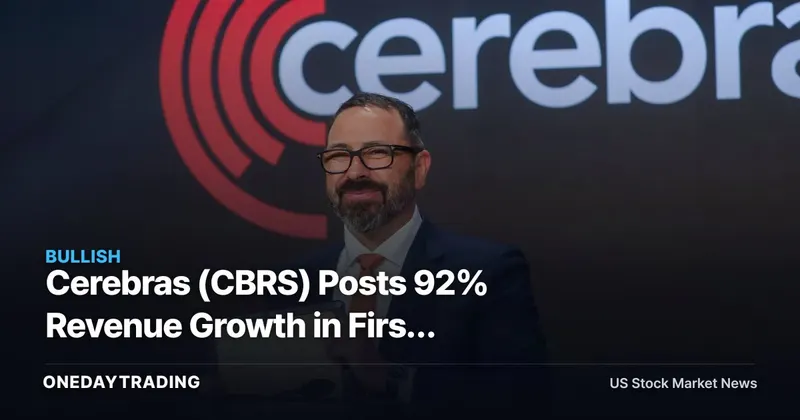
Cerebras used its first earnings report as a public company to show 92% revenue growth, validating demand for an alternative to the dominant GPU architecture. For investors, the print matters less as a single number and more as the first verifiable data point on whether a pureplay AI compute vendor can scale revenue fast enough to justify a richly priced IPO.
What Happened
Cerebras, which went public on the Nasdaq in May, reported its inaugural quarterly results since the listing and posted 92% revenue growth. The debut gives Wall Street something it has lacked: direct access to a company whose entire business is built around AI training and inference silicon, rather than a diversified chipmaker where AI is one line among many.
The 92% growth rate is the headline because it frames the central question around any newly listed AI hardware name. The market is paying for an expectation of durable, compounding demand. A near-doubling of revenue is the kind of figure that supports that thesis, but a first report also resets the baseline against which every future quarter will be judged.
Background and Context
Cerebras designs wafer-scale processors aimed at large-model training and high-speed inference, positioning itself as a challenger in a market where Nvidia commands the overwhelming share of AI accelerator spending. As a pureplay, its results are a cleaner read on standalone AI compute demand than the AI segments buried inside larger semiconductor reports.
The May IPO arrived during a window of intense investor appetite for AI infrastructure exposure, which raises both the reward for execution and the penalty for any deceleration.
Market and Stock Impact
- Cerebras (CBRS): The 92% growth supports the bull case that customers want a credible second source of AI compute, but as a freshly public name with a short track record, the stock carries elevated sensitivity to customer concentration and the next guidance update.
- Nvidia (NVDA): Cerebras is positioned as a direct architectural alternative; sustained Cerebras growth signals that buyers are willing to diversify away from GPUs, a long-term competitive consideration even as Nvidia retains dominant share.
- AMD (AMD): As the other named GPU challenger, AMD competes for the same diversification budget; evidence that buyers fund non-Nvidia silicon broadens the addressable opportunity for all alternatives.
- AI infrastructure suppliers: Memory, networking and packaging vendors benefit from any expansion of non-GPU compute deployments, since wafer-scale systems still require dense supporting hardware.
Investor Checkpoints
- Customer concentration: watch how much revenue depends on a handful of large buyers, the single biggest risk for a young AI hardware vendor.
- The next two quarters of guidance: whether 92% growth was a one-time ramp or the start of a sustained trajectory.
- Gross margin trend: hardware-heavy AI names must prove pricing power, not just volume.
- Lock-up expiry and share supply dynamics following the May IPO.
Outlook
The bull case is straightforward: a pureplay reporting 92% growth gives credibility to the idea that AI compute demand extends beyond a single supplier, and public-market access lets investors express that view directly. The counterweight is equally clear. A debut report sets an aggressive comparison base, newly listed AI names often trade on expectation rather than proven durability, and customer concentration plus unproven margin resilience leave little room for disappointment. The signal value of the next report, where growth meets a tougher comparison, will say more than this first one did.
Market data check: CBRS
CBRS last traded near $208.89 (-6.92%). Our composite signal — blending price momentum and news flow — reads 🟡 neutral. Price momentum scores 5/100 (soft).
Data as of publication. Price via market feeds; for reference only, not investment advice.
📊 Analysis
Signal Bullish
Why A 92% revenue jump in the first post-IPO report validates demand for Cerebras as a pureplay AI compute vendor, a positive catalyst tempered by its short public track record.
This article was independently written by OneDayTrading from public reporting. Read the original (CNBC)