Summary
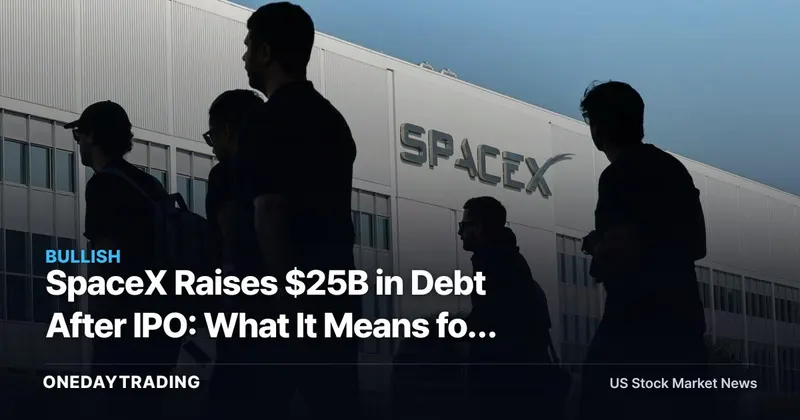
SpaceX raised $25 billion in a debt sale less than two weeks after going public, drawing close to $90 billion of orders. The oversubscription signals that fixed-income investors now treat the space economy as a fundable, credit-worthy industry rather than a venture experiment, which reprices risk across listed peers.
The Full Story
The size of the raise matters less than the demand behind it. Orders of nearly $90 billion against a $25 billion sale imply a book covered more than three times over, a level usually reserved for blue-chip issuers. Coming days after an IPO, it shows SpaceX can tap both equity and credit markets in quick succession, lowering its cost of capital while it scales Starlink and Starship.
For a capital-intensive business that burns cash on launch cadence and satellite manufacturing, locking in $25 billion of debt reduces the need for further dilutive equity and extends runway. Strong credit appetite also validates the recurring-revenue thesis of Starlink subscriptions, the part of the model bond buyers can underwrite most comfortably.
Structural Background
Until recently, pure-play space names struggled to fund themselves outside of equity and government contracts. A heavily oversubscribed corporate debt deal sets a new benchmark: it tells the market that satellite broadband and reusable launch can carry leverage. That reframes how investors value smaller listed competitors that have leaned on dilutive raises to survive.
Stock & Sector Ripple
- Rocket Lab (RKLB) — The closest listed launch competitor; SpaceX cementing cheap capital pressures pricing on small-launch and rideshare, but also legitimizes the category and could lift RKLB sentiment as a public proxy.
- AST SpaceMobile (ASTS) — Direct-to-cell ambitions overlap with Starlink's satellite-to-phone push; a better-funded SpaceX raises the competitive bar for spectrum and carrier deals.
- Iridium (IRDM) and Globalstar (GSAT) — Incumbent satellite connectivity players face a rival whose lower cost of capital can subsidize aggressive Starlink pricing, squeezing their niches.
- Tesla (TSLA) — Shares the same founder; a successful SpaceX financing burnishes Musk-linked execution credibility, an indirect sentiment factor for TSLA holders.
Bull vs Bear Scenarios
Bull case: deep credit demand de-risks SpaceX funding, accelerates Starship and Starlink, and pulls capital toward the entire listed space complex as the sector matures. Bear case: a far better-capitalized SpaceX is a competitive threat, not a tailwind, for smaller names; added leverage also raises refinancing risk if launch or subscriber growth disappoints, and current valuations across space stocks already price in optimism.
Investor Action Points
- Watch the coupon and tenor terms of the debt for the implied cost of capital, and any credit ratings assigned.
- Track Starlink subscriber and revenue disclosures, the metric bond buyers are underwriting.
- Monitor RKLB and ASTS next earnings and cash-runway commentary for competitive pressure or read-through demand.
- Compare incumbent ARPU trends at IRDM and GSAT for signs of Starlink-driven pricing erosion.
Market data check: RKLB
RKLB last traded near $95.22 (-5.06%). Our composite signal — blending price momentum and news flow — reads 🟡 neutral. Price momentum scores 10/100 (soft).
Data as of publication. Price via market feeds; for reference only, not investment advice.
📊 Analysis
Signal Bullish
Why A more than three-times-oversubscribed $25B debt sale validates space-economy credit demand and broadly lifts sentiment for the listed space sector despite competitive risk to smaller peers.
Tickers$RKLB$ASTS$TSLA$IRDM$GSAT
This article was independently written by OneDayTrading from public reporting. Read the original (CNBC)