At a Glance
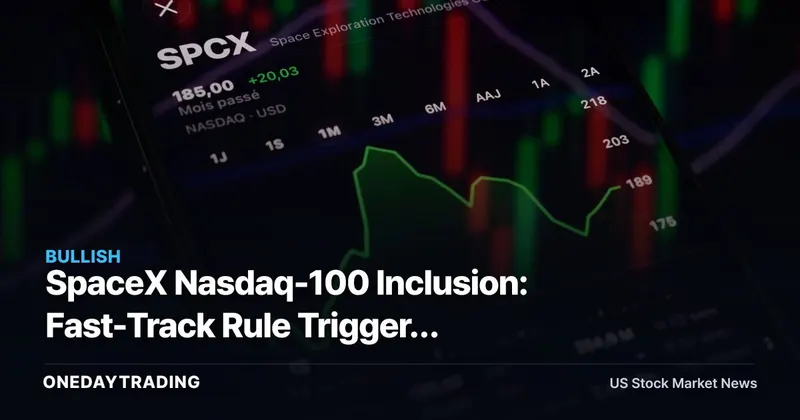
SpaceX would become one of the first companies admitted to the Nasdaq-100 under Nasdaq's newly adopted fast-track inclusion framework, compressing a process that normally runs on a fixed annual calendar. The read-through for investors is mechanical, not narrative: every fund benchmarked to the index must buy the new constituent and trim everyone else to make room. That demand lands on QQQ and its peers regardless of price.
Why It Matters Now
Index inclusion is the rare event where buying is forced rather than chosen. The Invesco QQQ Trust and the lower-fee QQQM track the Nasdaq-100, and behind them sits a deep bench of institutional mandates that replicate the same basket. When a name enters, those vehicles must purchase it at its assigned weight on the effective date, and they fund that purchase by shaving every existing holding pro rata. A fast-track entry concentrates that flow into a tighter window, which is precisely why the framework matters more than the headline.
The mechanism cuts two ways. The new member gets a one-time, price-insensitive bid. The incumbents get a small, uniform sell — a headwind spread across the other constituents, heaviest in dollar terms on the largest weights and most painful in percentage terms for whichever company sits at the bottom of the list and risks being bumped out entirely. Investors holding QQQ do not need to act; they own the rebalance by construction. Investors trying to trade around it face the harder problem, because forced-buying events are among the most front-run setups in the market.
The open question is eligibility. The Nasdaq-100 is built from the largest non-financial companies listed on the exchange, which presupposes a tradable, exchange-listed security. How SpaceX satisfies that prerequisite is the variable that governs the entire trade, and it is the detail retail investors should pin down before treating the inclusion as settled.
FAQ
- Can I buy SpaceX through this? Not directly as a standalone retail stock today; the practical exposure for most investors is the index vehicle, principally QQQ or QQQM, which would hold it at its index weight.
- Why does inclusion move a stock at all? Passive funds must replicate the index, so admission creates guaranteed, valuation-blind buying on the effective date.
- Who gets hurt? Existing Nasdaq-100 members absorb a small pro-rata sell to fund the addition, and the lowest-ranked constituent faces displacement risk.
- Is the fast-track a one-off? No — it is a standing framework, so SpaceX would be an early test case for how future additions are handled.
Related Stocks & Sectors
- QQQ / QQQM — direct conduits for the forced buying; both must add the new weight and rebalance the rest of the book.
- Nasdaq-100 mega-cap incumbents — names like AAPL, MSFT and NVDA carry the largest weights and absorb the biggest dollar trims, though the percentage impact on each is minor.
- NDAQ — the exchange operator benefits structurally as its index franchise and licensing footprint expand with marquee additions.
- Lowest-weighted constituents — the bottom of the index faces the real displacement risk and the sharpest relative pressure.
What to Watch
- The eligibility mechanism — how an exchange-listed, index-qualifying security for SpaceX comes to exist.
- The announced effective date, which is when passive funds must complete their purchases.
- The assigned index weight, which sizes both the inflow to SpaceX and the outflow from incumbents.
- Which constituent, if any, is removed to keep the count at 100.
Overall Outlook
The bull case is straightforward arithmetic: a fast-tracked entry funnels concentrated, price-insensitive demand through QQQ and its institutional shadow, and the exchange operator gains from a higher-profile index. The risk is that the entire setup hinges on an unresolved eligibility question, and that the inclusion bid is often anticipated and faded once the effective date passes. Forced flows are real, but they are also the most crowded trade on the calendar.
Market data check: QQQ
QQQ last traded near $706.52 (-1.38%). Our composite signal — blending price momentum and news flow — reads 🟡 neutral. Price momentum scores 39/100 (soft).
Data as of publication. Price via market feeds; for reference only, not investment advice.
📊 Analysis
Signal Bullish
Why Fast-tracked Nasdaq-100 inclusion forces mechanical, price-insensitive buying through QQQ and index-replicating funds, a structural tailwind for the constituent and the exchange franchise.
Tickers$QQQ$NDAQ$QQQM$AAPL$MSFT$NVDA
This article was independently written by OneDayTrading from public reporting. Read the original (CNBC)