Summary
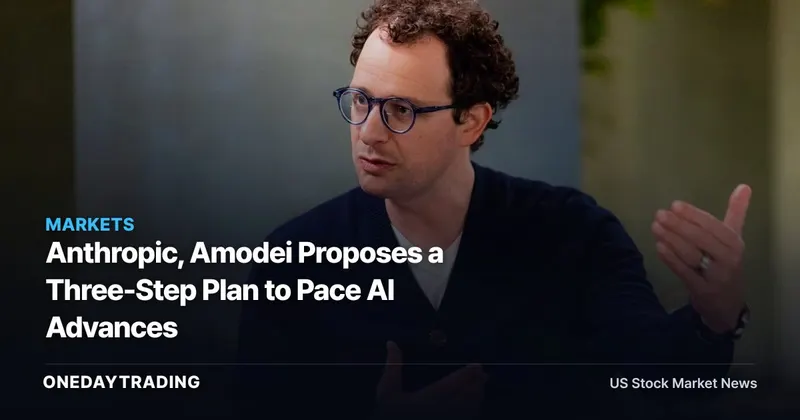
Anthropic investors have no public stock to trade, but the company’s approach to AI capability development has become a competitive issue for the broader AI sector. According to CNBC, Anthropic CEO Dario Amodei published an essay on Sept. 12, 2026, urging AI companies to pace improvements in model capabilities through a three-step plan.
The investment relevance lies in execution, not the proposal’s language. Based on the facts reported by CNBC, the first step creates a company-level verification mechanism, while the second and third steps depend on coordination whose participants and timing remain undisclosed.
The Full Story: Anthropic’s Three-Step AI Plan
Capability pacing means managing how quickly AI models improve while applying safety practices and independent scrutiny. According to CNBC, Anthropic has committed unilaterally to Amodei’s first step by granting third-party evaluators employee-level access so they can verify safety practices and report incidents.
According to CNBC, Amodei’s second step encourages leading AI companies in democratic countries to establish common safety standards. His third step calls for coordination between democratic and authoritarian governments. CNBC did not identify the companies, governments or evaluators that would participate, and it did not report when or whether the second and third steps will be implemented.
That distinction is central to the investor reading. Based on CNBC’s reporting, only Anthropic’s first step is described as a commitment; the other two remain proposals requiring action beyond Anthropic. Treating all three steps as implemented would therefore overstate the evidence.
Why Jacob Coxon’s Resignation Raises the Stakes
According to CNBC, researcher Jacob Coxon announced that he had resigned from Anthropic because of concerns about Anthropic and OpenAI, Anthropic’s chief rival. Coxon previously worked as a researcher at both companies, connecting his criticism directly to the two organizations named in his concerns.
Coxon said the companies were “gambling with our lives” and that people building AI “earnestly believe that it could kill us all by the end of the decade,” according to CNBC. Those statements represent Coxon’s assessment, not a reported outcome or a quantified forecast.
The dispute did not begin with the resignation. According to CNBC, OpenAI CEO Sam Altman and Anthropic CEO Dario Amodei signed a statement in 2023 describing mitigation of AI extinction risk as a global priority. Based on CNBC’s facts, the unresolved question is therefore not whether senior figures have acknowledged the issue, but whether acknowledgment produces verifiable and shared practices.
Structural Background: Verification Before Coordination
According to CNBC, Anthropic’s first step gives outside evaluators access comparable to employees for the purposes of checking safety practices and reporting incidents. On the evidence CNBC provides, this is the most concrete part of the plan because it specifies both an access mechanism and the evaluators’ intended functions.
The limits are equally important. CNBC does not identify the third-party evaluators, while the second and third steps lack named participants and implementation dates. Based on CNBC’s reporting, investors can assess the structure of Amodei’s proposal, but they cannot yet compare participation, compliance or outcomes.
Stock & Sector Ripple
- Anthropic: According to CNBC, the company has not officially disclosed when it plans to debut publicly. No listed ticker can therefore be assigned from the supplied facts, and the safety proposal cannot be translated into a direct public-share reaction.
- OpenAI: CNBC describes OpenAI as Anthropic’s chief rival and reports that Coxon’s resignation concerns named both companies. The supplied facts do not establish that OpenAI has joined Amodei’s proposed standards or government-coordination steps.
- AI sector: Based on CNBC’s reporting, the sector-level issue is whether Anthropic’s unilateral verification commitment expands into shared standards. The facts do not identify participating companies, so no listed beneficiary or affected peer can be named without speculation.
Bull vs Bear Scenarios
Bull case: Based on the mechanism CNBC reports, employee-level access for third-party evaluators could make Anthropic’s safety practices and incident reporting more verifiable. If named AI companies later adopt common standards, the second step could move from an executive proposal toward a shared operating framework. CNBC, however, reports neither those participants nor that implementation.
Bear case: Based on CNBC’s facts, the plan may remain concentrated in Anthropic’s unilateral first step because the later stages require coordination among companies and governments that have not been identified. Coxon’s resignation and criticism also show that a former researcher remained concerned despite Anthropic’s stated position.
Amodei’s own framing preserves the tension. “I continue to believe that AI can enormously improve the quality of human life,” he said, according to CNBC. The supplied evidence does not resolve whether the proposed safeguards will support that ambition, constrain development, or be adopted beyond Anthropic.
Investor Action Points
- Verify the first step: Check whether Anthropic identifies the third-party evaluators and provides evidence that they received the promised access to review safety practices and report incidents.
- Test the second step: Look for named leading AI companies in democratic countries and explicit confirmation that they have agreed to common safety standards.
- Test the third step: Look for identified democratic and authoritarian governments, a defined coordination process and confirmation that implementation has begun.
- Separate company policy from an investable event: According to CNBC, Anthropic has not officially disclosed when it plans to debut publicly. Until that changes, the proposal has sector relevance but no directly attributable public ticker.
The Next Evidence Threshold for Anthropic
The next meaningful development is not another statement of intent. Based on CNBC’s reporting, it is evidence that the first-step access exists, followed by named participation in the second and third steps. Without those disclosures, investors cannot determine whether Amodei’s three-step proposal is becoming a common standard or remains an Anthropic-only commitment.
📊 Analysis
Signal Neutral
Why The proposal introduces a concrete safety-verification commitment, but CNBC reports no implementation schedule for its broader coordination steps or public-debut date for Anthropic.
This article was independently written by OneDayTrading from public reporting. Read the original (CNBC)