At a Glance
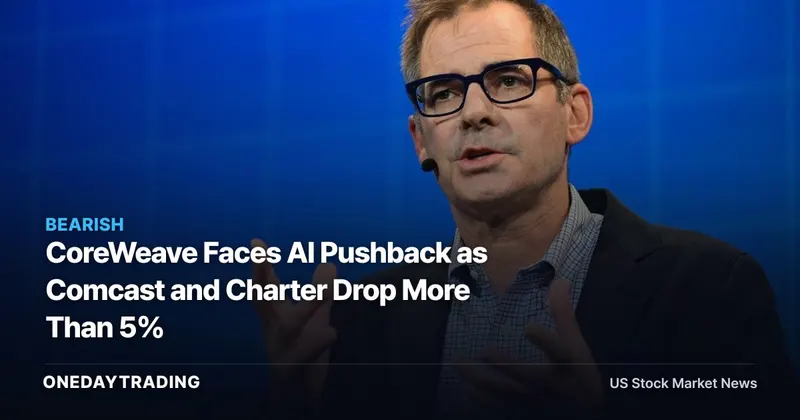
CoreWeave CEO Mike Intrator addressed opposition to artificial intelligence and data centers at the Goldman Sachs Communacopia + Technology Conference, while Comcast and Charter Communications confronted broadband competition, according to CNBC in an article whose URL shows a publication date of Sept. 9, 2026. For investors, CNBC’s account points to two distinct pressure points: AI infrastructure companies must explain the benefits of rapid technological change, while cable providers must defend customers and revenue against competing broadband technologies.
Comcast and Charter shares were each down more than 5% in midday trading, according to CNBC. The move gives the broadband discussion immediate market weight, although CNBC did not establish that any single conference statement caused the declines.
Why CoreWeave’s AI-Infrastructure Message Matters
AI infrastructure comprises the data-center capacity that allows AI companies to deliver their services. Intrator told CNBC that companies had not adequately communicated those benefits to the public, framing the challenge as a failure of explanation rather than evidence that opposition had stopped the underlying transformation.
The investor tension lies between capability and acceptance. On the facts reported by CNBC, CoreWeave’s case depends partly on whether the public connects data-center development with useful services for people, governments and decision-making. Yet CNBC did not quantify opposition to AI or data centers, so the scale of that resistance cannot be translated into a measurable operating or financial effect from the supplied evidence.
Intrator also argued that the fear concerns the speed of change more than data centers themselves. According to CNBC, his formulation shifts the debate from physical infrastructure to uncertainty about how rapid AI development may affect individuals and their children. The analytical implication, grounded in CNBC’s account, is that explaining facilities alone may not answer concerns centered on the broader technology.
AI Safety Concerns Complicate the Adoption Narrative
The conference discussion coincided with a sharper warning from Jacob Coxon, who resigned from Anthropic and published his concerns on X, according to CNBC. Coxon had worked at both Anthropic and OpenAI, which CNBC described as chief competitors.
Coxon warned that AI “could kill us all by the end of the decade” and accused companies of “gambling with our lives,” according to CNBC. Those statements intensify the contrast with Intrator’s emphasis on communicating benefits, but CNBC provided no evidence establishing whether Coxon’s prediction will occur. Investors therefore have a documented disagreement over risk framing, not a verified outcome.
According to CNBC’s evidence, the central issue is not simply whether AI can deliver benefits. It is whether companies can address fears about the pace and consequences of development without treating public concern as a communications problem alone. The supplied facts do not show which argument has greater public support.
Broadband Competition Reaches the Income Statement
Comcast CFO Jason Armstrong said competitive pressure from fixed wireless providers remains, according to CNBC. Fixed wireless uses 5G connectivity to provide broadband service, making 5G both the technology identified in the report and an alternative confronting Comcast and Charter.
The pressure is already visible in disclosed operating direction. According to CNBC, Comcast and Charter have experienced quarterly broadband customer losses in recent years. For Comcast’s reporting period ended June 30, CNBC said the company recorded another broadband customer loss and lower segment revenue, though the report supplied neither the number of customers lost nor the revenue amount.
On CNBC’s account, that combination matters more than an isolated share-price move. Customer losses show pressure on the subscriber base, while lower segment revenue shows that the challenge has reached reported financial performance. Without the missing customer and revenue figures, however, investors cannot determine the magnitude or rate of deterioration from this article alone.
Key Debates at the Goldman Sachs Conference
- Benefits versus acceptance: According to CNBC, Intrator said the industry had not explained what data centers enable well enough. CNBC did not quantify the resulting opposition, leaving its commercial significance unresolved.
- Speed versus infrastructure: Intrator attributed fear to rapid change rather than data centers specifically, according to CNBC. That distinction suggests a broader AI trust question than a debate limited to physical facilities.
- Safety warnings versus verified evidence: Coxon issued an extreme warning after leaving Anthropic, according to CNBC, but the report did not provide evidence that his predicted outcome will happen.
- Current versus emerging broadband pressure: Armstrong identified fixed wireless as an existing competitive force and satellite as a potential threat, according to CNBC. The report did not specify when satellite competition might become material.
Related Stocks and Sectors
- CoreWeave and AI infrastructure: According to CNBC, the company’s CEO placed public understanding of data-center-enabled benefits at the center of the AI opposition debate. The report provides no quantified measure of opposition or financial impact, limiting a company-specific valuation conclusion.
- Comcast and cable broadband: CNBC reported continued fixed-wireless pressure, another broadband customer loss and lower segment revenue for the period ended June 30. Those facts support a negative operating read-through, while the absent figures prevent measurement of its severity.
- Charter Communications and cable broadband: CNBC reported quarterly customer losses in recent years and a midday share decline of more than 5%. CEO Chris Winfrey said competition was affecting cable broadband in the short term while expressing confidence in longer-term improvement.
- Satellite broadband: Armstrong called satellite a potential threat and cited Starlink as an example, according to CNBC. His statement identifies a competitive possibility, not evidence that satellite has already produced a material effect.
What Investors Should Check Next
- Broadband customers: At the next Comcast and Charter reporting events, compare whether each company reports another customer loss. CNBC did not provide a future reporting date or a customer-loss figure.
- Broadband segment revenue: Check whether Comcast again reports lower segment revenue after the period ended June 30. The supplied CNBC facts establish the direction of the latest change, but not its size.
- Competitive commentary: Listen for whether management continues to identify fixed wireless as the immediate pressure and whether satellite moves from a potential threat to a reported operating factor.
- AI opposition evidence: Look for quantified measures of opposition or concrete effects on data-center activity. CNBC’s article documented the debate but supplied no such measurement.
Overall Outlook
The broadband evidence carries the clearer directional signal. According to CNBC, Comcast and Charter have lost broadband customers in recent years, Comcast reported lower segment revenue for the period ended June 30, and both stocks fell more than 5% in midday trading. Winfrey’s confidence in long-term improvement provides the countercase, but CNBC reported no supporting figures or achieved turnaround.
The AI-infrastructure outlook is less measurable. According to CNBC, Intrator sees inadequate communication of benefits and fear of rapid change, while Coxon’s resignation and warnings sharpen the safety debate. The next useful evidence is not another slogan from either side: it is a quantified indicator showing whether opposition affects data-center activity, paired with subsequent Comcast and Charter disclosures showing whether competitive pressure continues to reduce broadband customers and revenue.
FAQ
Did CNBC quantify opposition to CoreWeave or AI data centers?
No. CNBC reported Intrator’s explanation of public opposition, but the supplied facts contain no measurement of its scale and no quantified financial effect on CoreWeave.
How many broadband customers did Comcast and Charter lose?
CNBC reported quarterly broadband customer losses in recent years and another Comcast loss for the period ended June 30. The supplied article did not state the number lost by either company.
Has Starlink already materially affected Comcast or Charter?
The supplied evidence does not establish that. According to CNBC, Armstrong described satellite as a potential threat and identified Starlink as an example, but the article gave no timetable for a material impact.
📊 Analysis
Signal Bearish
Why CNBC reported persistent broadband competition, customer losses and lower Comcast segment revenue, while opposition and safety concerns complicated the AI narrative.
This article was independently written by OneDayTrading from public reporting. Read the original (CNBC)