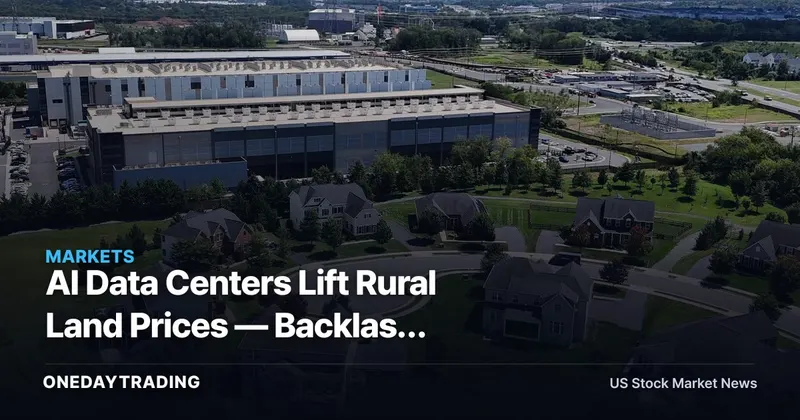
What Changes
An AI data center is a facility built to run compute-intensive artificial-intelligence workloads, linking servers and accelerators to land, power and physical development capacity. The rural land market therefore sits upstream of semiconductor shipments: a delayed site cannot absorb installed hardware on schedule.
CNBC identifies a split among rural stakeholders rather than a uniform land rush. Owners willing to transact gain negotiating leverage as demand lifts property values, while resisting farmers can narrow the pool of viable parcels and raise the nonfinancial cost of development through local opposition.
For investors, announced infrastructure spending is no longer enough. The higher-quality signal is conversion: land secured, approvals obtained, construction begun and computing capacity brought online.
By the Numbers
The supplied CNBC report provides no dollar increase, acreage total, capacity figure or percentage change for rural land prices. That absence prevents a defensible estimate of how much site inflation will affect project returns.
The next useful disclosures are land acquisition cost, permitting duration, delayed or canceled sites and the share of planned facilities entering construction. Those measures distinguish durable AI demand from a pipeline accumulating before local bottlenecks.
Winners & Losers
- Participating rural landowners: stronger developer demand can increase sale prices and bargaining power.
- AI infrastructure developers: access to acceptable sites supports expansion, but higher land costs and resistance can slow deployment.
- Data-center hardware suppliers: completed facilities create an outlet for servers and accelerators; site delays push hardware demand further out.
- Farmers opposing development: rising valuations offer financial leverage, but conversion threatens continued agricultural use.
Risk Check
- CNBC supplies no quantified land-price baseline, limiting valuation work.
- Community resistance can turn a planned facility into stranded preconstruction spending.
- Higher land prices benefit sellers but raise the capital required per completed site.
- A backlog of announcements can overstate near-term hardware demand if construction slips.
Bottom Line
Rising rural land demand supports the physical credibility of the AI buildout, but landowner backlash challenges its timing. The upside survives if developers convert sites into operating facilities; the risk grows if land inflation and opposition widen the gap between announced capacity and completed projects.
FAQ
Why are AI data centers raising rural land prices?
CNBC reports that the data-center buildout is increasing demand for rural property. Scarcer willing sellers can strengthen landowner negotiating power as developers compete for usable sites.
How does rural opposition affect AI data center stocks?
Rural opposition can delay the facilities that ultimately house AI servers and accelerators. If approvals or land purchases stall, infrastructure revenue can shift beyond the period implied by project announcements.
What should investors track in the AI data center buildout?
Investors should track secured sites, permitting duration, construction starts and completed facilities. The decisive test is whether planned capacity converts into operating capacity and hardware orders.
📊 Analysis
Signal Neutral
Why Rising rural land demand validates AI infrastructure expansion, but unquantified costs and local opposition create material timing and execution risks.
This article was independently written by OneDayTrading from public reporting. Read the original (CNBC)