What Changes
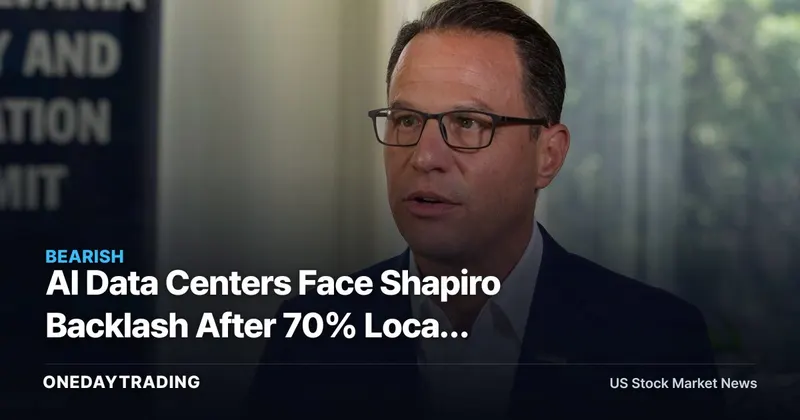
AI data center policy risk is moving from abstract permitting friction to a local-cost problem. Pennsylvania Gov. Josh Shapiro, per the CNBC source, framed the dispute around community burden, which means the approval debate can widen from land use to electricity demand, water use, noise, tax treatment and grid reliability.
For investors, the channel matters. AI infrastructure spending only converts into revenue when developers can secure land, interconnection, power and community acceptance; any delay at the permitting or utility-review layer pushes server halls, GPU clusters and cooling deployments into later quarters.
The tape already prices AI infrastructure as a demand story. The source points to the part the market discounts less cleanly: public resistance can raise the non-silicon cost of capacity, even when demand for AI compute remains intact.
By the Numbers
The cleanest figure in the source is the May Gallup survey showing seven in 10 Americans oppose constructing artificial intelligence data centers in their local area. That number is large enough to turn local hearings into a repeat risk rather than a one-off complaint.
The second figure is geographic rather than numerical: Pennsylvania is now part of the national AI data center debate because Gov. Josh Shapiro publicly criticized developers. Pennsylvania matters because data center economics depend on grid access and local approval, not only on chip availability.
Winners & Losers
- AI data center developers: Community opposition can lengthen project timelines and force higher spending on local benefits, grid upgrades or mitigation before new capacity produces rent or service revenue.
- Utilities and grid operators: Power demand from AI facilities can support load growth, but political resistance can make rate design, interconnection queues and infrastructure cost recovery harder to approve.
- GPU, server and cooling suppliers: Hardware demand stays linked to AI compute buildouts, but delayed campuses can shift shipment timing even when end demand remains strong.
- Local governments: Municipalities gain leverage when seven in 10 Americans oppose nearby AI data centers, because developers may need clearer tax, jobs and infrastructure packages to win approvals.
Risk Check
- Counter-scenario: Developers that offer power upgrades, local tax revenue and transparent community agreements can still win projects despite broad national opposition.
- Demand risk: The CNBC source does not show weaker AI compute demand; the risk is capacity timing, not a proven drop in enterprise AI usage.
- Policy risk: Pennsylvania Gov. Josh Shapiro criticized developer behavior, but the source does not cite a specific Pennsylvania ban, rule or permitting deadline.
- Market risk: Investors should avoid treating community opposition as an immediate earnings hit without company-specific exposure, backlog timing or guidance changes.
Bottom Line
AI data centers remain a buildout story, but the May Gallup figure and Gov. Josh Shapiro criticism show why the next constraint is not only chips or capital; if developers cannot translate AI demand into locally accepted projects, revenue recognition and infrastructure orders can move slower than the AI narrative assumes.
FAQ
Why are AI data centers facing local opposition?
AI data centers are facing local opposition because residents associate large computing campuses with power demand, infrastructure strain and community disruption. The May Gallup survey cited by the source found seven in 10 Americans oppose artificial intelligence data centers in their local area.
What did Pennsylvania Gov. Josh Shapiro say about data center developers?
Pennsylvania Gov. Josh Shapiro said too many data center developers do not care about communities, according to the CNBC source. That statement matters because state and local approval can affect how quickly AI data center capacity gets built.
What stocks are affected by AI data center permitting risk?
The CNBC source does not name specific listed companies, so no individual ticker can be tied directly to the report without adding outside facts. The affected groups are AI data center developers, utilities, GPU suppliers, server vendors and cooling-equipment providers whose revenue timing depends on completed data center capacity.
📊 Analysis
Signal Bearish
Why The source points to political and community resistance that can slow AI data center approvals and raise project costs, even without proving weaker AI demand.
This article was independently written by OneDayTrading from public reporting. Read the original (CNBC)