Donald Trump’s AI Accord Shifts the Investor Test to Execution
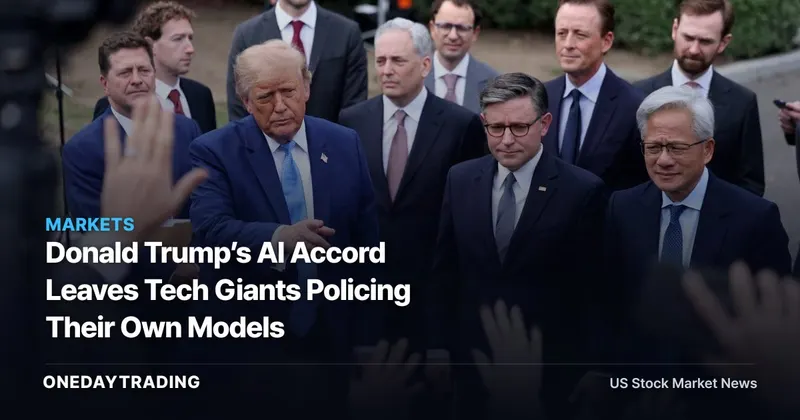
Donald Trump brought AI and technology leaders to the White House on Tuesday, where they signed a voluntary safety accord that leaves Alphabet, Meta, Nvidia, Anthropic, OpenAI and other companies responsible for monitoring their own technology. For investors, the central issue is not whether the industry endorsed safety in principle. It is whether internal controls, external evaluation and board oversight become visible, comparable operating disciplines rather than promises that cannot be tested from outside.
The White House Accord on Super Intelligence: Joint Commitment on Frontier Responsibilities is a company-led governance framework for developing AI safely and building trust with customers and the public. Its design places the first line of responsibility inside each participating company, which makes execution and disclosure more informative than the language of endorsement alone.
What the White House Accord Requires
CNBC reported that the two-page accord signed Tuesday contains four action items: internal monitoring of models, an internal team responsible for checking controls, cooperation with outside auditors or evaluators, and oversight by an independent board committee. Those requirements span the model itself, the people enforcing company policy, an outside review layer and the board.
That structure gives investors a practical framework for assessing implementation. Internal monitoring addresses how a company observes its models; the controls team tests whether safeguards function; outside evaluators add independent scrutiny; and board-committee oversight assigns responsibility above day-to-day management. The accord does not provide a common measurement system for comparing how companies perform those tasks.
Donald Trump described the rules as “morally binding.” That wording is decisive for the market interpretation: the agreement records commitments, while the supplied facts do not establish legal enforcement or penalties. Trump also said he signed a document purporting to change the name of AI officially to super intelligence, a label that does not alter the accord’s underlying control obligations.
Alphabet, Meta and Nvidia Face a Governance Question, Not a New Metric
The accord brings several parts of the AI industry into the same policy conversation. Sundar Pichai, associated with Alphabet, called the moment historic and consequential. Mark Zuckerberg, CEO of Meta, supported the agreement as an industry starting point, while Dario Amodei, CEO of Anthropic, said the industry could win safely by working with the president and others present.
Sam Altman leads OpenAI, and Jensen Huang leads Nvidia; SpaceX and Palantir were also among the technology companies represented in the reported event. The complete attendee and signatory lists were not provided, so participation should not be treated as proof that every named company accepted identical obligations or implementation plans.
For company analysis, the key distinction is between signing a shared framework and demonstrating that it changes internal practice. A company could make the accord more decision-useful by showing how model monitoring works, who sits on the controls team, which outside evaluator is involved and how the independent board committee reports its findings. No such company-specific evidence appears in the supplied facts, preventing a supported ranking of Alphabet, Meta, Nvidia, Anthropic, OpenAI, SpaceX or Palantir on safety execution.
Public Opinion Raises the Cost of an Unverifiable Promise
Verasight’s September national survey found that 63% of respondents wanted AI development to slow down, while 5% wanted it to accelerate. The figures show a wide difference between the measured preferences, although the supplied facts do not include the survey’s sample size, methodology or margin of error.
That public backdrop makes trust central to the accord’s relevance. The document says companies should develop their technology safely and build trust with customers and the public. Mark Zuckerberg captured the limited scope of the agreement when he said, “It is that this is a start and an accord that the whole industry can come to.” A starting point can organize expectations, but investors still need evidence that those expectations shape operating controls.
CNBC placed the White House lunch after three weeks of intense AI-industry debate. Bradley Tusk, CEO of Tusk Ventures, referred in his Tuesday interview to CEOs’ position two weeks earlier. Those relative periods establish the sequence described in the reporting without resolving the White House meeting to a calendar date that the article body did not explicitly provide.
Mark Warner’s Proposal Defines the Alternative Policy Path
Mark Warner said he introduced legislation that would require rigorous testing and evaluation of leading AI technology, along with stronger security and reporting before deployment of the most powerful models. This creates a clear analytical contrast with the White House accord: one path relies on company responsibility, while the other would place testing, security and reporting requirements in legislation.
The supplied facts do not include the proposal’s full text or legislative status. Investors therefore cannot infer that its requirements will take effect, nor can they quantify compliance consequences for any company. The useful comparison is narrower: Warner’s proposal emphasizes requirements before deployment, whereas the accord directs companies to establish their own monitoring and oversight arrangements.
November’s midterm elections provide the next stated political milestone in the fact sheet. They do not establish an outcome for either approach. They do identify a period in which the gap between voluntary commitments and proposed legislation may remain part of the AI-policy debate.
Stock-Specific Read-Throughs From the Trump AI Meeting
- Alphabet: Sundar Pichai’s support places the company inside the accord’s public-policy framework. The investable checkpoint is whether Alphabet identifies concrete monitoring, outside-evaluation and board-oversight practices linked to the agreement.
- Meta: Mark Zuckerberg explicitly characterized the accord as a beginning for the industry. Investors should distinguish that endorsement from evidence that Meta has implemented or disclosed each control required by the document.
- Nvidia: Jensen Huang’s company was represented among the technology leaders. The facts establish participation in the event, but they do not describe Nvidia-specific responsibilities, implementation or financial effects.
- Anthropic and OpenAI: Dario Amodei and Sam Altman lead companies directly associated with frontier AI development. The agreement makes internal model monitoring and external evaluation especially relevant analytical questions, without supplying company-level results.
- SpaceX and Palantir: Both were identified among the companies at the White House. No separate commitments or operating consequences were provided, so a more specific stock or business conclusion would exceed the evidence.
The Evidence Investors Need Next
- Control design: Check whether participating companies explain what their internal model monitoring covers and how the controls team determines that safeguards are working.
- Independent review: Look for identification of outside auditors or evaluators, along with an explanation of what they examine. Participation alone does not reveal the scope or independence of an evaluation.
- Board accountability: Determine whether companies designate an independent board committee and disclose how that committee oversees the internal controls team.
- Policy development: Track whether voluntary steps are later codified and whether Mark Warner’s legislative proposal advances with clarified testing, security and reporting requirements.
Why the Accord Supports a Neutral Sector View
The constructive case is that the accord gives leading AI and technology companies a common governance architecture. Internal monitoring, a dedicated controls team, outside evaluation and independent board oversight could make safety responsibility easier to identify if companies disclose how each layer works.
The risk is that the framework remains difficult to verify. The facts provide no enforcement mechanism, penalties or company-level implementation evidence. They also do not establish revenue, cost, demand, valuation or competitive effects for Alphabet, Meta, Nvidia, Anthropic, OpenAI, SpaceX or Palantir.
The next meaningful signal will come from execution, not another endorsement. Evidence that companies have installed the accord’s four control layers would make the framework more measurable; missing or opaque disclosure would preserve the uncertainty that followed Tuesday’s White House meeting.
📊 Analysis
Signal Neutral
Why The accord establishes a shared governance framework, but its voluntary status and unspecified enforcement leave the stock impact indeterminate.
This article was independently written by OneDayTrading from public reporting. Read the original (CNBC)