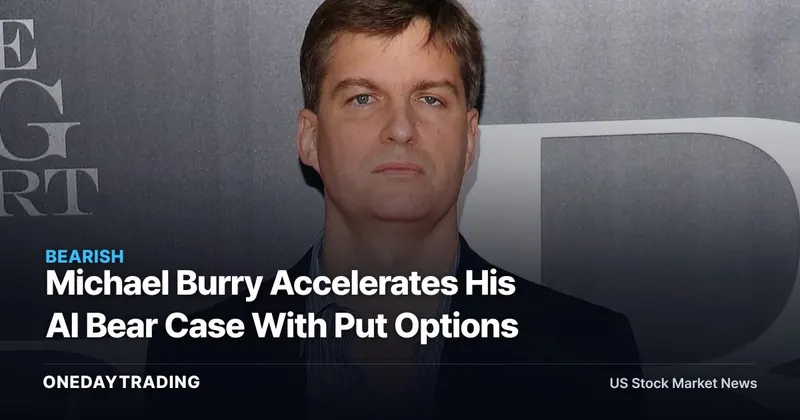
Michael Burry Moves Up His AI-Bubble Timeline
Michael Burry has turned a broad technology short thesis into a more time-sensitive options trade. On 2026-09-28, CNBC reported that he had replaced major short positions in Micron, Nebius, the SOXX iShares Semiconductor ETF and Palantir with put options, saying the artificial-intelligence bubble may break earlier than he previously believed.
The change matters because it sharpens both the direction and timing of his thesis. A short position generally benefits from a falling security, while a put option gives its holder exposure to a decline through a specified strike price and expiration. By choosing puts, Burry is expressing a bearish view through instruments whose outcomes depend not only on whether the underlying securities fall, but also on how their moves interact with the selected terms.
His message was explicit: “Fundamentally, I am moving timelines up.” Burry also wrote that “the bubble in AI may burst sooner than later.” Those statements describe his conviction, not a verified timetable for a reversal.
The Put Structure Reveals Where Burry Sees Risk
CNBC reported that Michael Burry exchanged his Micron short for puts in the $500 strike price range with a June expiration date. Micron was already 16% below its record level, so the position was not initiated against a stock sitting at its peak. The undisclosed expiration year prevents a precise assessment of how much time the trade allows for his thesis to develop.
Burry also converted his Nebius short into puts carrying a double digit strike price range and a June expiration. As with Micron, the available facts identify the expiration month without identifying the year. That omission is material because an option’s deadline determines how quickly the anticipated move would need to occur.
The longer-dated positions reach further into the semiconductor and software sides of the AI trade. Burry replaced his SOXX iShares Semiconductor ETF short with puts at a low $400s strike price for September 2027. He also replaced and rolled his Palantir short and put exposure into an enlarged put position centered on a low $100s strike price with a September 2027 expiration.
Palantir stood about 10% below its all-time high, according to the reporting. The September 2027 term gives that position a clearly stated horizon, while its enlargement indicates that Burry increased the put exposure rather than merely changing the instrument used to express it.
From AI Revenue Expectations to Semiconductor Exposure
The central analytical link is the dependence of the AI investment case on revenue expectations. Burry cited Ares Management research concerning reliance on unproven AI revenues. If those revenues fail to support the spending assumptions attached to them, investors could reassess the value assigned to companies and instruments exposed to the AI buildout.
That mechanism spans different parts of the market without making them identical. Micron represents semiconductor exposure, Nebius is another named target of Burry’s technology positioning, and SOXX iShares Semiconductor ETF broadens the trade beyond an individual company. Palantir extends the thesis into AI-linked software exposure.
The positions therefore test a shared premise from several angles: whether expected AI demand and revenue can continue to justify the market’s confidence. A disappointment would not need to affect every named security in the same way. The puts instead indicate that Burry sees enough common vulnerability to maintain bearish exposure across chips, a semiconductor fund and software.
Memory Supply Adds a Separate Pressure Point for Micron
Burry’s Micron thesis also includes a physical supply argument. Acer CEO Jason Chen was quoted as saying Chinese production capacity had been consistently increasing. That observation introduces a semiconductor-cycle risk distinct from the broader question of whether AI revenue meets expectations.
For Micron, the bearish mechanism is conditional: expanding production capacity could weaken a shortage-based narrative if supply increasingly meets demand. The fact sheet does not establish the scale, timing or direct financial effect of that capacity, so it cannot support a conclusion about Micron’s future revenue, margins or pricing.
This distinction is important. A weaker AI-spending thesis would challenge the demand side of the semiconductor story, while rising capacity would affect the supply side. Burry’s put position can benefit from a stock decline under either route, although the available evidence does not establish that either outcome will occur.
The Nasdaq Record Creates the Central Tension
The bearish repositioning arrived after the Nasdaq Composite closed at a record in the week before the article. The index level shows that broad market confidence had remained strong even as Burry moved toward a more leveraged expression of downside risk.
His caution also has a historical frame. In May, Michael Burry compared equities with the final phase of the 1999-2000 bubble period. He is also known for his position ahead of the 2007 – 2009 global financial crisis, according to CNBC, though that history does not validate the timing or outcome of his current AI thesis.
The tension for investors is straightforward: the Nasdaq Composite record reflects a market still rewarding the technology theme, while Burry’s options express the view that its supporting assumptions could weaken sooner than expected. Neither fact resolves the argument. They show a widening gap between prevailing market levels and his assessment of downside risk.
Bull and Bear Conditions Across the AI Trade
Bear case: AI revenue fails to substantiate the expectations behind continued investment, prompting a reassessment of companies tied to that spending. Increasing Chinese production capacity, as described by Jason Chen, could add supply pressure to the memory-chip side. Under that combination, Micron and broader semiconductor exposure could face both demand-expectation and capacity concerns, while Palantir could face closer scrutiny of AI-linked software expectations.
Countercase: The Nasdaq Composite record indicates that the market had not confirmed Burry’s reversal thesis. Micron and Palantir were already 16% and about 10% below their respective record levels, leaving open the possibility that some company-specific risk had already entered their prices. Continued confidence in AI revenue would weaken the premise behind an imminent break.
The options themselves do not prove that Burry is correct. They identify the securities, strike ranges and selected horizons through which he is expressing the view. Some changes were also intended to reduce his tax liability, he said, though the specific tax impact is unknown.
Checkpoints for Micron, SOXX and Palantir Investors
- Track the stated horizons: Micron and Nebius have June expirations with no disclosed year, while the SOXX iShares Semiconductor ETF and Palantir puts expire in September 2027. The missing June year should not be inferred.
- Test the revenue premise: Examine whether reported AI revenue supports the expectations attached to continued investment. This is the central vulnerability highlighted through the Ares Management research cited by Burry.
- Separate demand from supply: For Micron, assess AI-related demand alongside evidence about Chinese production capacity. These are distinct channels that could reinforce or offset each other.
- Avoid treating position structure as a forecast: The number of contracts, premiums paid and total position values were not disclosed. Those omissions prevent a reliable calculation of Burry’s capital at risk or the magnitude of decline needed for his overall positions to succeed.
The next decisive evidence will come from whether AI revenue validates continued spending and whether semiconductor supply conditions support the current market thesis. Until those variables change, Burry’s repositioning is a clearly bearish signal from one investor—not proof that an AI-market reversal has begun or a date for when one will occur.
📊 Analysis
Signal Bearish
Why Burry’s shift from short sales to put options expresses a more time-sensitive bearish view across AI, semiconductor and software exposures.
Tickers$MU$NBIS$SOXX$PLTR
This article was independently written by OneDayTrading from public reporting. Read the original (CNBC)