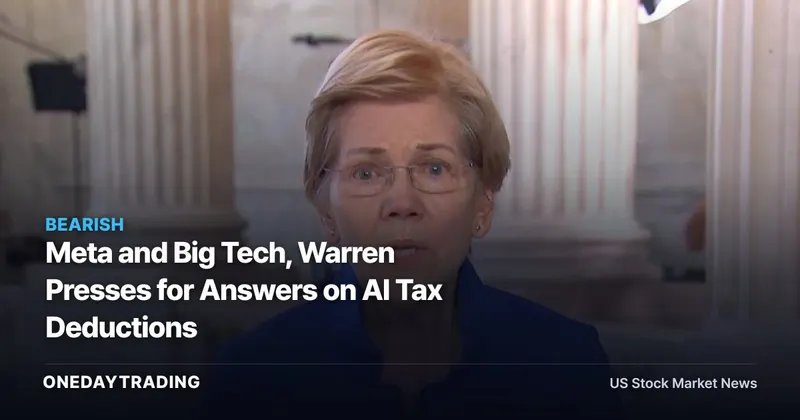
Meta and Big Tech Face an AI Tax Test
Meta, Amazon, Alphabet and Microsoft face a new investor question after Elizabeth Warren and five other senators asked their CEOs to disclose AI and data-center tax deductions and related lobbying. The inquiry, reported by CNBC on 2026-09-28, does not establish that any company acted improperly or that its tax treatment will change. It does challenge investors to separate the economics of AI infrastructure from the tax treatment supporting that spending.
For these companies, the central issue is not merely how much capital goes into data centers. It is how immediate deductions may affect the after-tax cost of that investment and whether those benefits are durable. Until the requested disclosures arrive, investors cannot determine how much of each company’s tax reduction came from AI incentives rather than other factors.
What Elizabeth Warren’s Letters Request
The inquiry seeks the amounts of deductions claimed for AI and data-center development, along with information about lobbying before passage of the 2025 Republican tax and spending legislation. Elizabeth Warren led the letters with Tina Smith, Jeff Merkley, Elissa Slotkin, Bernie Sanders and Richard Blumenthal. The lawmakers requested company answers by Oct. 12; the year associated with that deadline was not provided in the fact set.
AI and data-center tax deductions reduce the taxable cost of qualifying investment, potentially changing the after-tax economics of building infrastructure. That mechanism matters because a deduction can support cash retention without proving that the underlying AI investment will generate an adequate commercial return. Investors therefore need two separate answers: what tax value was claimed, and what operating value the associated infrastructure may ultimately produce.
The companies’ lobbying is a second line of inquiry. The letters ask what each business did before the legislation passed, though the details of those efforts are not yet known. Amazon, Meta, Microsoft and Alphabet each contributed $1 million to Donald Trump’s inauguration, according to CNBC, while the fact sheet does not establish a link between those contributions and any specific tax outcome.
The Tax Figures Behind the Scrutiny
CNBC reported that corporate tax payments are down 25% this year. Separately, the Congressional Budget Office projected in February that federal corporate income tax collections would decline 10.6% in 2026 from a year earlier, falling from $452 billion to $404 billion. Those aggregate figures establish the fiscal backdrop, not the cause of any individual company’s tax change.
Meta paid $2.8 billion in federal income tax in 2025, down from $9.6 billion in 2024, while earning roughly the same profit in both years, according to CNBC. Meta also recorded $72 billion in capital expenditures last year, with the lawmakers focusing on the extent to which data-center construction and other AI spending may have qualified for immediate deductions. The available evidence does not quantify Meta’s AI-specific deduction or prove that AI incentives caused the tax decline.
The figures are also material at the other companies. Microsoft’s current federal income tax expense dropped by more than $11 billion from fiscal year 2025 to 2026. Amazon’s federal income tax payment fell by nearly $8 billion from fiscal 2024 to 2025, while Alphabet’s combined current federal and state income tax expense declined by more than $7 billion over the same fiscal-year comparison.
Those measures are not identical: the fact sheet refers to tax paid for some companies and current tax expense for others. Treating them as directly comparable would overstate what the evidence shows. The useful analytical question is company-specific—how much of each change reflects the deductions under examination, and how much reflects other undisclosed factors.
Why AI Infrastructure Investors Should Care
- After-tax investment cost: If immediate deductions materially lower the cost of AI and data-center development, their durability may influence how investors assess the economics of continuing infrastructure spending. The letters seek the missing company-level amounts needed to evaluate that channel.
- Profit quality: A lower tax burden can support reported after-tax results even when the underlying profit base is broadly unchanged. Meta’s 2025 and 2024 comparison makes the distinction especially relevant, though the evidence does not assign the reduction to AI incentives.
- Policy exposure: The inquiry raises scrutiny around benefits authorized by the 2025 legislation. No reversal, repayment, enforcement action or legislative change is confirmed, so the present impact is uncertainty rather than an established financial charge.
- Disclosure quality: Company responses could allow investors to separate headline tax changes from deductions tied specifically to AI infrastructure. Without that split, the tax contribution to the investment case remains difficult to measure.
Meta, Amazon, Alphabet and Microsoft Stock Read-Through
- Meta: The company has the clearest numerical tension in the supplied evidence: $72 billion of capital expenditures last year alongside federal income tax payments of $2.8 billion in 2025 versus $9.6 billion in 2024. The risk is greater scrutiny of the tax support surrounding its AI buildout; the counter-scenario is that disclosure shows the change cannot be attributed mainly to AI incentives.
- Amazon: Its federal income tax payment fell by nearly $8 billion from fiscal 2024 to 2025. ABI Research ranks Amazon among the top three U.S. data-center companies by active IT capacity, making the requested deduction detail relevant to the after-tax economics of its physical infrastructure.
- Microsoft: Current federal income tax expense declined by more than $11 billion from fiscal year 2025 to 2026. Its top-three position in active U.S. data-center IT capacity, according to ABI Research, puts the company directly inside the inquiry’s AI-infrastructure focus.
- Alphabet: Combined current federal and state income tax expense fell by more than $7 billion from fiscal 2024 to 2025. Google Cloud, part of Alphabet, ranks 10th in active U.S. data-center IT capacity under the ABI Research comparison, giving investors a defined infrastructure link without revealing the amount of any associated deduction.
The Debate Is About Attribution, Not Just Tax Totals
The lawmakers wrote that Americans are worried about AI’s effects on their lives and argued that Republicans in Washington passed subsidies for AI development and data centers. They also told Mark Zuckerberg that Meta’s relationship with President Donald Trump appeared to be producing benefits. Those are the lawmakers’ allegations and political interpretation, not established findings about causation.
That distinction sets the analytical boundary. Falling tax payments do not by themselves reveal which deductions were used, how lobbying affected the legislation or whether any tax advantage will persist. Spokespeople for Meta, Amazon, Alphabet and Microsoft, as well as the White House, did not immediately respond to CNBC’s requests for comment.
Oct. 12 Is the Next Disclosure Checkpoint
- Company-level deduction amounts: Look for a quantified split of AI- and data-center-related deductions rather than broad descriptions of capital spending.
- Reconciliation of tax changes: Each company should be assessed against its own reported measure—tax payment, federal tax expense, or combined federal and state tax expense—rather than forced into a single comparison.
- Lobbying details: The requested responses may clarify what the companies sought before passage of the 2025 legislation and whether their positions addressed specific deductions.
- Responses or silence: The companies’ Oct. 12 answers are the next identified checkpoint. Whether the companies or the White House will respond remains unknown.
The bearish element is policy and disclosure uncertainty around a tax benefit that may improve the economics of heavy AI infrastructure spending. The balancing case is equally important: the letters have not established the amounts claimed, proven that AI incentives caused the reported tax declines or produced a change in tax policy. For investors, the decisive evidence is not another aggregate tax figure; it is the company-by-company bridge between AI investment, claimed deductions and reported tax expense.
📊 Analysis
Signal Bearish
Why The inquiry creates uncertainty over the transparency and durability of tax benefits tied to AI infrastructure spending, although no policy change has been established.
Tickers$META$AMZN$GOOGL$MSFT
This article was independently written by OneDayTrading from public reporting. Read the original (CNBC)