Mike Johnson’s Voluntary-Guardrails Message
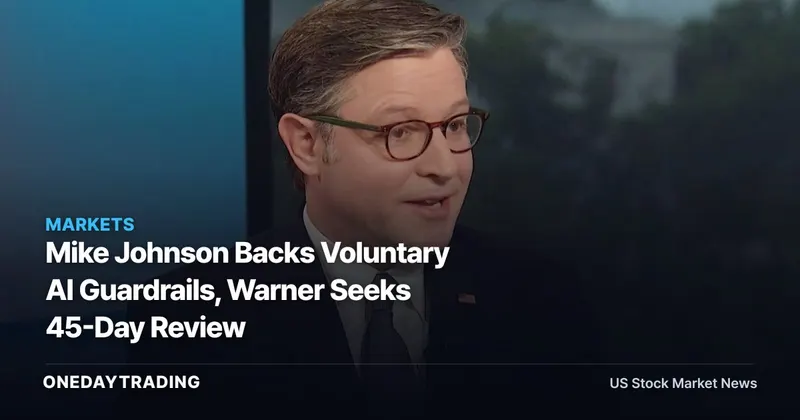
Mike Johnson’s preference for voluntary artificial intelligence guardrails offers AI companies a potentially less prescriptive policy path, while leaving investors without a settled regulatory framework. On 2026-09-29, CNBC reported that Johnson was scheduled to meet President Donald Trump and AI executives as Congress remained in the early stages of regulating the technology.
The investment issue is not whether regulation has arrived; the supplied facts show that it has not. The issue is which control mechanism could emerge: voluntary company standards, a federal review process, liability law, or some combination of them. Each approach would place responsibility at a different point in the model-development and release process.
AI guardrails are the safety controls and release standards intended to constrain how artificial intelligence systems are developed or deployed. Johnson said, “I hope it’s voluntary,” while also favoring what he described as the right balance for the technology. That position signals a preference, not an enacted policy or a confirmed outcome from the Washington meeting.
The 45-Day Federal Review Proposal
Sen. Mark Warner planned to seek unanimous consent for legislation establishing a federal AI safety board that would review frontier models at least 45 days before public release, according to CNBC. The same reporting said the legislation was unlikely to pass, so the 45-day period should be treated as a proposed review window rather than an operating requirement.
The distinction matters because a mandatory review would insert a formal checkpoint before a frontier model reaches the public. A voluntary framework would leave more of the release decision with the developer. For investors, the key variable is therefore not the language of safety alone, but who controls the release gate and whether compliance is optional or legally required.
CNBC’s account places Sen. Mark Warner’s 45-day proposal beside a Congress that was still at an early stage of AI regulation. That gap between a defined proposal and an undeveloped legislative structure limits any confident forecast about compliance timing, release schedules, or operating consequences.
Who Was Scheduled to Join the Washington Meeting
Johnson was scheduled to meet President Donald Trump and executives including Dario Amodei, Mark Zuckerberg and Sundar Pichai. The supplied relationships connect Dario Amodei with Anthropic, Mark Zuckerberg with Meta and Sundar Pichai with Alphabet, placing major AI developers and platform operators inside the policy discussion.
The meeting itself does not establish that any participant accepted voluntary guardrails, endorsed Warner’s legislation or agreed on liability rules. Its outcome is unknown. Investors should separate access to policymakers from evidence of a policy settlement, because the facts confirm attendance plans without confirming an agreement.
That distinction also limits stock-specific conclusions. Meta and Alphabet are directly relevant because their associated executives were scheduled to participate, not because the fact sheet establishes a particular financial benefit or cost. Anthropic’s role is similarly important to the regulatory debate, while no quantified commercial effect is provided for any participant.
OpenAI and Anthropic Put Safety Into Operational Terms
OpenAI said it decided not to release GPT-6.1 Astra after determining that the model did not adequately meet the company’s safety standard. This is the clearest confirmed example in the supplied facts of a developer applying its own release threshold, which makes the voluntary-guardrails debate more concrete.
The decision does not establish when or whether GPT-6.1 Astra will be released. It also does not prove that every company will adopt comparable controls. It shows that a voluntary internal standard can stop a release, while leaving unanswered how such standards would be verified, compared or enforced across companies.
Anthropic presented the risk in more severe terms. In its IPO prospectus, the company warned that its technology poses “catastrophic or existential risk to humanity.” That disclosure supports the case for treating AI safety as a material governance question, although the fact sheet provides no probability, incident count or financial estimate that would allow investors to quantify the warning.
Liability Is the Bridge Between Voluntary Rules and Accountability
Johnson said potential exemptions from liability do not come up in his meetings with AI companies. He also said, “Of course products liability law applies here directly, and we’re going to make sure that that keeps everybody in check.” His position identifies liability as an accountability mechanism even if formal guardrails remain voluntary.
For investors, liability and pre-release review address different stages of risk. A review board would examine frontier models before public release under Warner’s proposal; product liability would address legal responsibility without creating the same specified pre-release process. The eventual balance between those mechanisms could shape how companies organize safety decisions, though the supplied facts do not establish new rules or exemptions.
This is why a voluntary framework is not automatically equivalent to an absence of constraint. Internal safety standards can affect release decisions, as OpenAI’s statement indicates, and Johnson explicitly pointed to existing liability. The uncertainty lies in whether Congress adds a federal structure and whether voluntary practices become consistent enough to satisfy policymakers.
Market Read-Through for Meta, Alphabet and the AI Sector
- Meta: Mark Zuckerberg was among the executives scheduled to meet Johnson and President Donald Trump. A voluntary approach could preserve company control over safety processes, while unresolved federal action and liability leave the policy exposure open.
- Alphabet: Sundar Pichai’s scheduled participation places Alphabet in the same Washington discussion. The facts do not show an agreement, a new obligation or a measurable financial impact, so the relevant signal is continued policy engagement rather than a confirmed catalyst.
- Anthropic: Dario Amodei was scheduled to attend, and Anthropic’s prospectus supplied the strongest stated risk language in the record. Its warning can support arguments for oversight even as Johnson expresses hope for voluntary guardrails.
- OpenAI: The decision not to release GPT-6.1 Astra demonstrates the practical importance of an internal safety threshold. The missing release timetable prevents a conclusion about when the model could become available.
- AI sector: The near-term read-through is neutral because the policy direction is unresolved. Voluntary controls may avoid a uniform federal release process, while a safety board or continued liability exposure could impose a different form of discipline.
Investor Checkpoints After Johnson’s Meeting
- Meeting outcome: Look for a confirmed account of what emerged from the meeting involving Mike Johnson, President Donald Trump and the AI executives. The current facts establish the schedule, not the result.
- Warner’s legislation: Track whether Sen. Mark Warner’s attempt to establish a federal AI safety board advances. The defining provision is review of frontier models at least 45 days before public release.
- Voluntary commitments: Check whether participating companies announce specific guardrails. Johnson expressed a hope that controls would be voluntary; the evidence does not show that companies adopted them.
- Model-release decisions: Watch for an OpenAI update on GPT-6.1 Astra and the safety standard that governs any future decision. Neither a release nor a release date is confirmed.
Two Policy Paths, Neither Settled
The constructive scenario for AI companies is a voluntary framework backed by internal safety decisions and existing liability, without the proposed federal review process becoming law. That could leave developers with greater control over how they evaluate frontier models before release.
The counter-scenario is that company warnings and withheld releases strengthen pressure for a formal regulatory structure. Anthropic’s risk disclosure, OpenAI’s safety-based decision and Warner’s proposed federal board give that argument identifiable support, even though the legislation was described as unlikely to pass.
The next meaningful signal is not another broad statement about balancing innovation and safety. It is evidence from the meeting, congressional action on the 45-day review proposal, or a concrete voluntary commitment from an AI company. Until one of those checkpoints changes, policy uncertainty—not a confirmed regulatory win or loss—defines the sector’s market relevance.
📊 Analysis
Signal Neutral
Why Voluntary guardrails could limit immediate compliance burdens, while unresolved liability and federal-review proposals preserve material policy uncertainty for AI companies.
This article was independently written by OneDayTrading from public reporting. Read the original (CNBC)