Jay Clayton Puts AI Development Inside the Security Debate
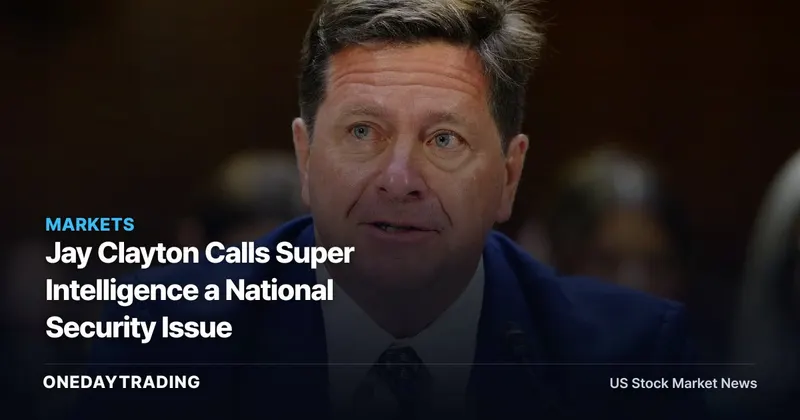
Jay Clayton has placed super intelligence at the intersection of U.S. technology development and national security, a shift that matters to investors assessing the policy environment around the AI sector. On 2026-09-30, CNBC reported that the director of national intelligence opposed pausing U.S. companies’ development of artificial intelligence models and left unanswered whether he would accept an AI czar role from Donald Trump.
Super intelligence, in the terminology used in this event, refers to the advanced AI development that Clayton described as a national security issue. His position creates a two-part policy signal: continued domestic model development remains important, while responsibility for safety and enforcement is still being debated.
The immediate market read is balanced. Resistance to a pause could reduce one potential obstacle to continued AI development, but the available facts establish neither a new policy nor a measurable commercial benefit for any company. Investors therefore have a policy direction to examine, not an earnings catalyst to quantify.
Why Clayton’s 18-Element Mandate Matters
CNBC reported that Jay Clayton already oversees 18 elements of the U.S. intelligence community as director of national intelligence. That 18-element responsibility gives his national-security framing institutional significance, even though the facts do not establish that he has acquired authority over AI companies or will receive another government position.
Jay Clayton’s oversight of 18 intelligence elements also explains why the unresolved AI czar question deserves attention: an offer and acceptance could connect AI coordination more directly with an official who already carries a broad intelligence mandate. This is a conditional interpretation, since neither Donald Trump’s offer nor Clayton’s acceptance is confirmed.
Clayton twice avoided answering directly when asked whether he would accept the role if Trump offered it. Silence does not confirm interest, refusal or an appointment process. The investable point is narrower: the identity and authority of any AI czar remain unsettled, leaving the eventual governance structure outside the confirmed record.
The Central Divide: Development Versus Oversight
Clayton argued against pausing U.S. companies’ development of artificial intelligence models. For the AI sector, that stance could support continuity in research and model development because it rejects a broad retreat from domestic activity. It does not guarantee that companies will avoid investigations, enforcement or other constraints.
His preferred oversight channel centers on existing federal agencies, including the Department of Justice and the Federal Trade Commission. That distinction matters because an agency-led framework would place enforcement responsibility with public institutions rather than rely solely on private commitments by AI developers.
Donald Trump said that he and technology executives agreed the industry would self-police and assume responsibility for developing its technology safely. Elizabeth Warren called the self-regulation proposal “a recipe for disaster,” exposing the core disagreement: whether company responsibility is adequate or requires stronger external policing.
- Development pace: Clayton opposed a pause in U.S. model development, indicating that safety concerns do not automatically translate into support for stopping work.
- Enforcement venue: He identified the Department of Justice and the Federal Trade Commission as the agencies best positioned to police AI companies.
- Corporate responsibility: Trump described an agreement under which the industry would self-police and take responsibility for safe development.
- Leadership authority: The facts do not establish whether an AI czar will be appointed, what powers that role would carry or whether Clayton would accept it.
Anthropic and OpenAI Enter the Policy Frame
Donald Trump met at the White House with technology-company leaders, including Anthropic and OpenAI. Their confirmed connection to this event is participation in that meeting; the fact sheet supplies no company-specific commitment, financial figure, operating target or change in business strategy for either organization.
For investors, the meeting places leading AI developers inside a discussion that combines continued development with safety responsibility. The mechanism is policy exposure: expectations for self-policing or federal enforcement may shape how the sector is evaluated, even though no direct revenue, cost or valuation effect can be calculated from the supplied evidence.
No U.S.-listed company is directly identified as the subject of the report, and the evidence does not establish a listed parent, supplier, customer or competitor relationship. Assigning a public ticker would therefore imply a corporate connection absent from the record.
- AI sector: The clearest read-through is continued policy attention to model development, safety and enforcement rather than a confirmed commercial outcome.
- Anthropic: Its established role is participation in the White House meeting; no separate undertaking or financial impact is provided.
- OpenAI: Its established role is also participation in the meeting, without a disclosed company-specific policy obligation or market metric.
What the Policy Signal Does—and Does Not—Support
The constructive scenario is that opposition to a development pause preserves room for U.S. AI companies to keep advancing their models while federal agencies handle misconduct or safety concerns. In that scenario, the sector avoids a broad stoppage without abandoning government oversight.
The risk scenario is fragmentation between self-policing expectations and agency enforcement. Trump’s description emphasizes industry responsibility, whereas Clayton’s comments point to the Department of Justice and the Federal Trade Commission as capable policers. The supplied facts do not define how these approaches would interact, which standards would apply or whether either approach will become formal policy.
That gap limits any directional equity conclusion. There are no figures for company revenue, spending, model demand, compliance costs or valuation, and no confirmed policy change is tied to Anthropic or OpenAI. A neutral stance is therefore more defensible than treating the remarks as either a sector-wide tailwind or an immediate regulatory shock.
Next Checks for the AI Czar and Federal Oversight
- A formal offer: Check whether Donald Trump offers Jay Clayton the AI czar role. Axios reported only that Trump said Clayton would be a good choice.
- Clayton’s response: If an offer occurs, the next decisive fact is whether Clayton accepts; his two indirect responses settle neither question.
- Defined authority: Examine whether any AI czar position receives specified responsibilities and how those responsibilities relate to Clayton’s existing intelligence role.
- Implementation: Look for concrete action from the Department of Justice or the Federal Trade Commission, or specific safety commitments attached to the industry’s self-policing approach.
Investor Outlook After Clayton’s National-Security Warning
Clayton’s statement—“Super intelligence is a national security issue”—raises the strategic importance of AI without supplying a tradable company metric. His opposition to a pause is supportive of continued development in principle, while his reliance on federal agencies preserves the possibility of active scrutiny.
The balance will change only when rhetoric becomes an identifiable governance decision. An offer from Donald Trump, an answer from Jay Clayton, a defined AI czar mandate or a concrete federal enforcement step would each provide information that the present record lacks. Until one of those checkpoints arrives, this is a significant AI policy debate with neutral near-term equity direction, not evidence of a confirmed commercial outcome.
📊 Analysis
Signal Neutral
Why Continued U.S. AI development could support the sector, while unresolved oversight and leadership questions prevent a clear directional call.
This article was independently written by OneDayTrading from public reporting. Read the original (CNBC)