Summary
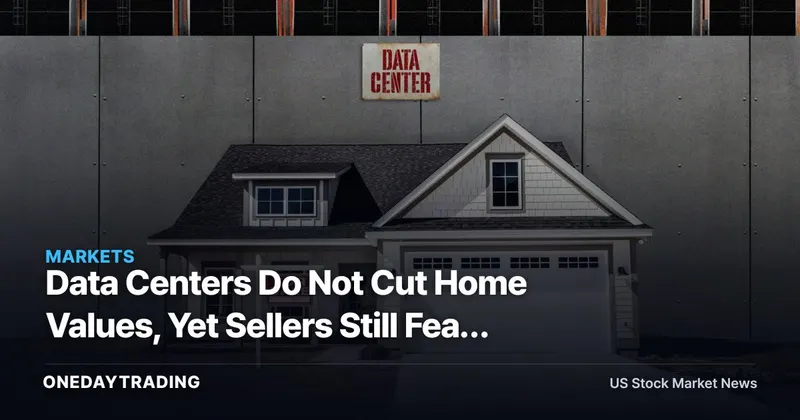
Data-center construction has become a housing-market flashpoint, but the research cited by MarketWatch finds no evidence that nearby facilities reduce home values. The investment tension is behavioral: sellers remain worried even when measured prices do not show a penalty, creating a gap between public perception and observed outcomes.
For data-center landlords such as Equinix and Digital Realty, that gap matters because opposition can slow permits, raise development costs and extend project timelines even without a direct real-estate discount.
The Full Story
Americans have become more vocal in recent months about whether data centers hurt residential property values. MarketWatch reports that research says they do not, while sellers disagree. That split is the central signal for investors: the immediate valuation risk appears unproven, but the political and permitting risk is becoming more visible.
A data center is a large computing facility that houses servers, power systems and cooling equipment for digital services and artificial-intelligence workloads. Its physical footprint can bring construction traffic, electricity demand and industrial-scale equipment close to neighborhoods, while its economic benefits and local costs are distributed unevenly.
The source provides no study sample, geography, time span or price-control methodology, so the research finding cannot be treated as a universal rule. A result showing no average effect can still conceal localized discounts near facilities with noise, backup generators or heavy utility work. Conversely, sellers may be reacting to anticipated disruption rather than a price change already recorded in transactions.
Structural Background
Data-center demand is tied to cloud computing and AI infrastructure, but residential markets clear through highly local variables: zoning, traffic, visual impact, tax receipts and competing land uses. That makes permitting a more important transmission channel than a national home-price statistic.
For operators, a delayed project can defer revenue while leaving land, design and interconnection expenses in place. For communities, the decision is a trade-off between investment and neighborhood externalities, not a simple referendum on technology.
Stock & Sector Ripple
- EQIX (Equinix): A neutral housing-price study is supportive at the margin, but seller opposition can increase entitlement friction for new sites and expansions.
- DLR (Digital Realty): Large power and land requirements make local approval a material execution variable even when nearby home values hold steady.
- Data-center REIT sector: The key risk is schedule slippage and higher development cost, not an established nationwide residential-price discount.
- Cloud and AI infrastructure customers: Persistent permitting resistance could constrain where new capacity is built, affecting deployment speed rather than demand itself.
Bull vs Bear Scenarios
The bullish case is that further evidence confirms the reported research: home prices remain intact, communities capture economic benefits, and operators secure approvals without a broad real-estate backlash. That would reduce one argument against data-center expansion.
The bearish case is a widening perception gap. If sellers organize around local complaints, governments can impose tougher zoning or delay power and construction approvals, raising capital intensity and pushing delivery dates out even without measurable home-value damage.
Investor Action Points
- Track local zoning decisions and approval timelines for EQIX and DLR projects rather than relying only on national housing data.
- Read future research for sample size, location and controls; those details determine whether a no-impact result is transferable.
- Monitor development spending, interconnection progress and project completion dates for signs that opposition is raising costs.
- Compare transaction prices with seller sentiment in the same market to identify where perception is becoming a financial constraint.
FAQ
Do data centers lower nearby home values?
MarketWatch reports that cited research finds no reduction in home values, but the article also reports that sellers disagree. The evidence supplied does not establish whether effects differ by facility design, distance or neighborhood.
Why are sellers worried about data centers?
Sellers have become more vocal as data centers bring industrial-scale construction, power and cooling infrastructure into proximity with homes. Their concern may reflect expected disruption or stigma, even when recorded prices show no average decline.
What is the data-center risk for EQIX and DLR investors?
The documented risk is indirect: community opposition can slow permits and complicate expansion. Investors should therefore follow entitlement milestones, development costs and completion dates alongside demand for computing capacity.
Market data check: EQIX
EQIX last traded near $1,037.15 (-0.35%). Our composite signal — blending price momentum and news flow — reads 🟡 neutral. Price momentum scores 47/100.
Data as of publication. Price via market feeds; for reference only, not investment advice.
📊 Analysis
Signal Neutral
Why Research reports no home-value damage, while seller opposition introduces unresolved permitting and execution risk for data-center operators.
This article was independently written by OneDayTrading from public reporting. Read the original (MarketWatch)