Key Takeaways
Gulf carriers returning to near pre-war flight volumes is less an airline-by-airline story than a demand signal that flows straight into the U.S. aerospace supply chain. Restored long-haul capacity supports delivery slots, engine flight hours and lease economics — the channels where investors actually get paid. The catch is that schedule recovery does not equal order recovery, and Middle East risk premia can return faster than they faded.
What Happened
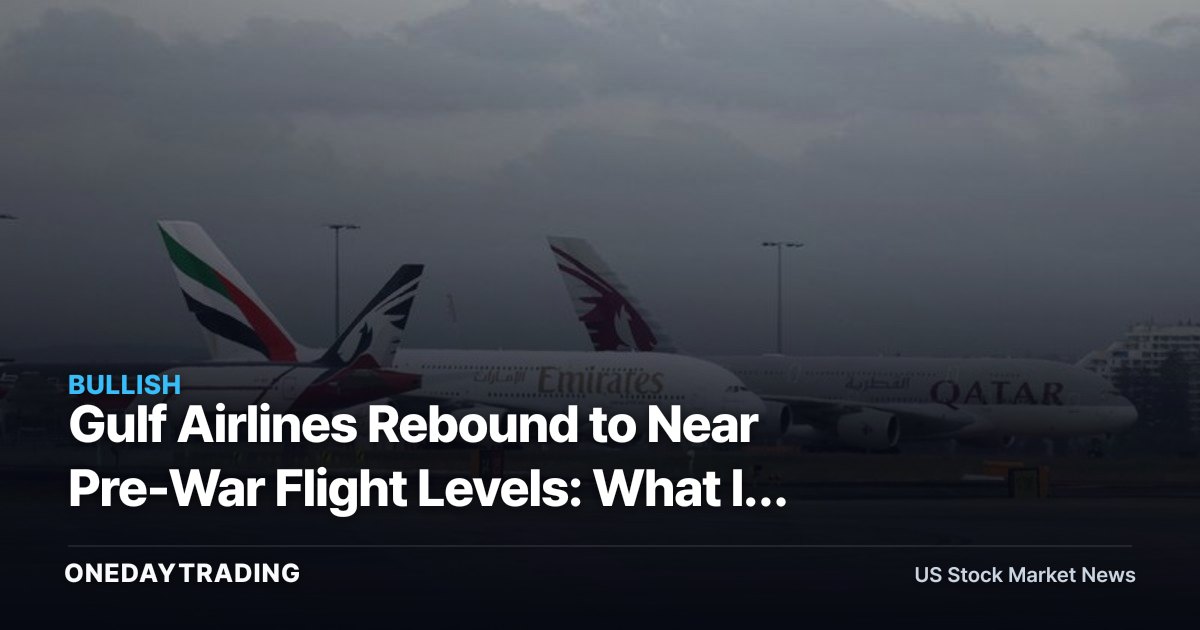
Major Gulf operators — names like Emirates, Qatar Airways, Etihad and flydubai — are rebuilding their networks as flight activity approaches the levels seen before the regional conflict disrupted airspace and forced reroutes. The normalization matters because these carriers run some of the world's most intensive wide-body, long-haul operations connecting Asia, Europe and the Americas through the Gulf hubs.
When their flights were curtailed, the pain was not contained to ticket sales. Wide-body utilization drives engine maintenance cycles, spare-parts demand and the case for taking new deliveries on schedule. A return toward pre-war activity puts those mechanisms back in motion, which is why the most leveraged equities are aircraft makers, engine suppliers and lessors rather than the unlisted Gulf airlines themselves.
Background and Context
Gulf carriers are anchor customers for both Boeing and Airbus wide-bodies, and their fleets concentrate high-cycle, high-thrust engines that generate recurring aftermarket revenue for U.S. suppliers. Airspace closures and longer reroutes burn more fuel and compress schedules, so a recovery in flying hours feeds the part of the business — services and spares — that carries the richest margins for the engine makers.
Market and Stock Impact
- Boeing (BA): Gulf carriers are among the largest 777 and 787 buyers; sustained flying strengthens the customer case for honoring delivery slots and future wide-body orders, the segment where Boeing most needs momentum.
- GE Aerospace (GE): Powers much of the Gulf wide-body fleet through GE and joint-venture engines; aftermarket and shop-visit demand scales with flight hours, so higher utilization is a direct services tailwind.
- AerCap (AER): As a major lessor, healthier Gulf demand supports lease rates and residual values on in-demand wide-bodies and narrow-bodies placed in the region.
- RTX (RTX): Exposure via Pratt and Whitney narrow-body engines on regional Gulf fleets plus avionics content benefits from rising cycles and maintenance.
Investor Checkpoints
- Boeing and GE quarterly deliveries and services revenue for confirmation that Gulf flying converts into supplier sales, not just schedules.
- Any new or reaffirmed Gulf wide-body orders or delivery deferrals announced by carriers and OEMs.
- Jet-fuel and Brent crude levels, since reroute risk and fuel costs gate how aggressively carriers restore capacity.
- Regional airspace and insurance-premium headlines that could reverse the normalization quickly.
Outlook
The bull case is clean: Gulf hubs are structural long-haul winners, and a return to pre-war flying restarts the recurring services and delivery flywheel that U.S. aerospace names depend on. The counterweight is fragility — a renewed flare-up in the region can shut airspace overnight, and a recovery in flight counts can run well ahead of any firm increase in orders or backlog conversion. Treat schedule normalization as a confirmation to track in delivery and services data, not as a standalone catalyst already in the price.
Market data check: BA
BA last traded near $222.72 (-1.29%). Our composite signal — blending price momentum and news flow — reads 🟡 neutral. Price momentum scores 40/100 (soft).
Data as of publication. Price via market feeds; for reference only, not investment advice.
📊 Analysis
Signal Bullish
Why Gulf carriers restoring near pre-war flight volumes revives delivery, engine-aftermarket and lease demand for U.S. aerospace suppliers.
This article was independently written by OneDayTrading from public reporting. Read the original (Yahoo Finance)