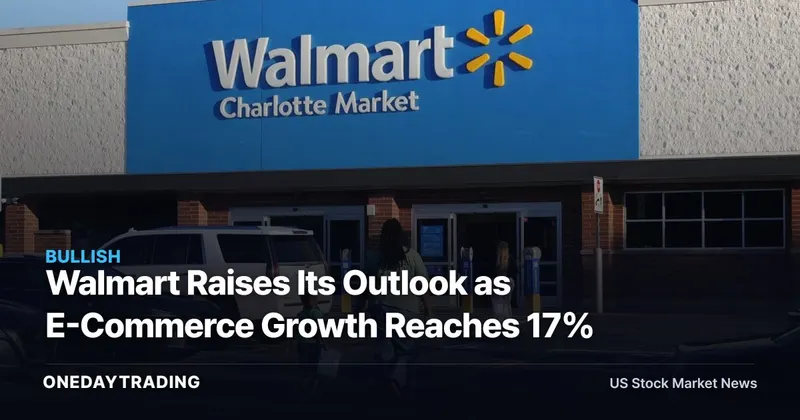
Walmart’s Guidance Raise Broadens the Earnings Story
Walmart’s fiscal third-quarter report presents a stronger operating picture than a narrow earnings beat alone: the retailer raised its full-year outlook while reporting growth across physical stores, e-commerce, advertising and memberships. For retail investors, that breadth matters because the quarter did not depend on a single sales channel. The positive signal reaches Walmart U.S., Sam's Club U.S. and the company’s digital businesses, even as higher transportation inputs create a clear counterweight.
An outlook raise is an increase in management’s expected full-year range, not an achieved full-year result. Walmart now expects full-year net sales growth of 4.9-5.2%, compared with previous guidance of 4-5%. Full-year adjusted earnings are expected at $2.84-2.89 per share, above the prior range of $2.80-2.87 per share.
The operating-income revision provides another useful test of quality. Walmart expects full-year adjusted operating income to rise 8-8.6%, versus its previous outlook of 7-8.5%. That range indicates management raised its expectations for both sales and adjusted operating income, while John David Rainey said the company was retaining “flexibility” in its guidance.
Digital Growth Is Moving Beyond the Checkout
Walmart global e-commerce sales increased 17% in the fiscal third quarter, while Walmart U.S. grew 23% and Sam's Club U.S. rose 30%, CNBC reported. Store-fulfilled pickup and delivery drove the global increase. John David Rainey attributed online-order growth to faster delivery and reduced prices, linking digital demand to the same convenience-and-value proposition used in the stores.
The mechanism is important for the income statement. Store-fulfilled ordering can extend the role of Walmart’s physical locations into pickup and delivery, while a larger flow of digital activity creates more opportunities for advertising and membership engagement. Walmart U.S. advertising sales increased 37% during the quarter, giving investors a second digital metric to track alongside online merchandise sales.
Management also described improving profitability in its digital businesses. The fact sheet does not quantify that improvement, so it cannot establish the size of the profit contribution. The next earnings report should show whether e-commerce growth, Walmart U.S. advertising sales and adjusted operating income continue to advance together; divergence among those measures would weaken the case that digital scale is improving the business mix.
Price Reductions Meet a More Expensive Delivery Network
Walmart rolled back prices on nearly 8,000 products across its stores. That action supports the retailer’s value positioning, and Rainey said Walmart recorded its largest food-category share gain in three years during the fiscal third quarter. The evidence links lower prices and delivery speed with online-order growth, though it does not identify each rollback category or quantify the sales generated by those reductions.
Cost pressure complicates that strategy. John Furner told CNBC’s Becky Quick that diesel costs were higher than expected and explained that increases in diesel fuel and transportation flow into the cost of goods. He also said tariff refunds helped offset those inputs and that Walmart would “keep prices as low as we can.”
That tension is the core risk for the retail thesis: reduced prices may support demand and share gains, while transportation costs can make those prices harder to sustain. The exact tariff refunds and diesel or transportation increases are unknown. Investors therefore cannot calculate the net offset from the available evidence and should look for future disclosure on input costs, price actions and adjusted operating income.
Walmart U.S. and Sam’s Club Supply the Sales Base
For the quarter ended Oct. 31, Walmart revenue rose 5.2%. Walmart U.S. generated $125 billion in net sales, an increase of 3.6% year over year, while comparable sales excluding fuel rose 2.9%. StreetAccount said that comparable-sales result was in line with Wall Street expectations.
Sam's Club reported $25.9 billion in net sales for the quarter ended Oct. 31, up 10% year over year. Walmart attributed the segment’s sales performance to strength in grocery and general merchandise. Together, these figures show growth in the core U.S. operation and a faster reported sales increase at Sam's Club, without establishing the separate profit contribution from either growth rate.
Net income moved in the other direction. Walmart recorded $4.95 billion, or 62 cents per share, for the quarter ended Oct. 31, compared with $6.14 billion, or 77 cents per share, in the year-prior quarter. That decline prevents a one-sided reading of the report: revenue, guidance and several operating channels improved, yet reported net income did not follow the same direction.
Memberships and Sparky Extend the Basket Strategy
Walmart announced in October a joint Walmart+ and Sam's Club membership option while keeping the standalone memberships. Since the joint option launched in late October, Sam's Club has attracted roughly two million people, according to John Furner. Rainey said participating consumers were “spending appreciably more,” while Walmart global membership fee revenue grew 17% in the third quarter.
The joint option may connect membership access with more customer spending across Walmart and Sam's Club. The next checkpoint is whether membership fee revenue continues to grow and whether management provides clearer evidence on the returns from the joint model. The exact launch date and the effect of reimbursements on those returns are not available in the fact sheet.
Sparky, Walmart’s artificial-intelligence agent, is another attempt to complete more of a customer’s shopping basket. Furner said Sparky produced customer-basket increases of 40% on average. That figure is notable, though the available evidence provides neither Sparky’s revenue contribution nor its profit contribution, so investors should treat it as an adoption indicator rather than a complete financial result.
Winners, Constraints and the Next Evidence
- Walmart: The raised full-year ranges, 17% global e-commerce growth and 37% Walmart U.S. advertising growth support a constructive reading of the company’s operating momentum.
- Walmart U.S.: Net sales of $125 billion and 2.9% comparable-sales growth excluding fuel show expansion, with the comparable-sales result matching StreetAccount expectations rather than exceeding them.
- Sam's Club: Net sales rose 10% year over year to $25.9 billion, supported by grocery and general merchandise, alongside membership expansion tied to the joint option.
- Cost structure: Higher-than-expected diesel expenses and transportation costs could reduce the benefit of price reductions if tariff refunds do not continue to provide sufficient offsets.
The Investment Read on Walmart
Walmart’s raised outlook is bullish for the company’s earnings narrative because it is supported by growth across U.S. sales, e-commerce, advertising and membership fees rather than one isolated metric. Shares were up roughly 13% year to date, so future market outcomes will depend on whether the company can deliver within its higher full-year ranges and sustain the operating trends behind them.
The next earnings event should be judged on a compact set of connected measures: full-year net sales growth of 4.9-5.2%, adjusted earnings of $2.84-2.89 per share, adjusted operating-income growth of 8-8.6%, and the direction of digital and membership growth. Continued progress would reinforce the thesis that convenience and value are translating into a broader revenue mix. Persistent transportation pressure, weaker digital profitability or another gap between sales growth and net income would challenge it.
📊 Analysis
Signal Bullish
Why The higher full-year outlook and broad growth across sales, e-commerce, advertising and memberships form a positive catalyst, tempered by transportation costs and lower net income.
This article was independently written by OneDayTrading from public reporting. Read the original (CNBC)