U.S. Measles Costs Move Beyond the Hospital Bill
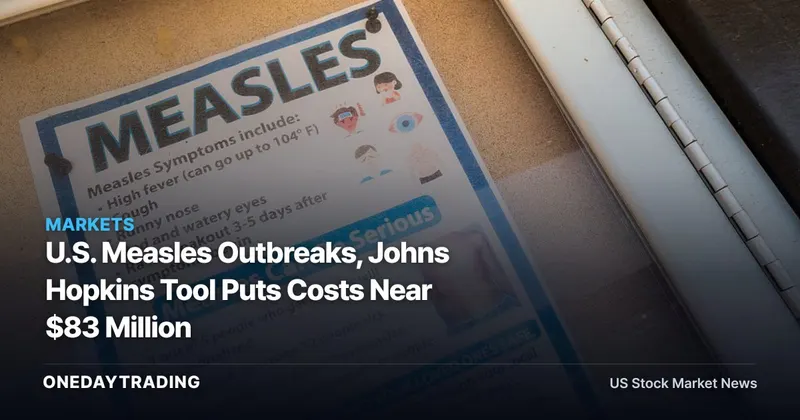
U.S. measles outbreaks have become a material public-health expense, with more than 5,100 cases reported in 2026 as of early November and a Johns Hopkins University tool estimating nearly $83 million in economic costs. For investors, the central point is narrower than the headline: most of the modeled burden sits outside direct medical treatment, while the supplied evidence establishes no company-specific earnings impact or listed-stock beneficiary.
CNBC reported that states had confirmed 8 deaths associated with measles in the U.S. so far in 2026. The economic estimate is not a definitive accounting, and the final nationwide case count, death total and actual cost remain unknown.
What the Johns Hopkins University Estimate Measures
The Johns Hopkins University tool is a cost model that combines national averages with state-specific inputs, including inpatient hospital costs and wages, to estimate the burden associated with reported measles cases. For the U.S. outbreaks in 2026, it assigns nearly $56 million to public-health responses, almost $25 million to lost productivity and more than $1.8 million to direct medical expenses.
That composition is the key analytical signal. The response category captures resources needed to investigate and contain outbreaks, while the productivity category accounts for work missed by affected people. Direct medical expenses are only one component of the model, so interpreting the nearly $83 million total as a hospital-spending figure would misread what the estimate measures.
The same tool estimates that the 2025 U.S. outbreaks involved 2,289 confirmed cases and cost more than $37 million. This provides a consistent model-based reference point, not proof of the definitive economic cost in either year.
Why Response Costs Can Arrive Up Front
Bryan Patenaude of the International Vaccine Access Center at the Johns Hopkins Bloomberg School of Public Health described the response burden as front-loaded. “A lot of this is incurred up front,” he told CNBC, adding, “It's a largely labor-driven cost.”
The historical model reviewed published studies and government reports covering 18 states. It estimated a historical average of nearly $59,000 per case in public-health response costs, with roughly $298,000 in fixed costs and about $16,300 for each additional case.
Those figures explain why case totals alone do not provide a complete cost comparison. Fixed mobilization expenses and additional-case costs behave differently, while wages and inpatient charges vary by state. The historical model also excluded productivity losses because the reviewed studies did not account for them consistently, limiting direct comparison with the broader tool.
New York and Texas Show the State-Level Variation
New York illustrates how local inputs shape the estimate. Its average inpatient hospital stay is roughly $4,200 per day, and its minimum wage is $16 per hour. For 48 cases in 2025, the tool estimates $1.1 million in total costs: nearly $749,000 for public-health responses, $333,000 in productivity losses and roughly $24,500 in direct medical expenses.
Texas, the epicenter of the largest U.S. measles outbreak in 2025, recorded 803 cases that year. The tool assigns Texas nearly $13 million in estimated costs, including $9 million in public-health costs, $4 million in productivity losses and around $288,000 in direct medical expenses.
The two state estimates reinforce the model’s intended use. Case counts matter, while state wages and inpatient costs also influence the output. They do not establish the actual amount ultimately spent by each state.
Quarantine Broadens the Economic Exposure
Joey Mattingly of the University of Utah modeled a hypothetical 1,500-case outbreak in a 2025 study. That analysis estimated about $90 million in costs, including roughly $26 million in productivity losses.
The study assigned roughly $300 in lost productivity to each quarantined person. If one measles case exposes 40 to 50 people who require quarantine, the estimated productivity loss reaches $12,000 to $15,000 even when those contacts do not become sick.
“Even if you don't get the infection, the contact costs you,” Mattingly told CNBC. That mechanism separates the economic footprint from the number of patients receiving medical care: exposure and quarantine can generate costs without adding a confirmed illness.
Healthcare-Sector Read-Through Without a Stock Call
- Public-health response: The Johns Hopkins University estimate places nearly $56 million of the 2026 U.S. burden in this category, making labor and outbreak containment the largest identified cost pool in the supplied evidence.
- Workforce productivity: Almost $25 million of estimated 2026 costs comes from lost productivity, with quarantine capable of creating losses among people who never develop the disease.
- Direct medical care: More than $1.8 million is assigned to direct medical expenses in 2026. That figure is meaningful, though it represents only one part of the nearly $83 million estimate.
- Listed equities: No supplied relationship connects these costs to the revenue, margins, cash flow or valuation of a U.S.-listed company. Assigning a ticker or directional stock call would therefore exceed the evidence.
What Could Raise or Limit the Estimated Burden
The adverse scenario is continued growth in reported cases accompanied by more response work and productivity losses. Patenaude’s warning captures the cost risk: repeated diversion of state and local resources means “you're going to wind up spending a lot of money very quickly,” he told CNBC.
The limiting case is equally important. The nearly $83 million figure is a model output based on reported cases and selected inputs, not audited spending. The definitive costs of the 2025 and 2026 outbreaks and the precise costs of future outbreaks are unknown, preventing a stronger financial-market conclusion.
Next Checks for the U.S. Measles Cost Thesis
- Final case and death totals: Compare the eventual U.S. figures with the more than 5,100 cases reported as of early November 2026 and the 8 associated deaths confirmed so far in 2026.
- Cost composition: Track whether updated estimates preserve the current split among nearly $56 million in public-health response costs, almost $25 million in lost productivity and more than $1.8 million in direct medical expenses.
- State-level inputs: Examine wages and inpatient hospital costs when comparing New York, Texas or other state estimates; the tool does not apply case counts in isolation.
- Elimination-status review: The outcome of the Pan American Health Organization review of U.S. measles elimination status remains unknown and is the next institutional checkpoint identified by the evidence.
📊 Analysis
Signal Neutral
Why The outbreaks carry substantial estimated economic costs, but the evidence identifies no direct revenue, earnings or valuation effect for any listed company.
This article was independently written by OneDayTrading from public reporting. Read the original (CNBC)