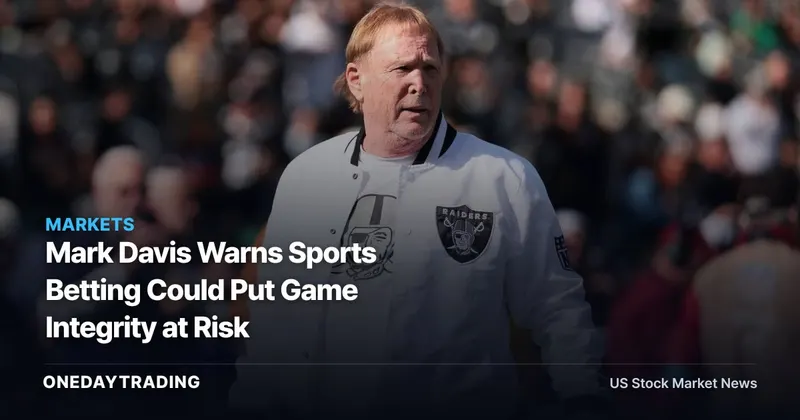
Mark Davis Puts Integrity Ahead of Gambling Revenue
- Las Vegas Raiders and Aces owner Mark Davis told CNBC Sport that he is not a fan of sports betting, particularly proposition bets.
- His concern centers on whether the expansion of sports gambling and prediction markets could undermine confidence in professional competition.
- The investor issue is regulatory and reputational uncertainty, not a demonstrated financial loss: partnership revenue, proposed rules and any effect on game outcomes remain unquantified.
Mark Davis has exposed the central tension facing sports-linked gambling businesses: leagues and teams can acknowledge meaningful gambling revenue while questioning whether certain wagers threaten trust in the underlying competition. CNBC reported the comments in an interview with CNBC Sport’s Michael Ozanian, with the article date shown as 2026-11-05.
The immediate read-through is neutral rather than decisively positive or negative. Both the Las Vegas Raiders and Aces maintain relationships with BetMGM, while their owner is publicly challenging the risks surrounding the broader activity. That combination signals caution without establishing a retreat from existing partnerships.
Why Proposition Bets Change the Risk Debate
A proposition bet is a wager on a specific event within a game rather than necessarily on the game’s final outcome. Davis singled out this form of betting when he said, “I'm not a fan per se of gambling on sports, especially the one-on-ones, the proposition types of betting.”
His objection focuses on belief in the contest itself. “I think the key thing is the integrity of the game,” Davis told CNBC. He reinforced the point with the statement, “People have to believe in the game.”
For investors, the distinction matters because the commercial value associated with sports gambling depends on continued engagement with professional sports, while Davis’s warning concerns confidence in that underlying product. This is an analytical transmission channel, not evidence that confidence has already deteriorated. The fact sheet does not establish that sports gambling has changed the outcome or integrity of any game.
The issue therefore cannot be reduced to partnership income alone. Davis acknowledged that gambling generates significant revenue, then framed integrity as the condition that professional sports must protect. The amount of revenue produced by those partnerships is unknown, preventing a defensible estimate of the earnings exposure on either side of the debate.
The NFL’s Prediction-Market Boundary
Prediction markets allow users to trade contracts connected to sporting outcomes. The NFL has declined to establish official partnerships with prediction-market operators, creating a clear boundary between the league and that category even as the wider sports-gambling discussion continues.
The NFL also filed an amicus brief with the Supreme Court in October. Its argument was that prediction markets constitute gambling and should be regulated by states. The specific regulations sought are not included in the available facts, and the eventual regulatory outcome is unknown.
This posture places regulation and competition integrity at the center of the next decision point. It does not show that existing team partnerships must change, nor does it establish how prediction-market operators would be affected under any future framework. The supported conclusion is narrower: the NFL is withholding official partnerships while advocating state regulation.
Roger Goodell is among the named figures surrounding the NFL debate, although the permitted facts do not provide a statement from him that can be analyzed here. The investable question is therefore institutional rather than personal: whether the league’s current boundary remains intact as the legal treatment of prediction markets develops.
Las Vegas Partnerships Complicate a Simple Bear Case
Davis moved the Raiders from Oakland to Las Vegas in 2020, according to CNBC. That 2020 move gives his warning particular relevance because the comments come from the owner of a team based in a city closely identified in the source event with gambling, rather than from an owner without disclosed gambling partnerships.
Both the Raiders and Aces are partners with BetMGM. The relationship means Davis’s remarks should not be read as evidence of complete commercial disengagement from sports gambling. They instead identify a boundary he believes leagues must examine: revenue can be significant, while the integrity question remains unresolved.
The connection also runs through team ownership. MGM Resorts CEO Bill Hornbuckle was instrumental in Davis purchasing the Aces. That relationship supports a more balanced interpretation of the interview: Davis recognizes commercial links to gambling businesses and still voices concern about proposition betting and prediction markets.
Those facts do not reveal the duration, economics or strategic importance of either BetMGM partnership. Without the revenue amount, it is impossible to translate the comments into a quantified effect on MGM Resorts, BetMGM, the Raiders or the Aces. Treating the interview as an earnings catalyst would go beyond the evidence.
The Two Numbers That Define the Story
The first number is 2020, the year CNBC says Davis moved the Raiders from Oakland to Las Vegas. It establishes the timing of the franchise relocation and explains why his position carries an unusual tension: the owner operates in Las Vegas while openly questioning parts of sports gambling.
The second is 1 point. Mark Davis said he simply wants to win by 1 point when asked about winning margins, using the remark to redirect attention from betting expectations to competition on the field.
Neither number quantifies the commercial opportunity or risk. No partnership revenue, prediction-market volume or prospective regulatory cost is supplied. The figures instead clarify Davis’s standpoint: his team’s Las Vegas history is established, and his stated priority remains the game itself.
Who Faces Opportunity and Who Carries Risk
- Professional sports leagues: Significant gambling revenue represents the acknowledged benefit. The counterweight is the possibility, raised by Davis, that expansion could threaten confidence in competition.
- Prediction-market operators: The NFL’s refusal to enter official partnerships limits the evidence for league acceptance, while its Supreme Court brief introduces an unresolved state-regulation question.
- BetMGM: Partnerships with both the Raiders and Aces confirm direct commercial relationships. No fact provided shows that those arrangements are ending or changing.
- MGM Resorts: Bill Hornbuckle’s role in Davis’s purchase of the Aces establishes a relationship, though the facts do not quantify any related financial benefit.
- Las Vegas Raiders and Aces: Their owner’s concerns create a reputational and governance issue to monitor, not evidence of a current financial impairment.
Evidence Limits and the Next Observable Checks
- Regulatory detail: Watch for a specific framework defining how prediction markets would be regulated and which state requirements would apply.
- NFL partnerships: A change in the league’s refusal to partner officially with prediction-market operators would alter the current institutional signal.
- Existing commercial relationships: Any disclosed change involving BetMGM, the Raiders or the Aces would provide firmer evidence than the interview alone.
- Integrity evidence: The available facts identify a risk raised by Davis; they do not show that any game’s outcome or integrity has been affected.
Mark Davis’s Warning Leaves the Financial Question Open
Davis’s comments matter because they come from an owner with direct ties to Las Vegas, BetMGM and MGM Resorts, not because they prove an immediate earnings effect. His stance separates acceptance of significant gambling revenue from acceptance of every betting format and every prediction-market relationship.
The constructive scenario is continued commercial activity under rules that preserve confidence in professional competition. The adverse scenario is a widening integrity concern that brings stronger restrictions or changes partnership decisions. Neither outcome is established by the current evidence.
The next meaningful signal will come from action: detailed regulation, a shift in the NFL’s partnership policy, or a disclosed change to existing team relationships. Until one appears, “I'm more worried about the game on the field,” as Davis told CNBC, is best read as a governance warning rather than a measurable financial forecast.
📊 Analysis
Signal Neutral
Why The comments raise regulatory and reputational questions, but the available facts establish neither a measurable financial effect nor a regulatory outcome.
This article was independently written by OneDayTrading from public reporting. Read the original (CNBC)