Disney’s Several-Thousand-Job Plan at a Glance
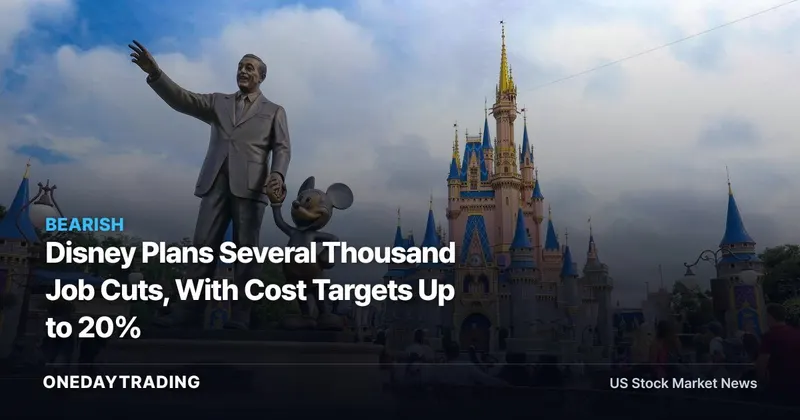
Disney is planning to eliminate several thousand jobs, CNBC reported on 2026-11-03, while some managers have been asked to reduce costs by up to 20% in the latest round. For investors, the immediate message is clear: management is pursuing a material reset of the expense base, although the financial benefit and operating cost of that reset cannot yet be calculated.
A workforce reduction is a cost-restructuring action intended to lower ongoing expenses or redirect resources. Here, the investment case depends less on the headline job count than on whether Disney can convert lower costs into durable investment capacity without weakening the operations expected to support future growth.
Why Disney’s Cost Reset Matters to Investors
The scale makes this more than an isolated personnel adjustment. Disney had about 231,000 employees at the close of fiscal year 2025, according to the company’s annual financial report cited by CNBC. The exact number in the latest planned cuts is unknown, so investors cannot calculate the share of the workforce affected or estimate savings from the available evidence.
The up-to-20% target also requires careful interpretation. It applies to some managers’ requested cost reductions, not necessarily to Disney’s total corporate expenses, every division or the workforce itself. Without knowing which managers, budgets or business areas are covered, treating that ceiling as an enterprise-wide savings forecast would overstate the evidence.
The potential transmission to financial performance is straightforward, though conditional. Lower recurring expenses could create room for growth investment, consistent with the priorities described by Josh D'Amaro and Hugh Johnston in their Aug. 5 shareholder letter. That benefit depends on what is cut, how quickly changes take effect and whether the affected functions can maintain their output.
The opposing risk sits inside the same mechanism. If reductions remove capabilities needed to execute management’s plans, near-term expense relief could be offset by weaker operating delivery. The fact sheet does not identify the latest affected divisions or locations, so no business-specific revenue or margin conclusion is supportable.
Disney’s Earlier Reductions Show a Broader Reshaping
The latest plan follows distinct actions already disclosed. Disney had separate plans in April to cut as many as 1,000 employees, predominantly in marketing. In September, Disney separately planned to cut about 300 employees, many in human resources and technology.
Those earlier actions matter because the functions were identified, while the newest round has not been mapped by division. Investors should avoid simply adding the figures together as though they describe one program with one timetable; the fact sheet presents them as separate plans.
Disney also introduced an early retirement program for some employees in August. In an Aug. 24 employee letter, Sonia Coleman said organizational changes included involuntary reductions that had begun in some areas and would continue into next year. That statement establishes a broader restructuring process, although it does not supply the timing or scope of the latest several-thousand-job plan.
The sequence shifts the analytical burden from announcement to execution. Repeated cost actions can support a leaner expense structure, yet job counts alone do not show whether savings are recurring, what implementation costs may arise or how much capacity management intends to reinvest.
The Central Debate: Savings Capacity Versus Execution Risk
- How broad is the program? Several thousand planned job cuts indicate scale, but the exact total, divisions, locations and timetable remain undisclosed.
- What does “up to 20%” measure? The figure describes requests made to some managers. It is not evidence of a companywide expense reduction or a completed saving.
- Where could the savings go? Josh D'Amaro and Hugh Johnston told shareholders that Disney was evaluating cost levers to create additional capacity for growth investment. The allocation and amount of that capacity were not provided.
- Can operations absorb the change? The answer depends on which work is removed, consolidated or preserved. No division-level detail supports a firmer judgment.
Media-Sector Read-Through Beyond Disney
- Disney: The directly affected company faces a two-sided setup. A lower recurring cost base could support investment capacity, while an unspecified implementation plan leaves the operational trade-off unresolved.
- Netflix: Netflix said in a memo last month that it would lay off roughly 6% of its workforce. That is relevant evidence of cost reduction elsewhere in media, not proof that its rationale, financial effect or execution risk matches Disney’s.
- Skydance: Skydance is described as the newly combined company of Paramount and Warner Bros. Discovery, with 6 $ billion in synergies over three years. That target provides sector context for cost discipline, though a synergy goal is not an achieved result and is not directly comparable with Disney’s manager-level budget requests.
Together, these facts show that cost structures are an active investor issue across the named media companies. They do not establish a common cause, identical strategy or certain benefit for any stock. Each company’s outcome must be judged against its own disclosed scope and subsequent financial reporting.
What Disney Investors Should Check on Nov. 17
- Scope: Disney’s fiscal fourth-quarter earnings report on Nov. 17 is the next dated checkpoint for any clarification of the exact job count, affected functions or implementation schedule.
- Financial translation: Investors need a quantified bridge from workforce and budget actions to expenses, savings and growth investment before treating the program as a durable earnings lever.
- Definition of the target: Any explanation of which cost categories face reductions of up to 20% would determine whether the request is narrow or broad.
- Operating safeguards: Detail on how Disney plans to preserve essential capabilities would help investors weigh expense relief against execution risk.
Disney’s Balanced Investment Outlook
The constructive case is that Disney can remove recurring expense and redirect part of the resulting capacity toward growth, matching the stated objective in the Aug. 5 shareholder letter. If management quantifies the savings and shows that operating priorities remain funded, investors would have a firmer basis for evaluating the restructuring.
The bearish case starts with what is missing. The latest round has no exact headcount, divisional map, location detail, timetable or quantified financial outcome. Plans for several thousand job cuts and manager targets of up to 20% therefore indicate pressure and intent, not completed savings.
Nov. 17 is the decisive next checkpoint because it can turn an organizational headline into measurable financial information. Until then, the disciplined reading is cautious: the potential expense benefit is credible as a mechanism, while its size, durability and operational price remain open questions.
Market data check: Walt Disney Company (The)
Walt Disney Company (The) last traded near $113.41 (+0.26%). Our composite signal — blending price momentum and news flow — reads 🟡 neutral. Price momentum scores 60/100 (firm).
Data as of publication. Price via market feeds; for reference only, not investment advice.
📊 Analysis
Signal Bearish
Why The planned workforce reductions signal substantial cost pressure, while the savings, implementation timetable and operating effects remain unquantified.
This article was independently written by OneDayTrading from public reporting. Read the original (CNBC)